

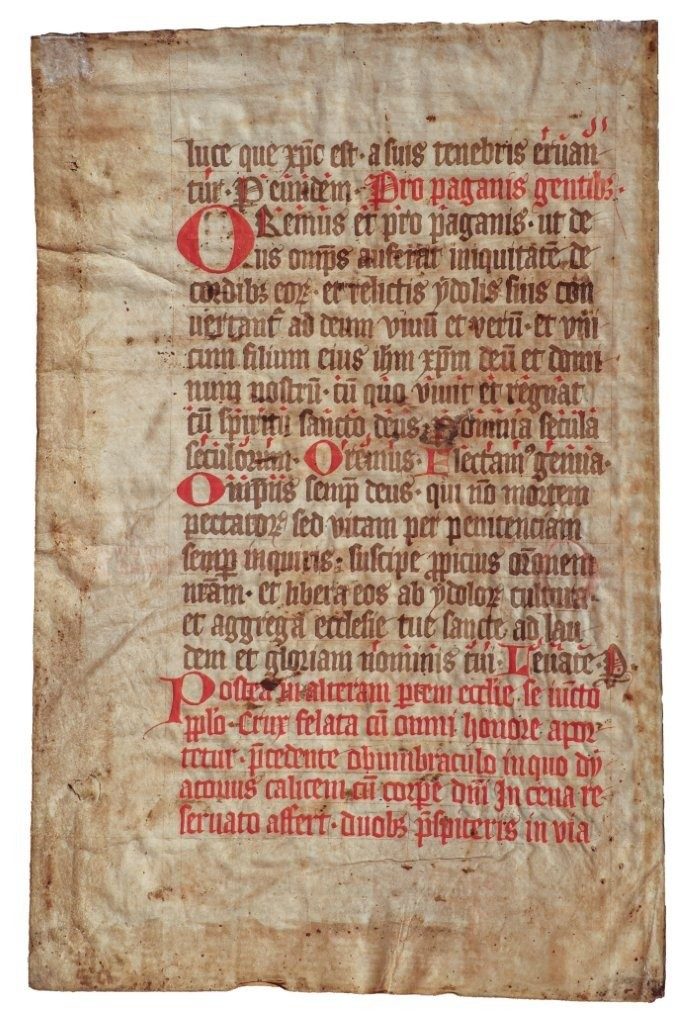
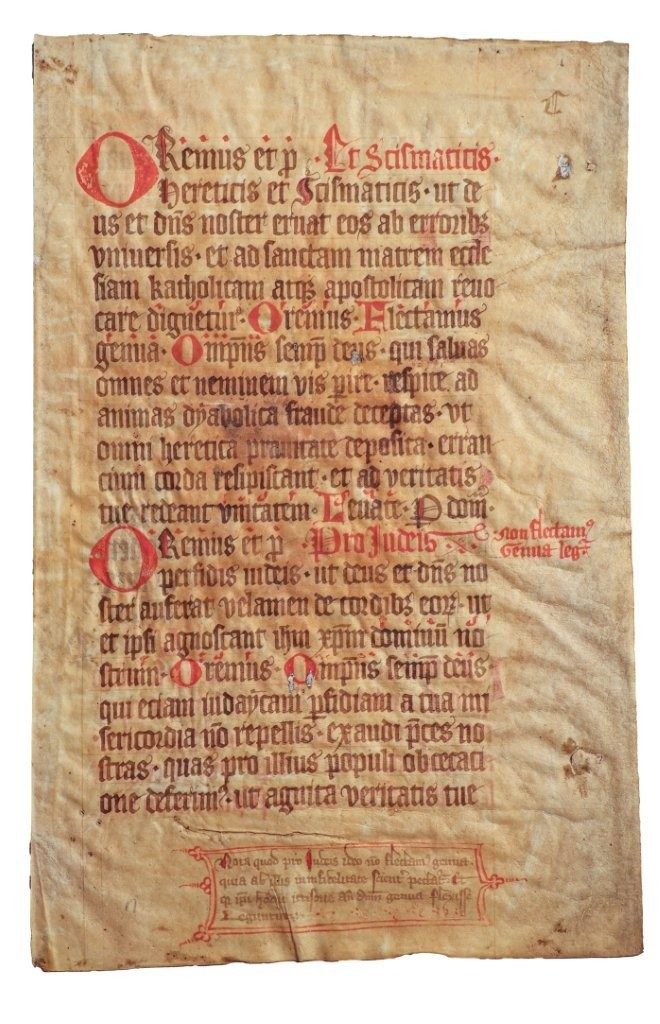
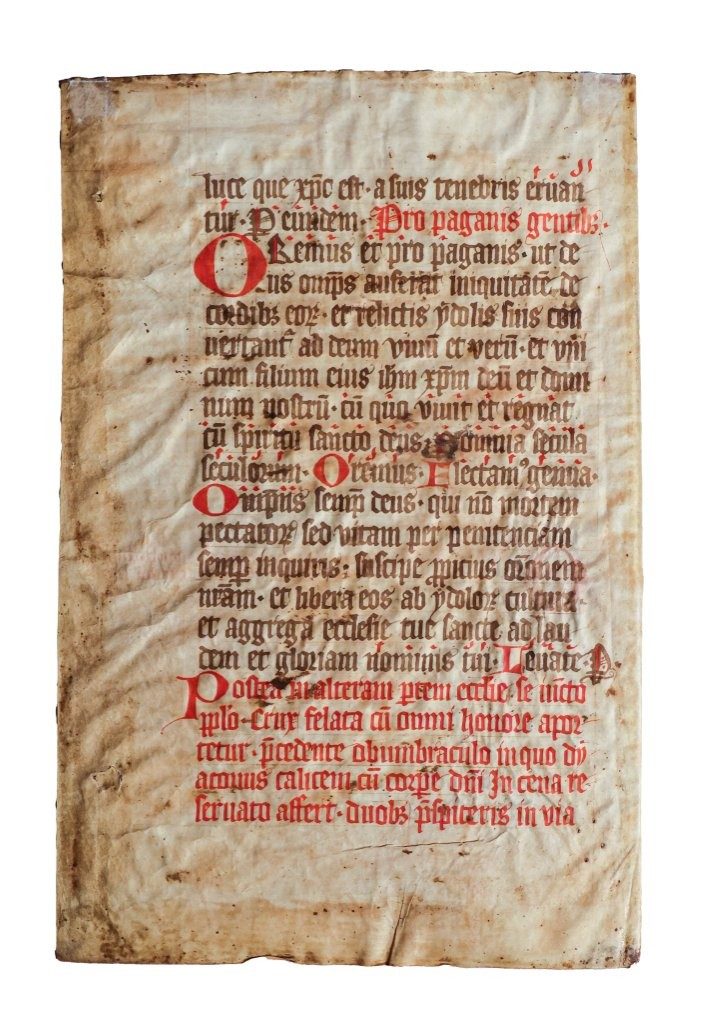
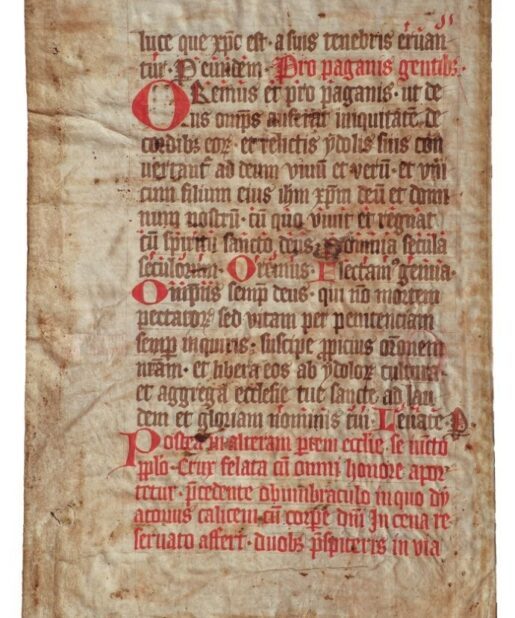
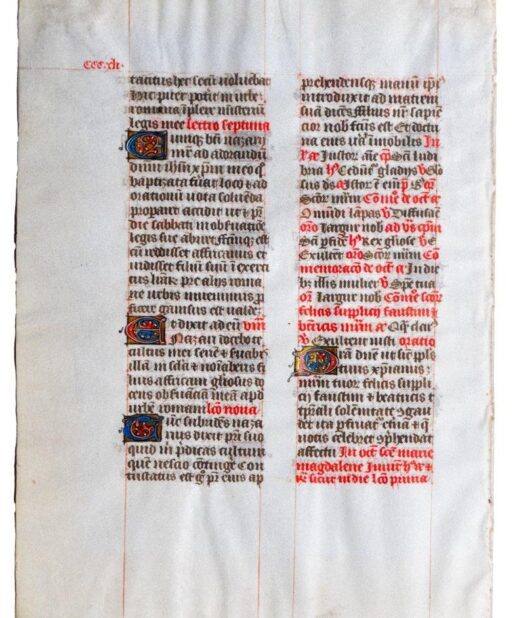
Leaf from a Roman Missal Manuscript on vellum Germany, 14th century
c. 270 x 210
Description
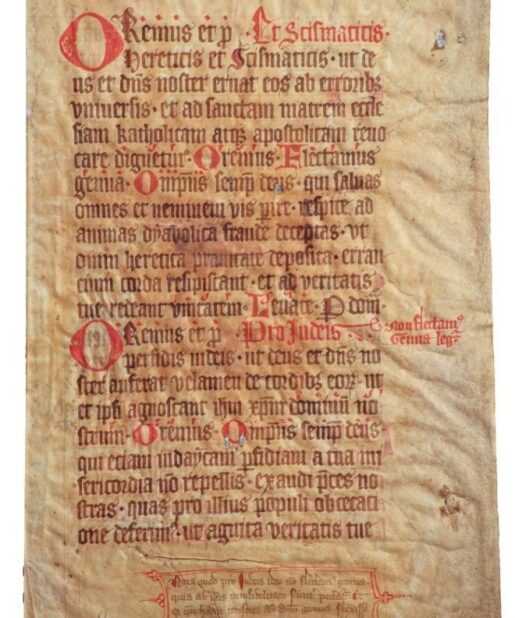
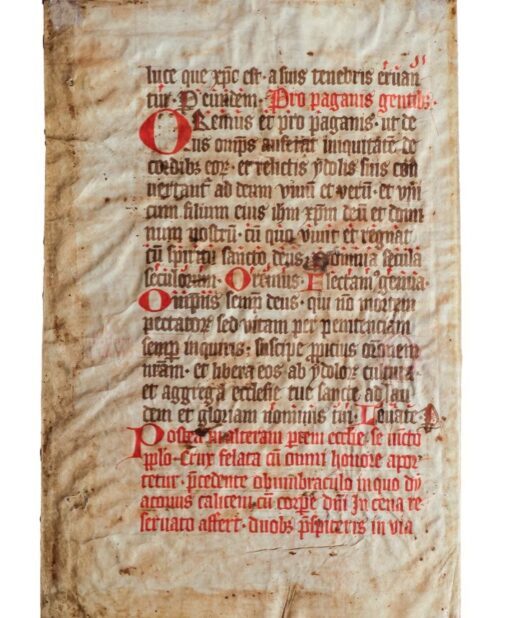
Leaf written in a clear early Gothic bookhand in brown ink, with bold red lombard initials and rubrication.
Substantial leaf from a medieval Roman Missal preserving part of the Solemn Intercessions for Good Friday (Feria VI in Parasceve), the most austere and emotionally charged ceremony of the liturgical year.
Text
The page records the formal sequence of intercessory prayers beginning “Oremus et pro…” and punctuated by the ritual responses “Flectamus genua” and “Levate.” Among the prayers are intercessions ‘pro paganis gentibus, pro haereticis et schismaticis’, and notably ‘pro perfidis Iudaeis’. In medieval Latin, perfidis meant “unbelieving” or “faithless” (in the sense of not accepting Christ), rather than the later English meaning of “treacherous.” Nevertheless, the formula — often translated into English as “Let us pray also for the perfidious Jews” — became one of the most controversial elements of the Roman Good Friday liturgy.
The Good Friday rite commemorates the Passion and Crucifixion of Christ. In medieval Europe, this annual focus on the events surrounding the Crucifixion could sharpen theological and social hostility toward Jewish communities, who were often portrayed in sermons and devotional literature as participants in Christ’s death. While the liturgical prayer itself petitioned for their conversion rather than harm, the broader Holy Week atmosphere sometimes coincided with heightened discrimination, forced disputations, expulsions, or outbreaks of violence in various regions of Europe. The text on this leaf thus stands at the intersection of devotion, doctrine, and the fraught history of Christian– Jewish relations.
Product Enquiry
Related products


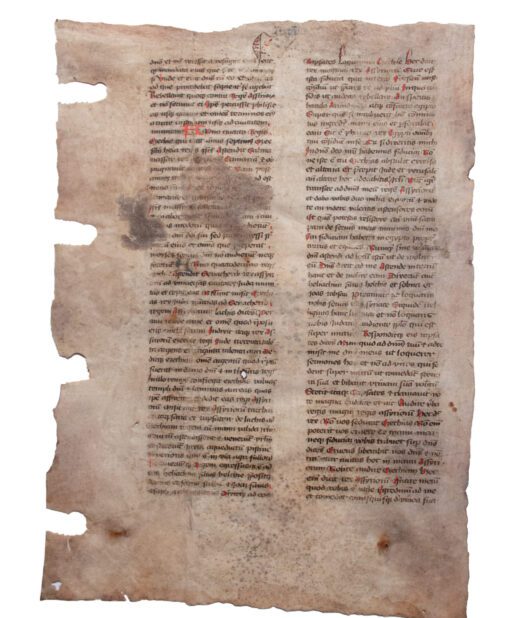
C14th -C16th manuscripts
Leaf from a Bible, II Kings 17, C15th manuscript in Latin on parchment
£750.00
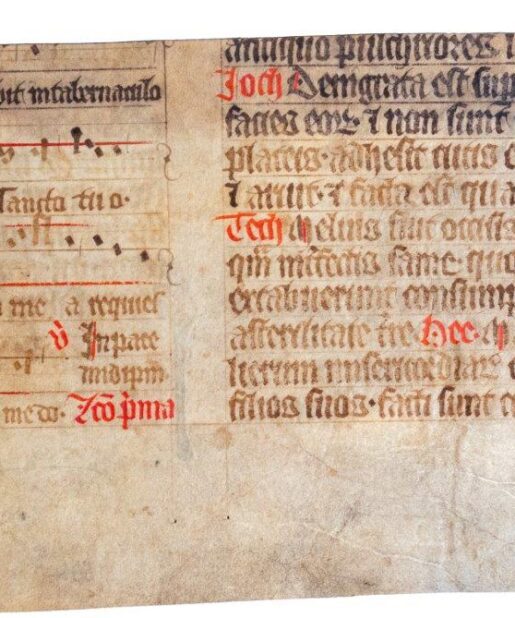
C14th -C16th manuscripts
A C14th cutting from a Noted Breviary with music on a 4-line stave arranged around a red clef line
£280.00
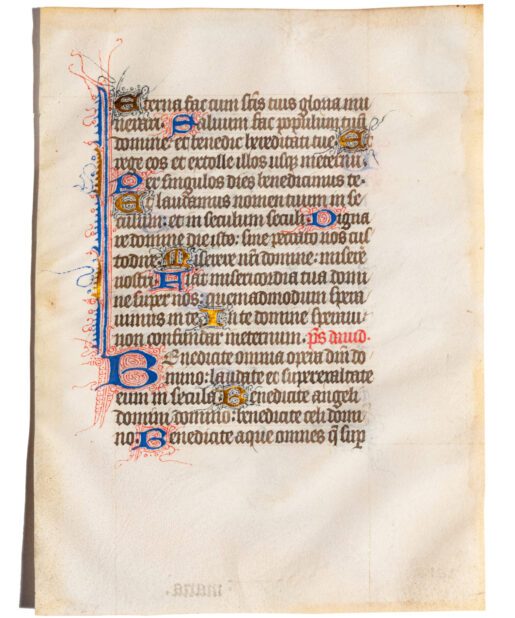
C14th -C16th manuscripts
Finely produced illuminated leaf from a French Psalter c.1480
£550.00

C14th -C16th manuscripts
Finely produced illuminated leaf from a French Psalter, c.1480
£550.00


Arabic and Ottoman
£1,900.00
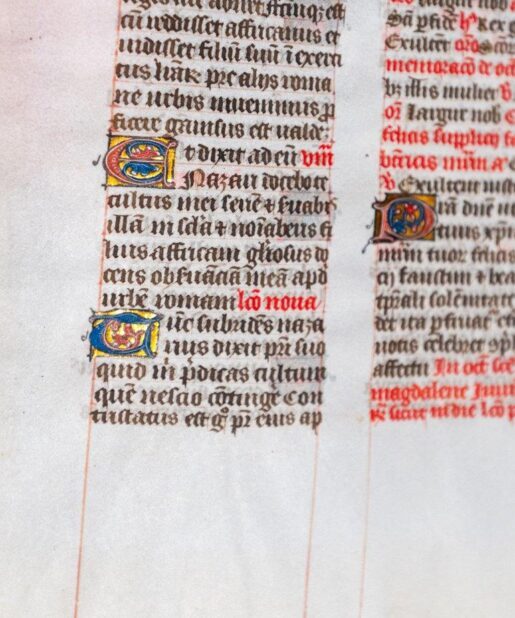
C14th -C16th manuscripts
Single leaf from the so-called ‘Carondelet Breviary’ 1458 from the scribe Jean d’Aussert
£600.00
![Leaf from Baldo degli Ubaldi (1327–1400), Sextum codicis librum commentaria [Italy, late 15th century]](https://stephenbutler.com/wp-content/uploads/2023/07/IMG_0101-515x618.jpg "Leaf from Baldo degli Ubaldi (1327–1400), Sextum codicis librum commentaria [Italy, late 15th century]")
C14th -C16th manuscripts
£800.00