

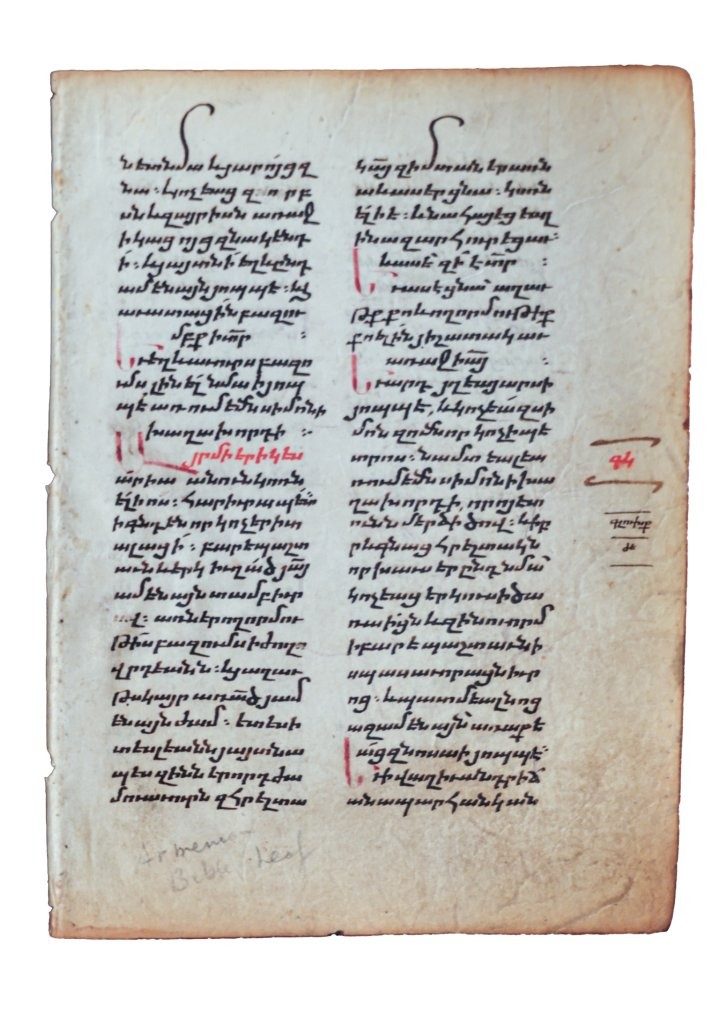
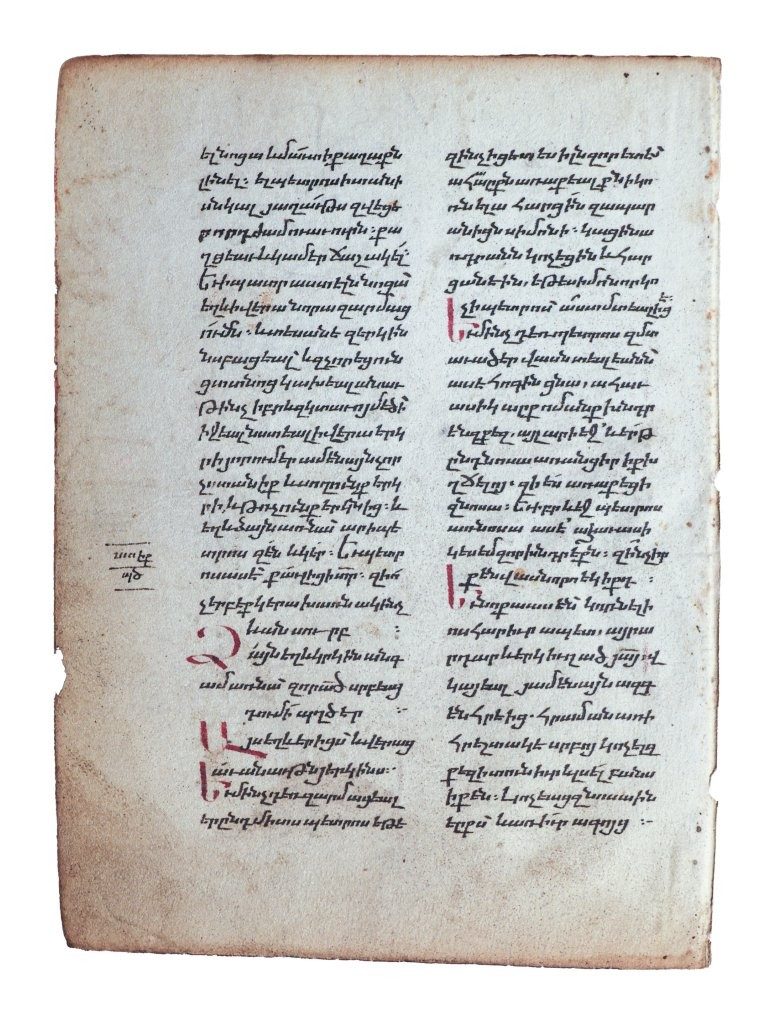


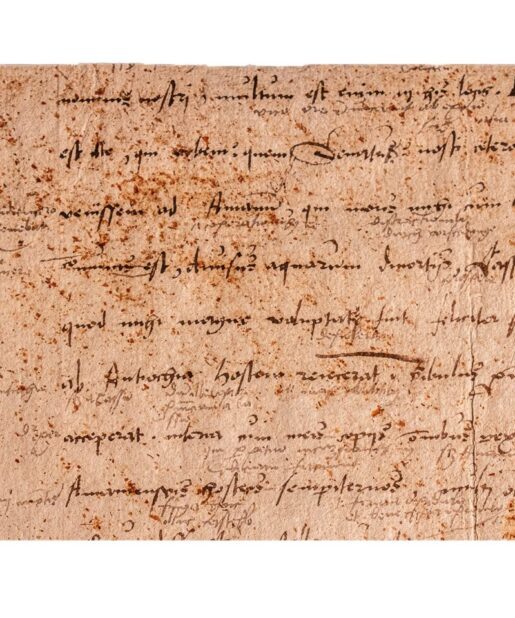
Leaf from an Armenian Psalter ,including Psalm 84 manuscript leaf on laid paper with chapter headings, C15th 14cm x 10.5cm
[Armenia, Eastern Anatolia or Persia, late 15th century]
Single leaf from an Armenian manuscript Psalter, written on laid paper in a clear and elegant bolorgir bookhand in black ink, with rubricated initials and sectional divisions in red. The text is arranged in two columns of approximately 22–26 lines per column. Armenian numeral notation in the margin identifies the text as part of Psalm 84 (Septuagint numbering), confirming the leaf’s origin within the Psalter, the most widely used and frequently copied book of the Armenian biblical tradition. The manuscript is executed on fine laid paper, likely of Italian manufacture, reflecting the extensive importation of Venetian and Fabriano papers into Armenian scriptoria during the early modern period. The leaf survives in excellent condition, with strong legibility, well-preserved rubrication, and only minor marginal toning consistent with its age.
The Armenian Psalter occupied a central role in the devotional and liturgical life of the Armenian Church. First translated into Armenian in the early fifth century following the creation of the Armenian alphabet by Mesrop Mashtots, the Armenian Bible became renowned for the accuracy and literary quality of its translation. The Psalms in particular formed the foundation of Armenian liturgical practice, monastic devotion, and private prayer, and were frequently copied both as part of complete biblical codices and as independent volumes. Manuscripts such as the present example were produced in Armenian ecclesiastical and scholarly centres throughout Eastern Anatolia, Persia, and the wider Armenian diaspora, preserving an unbroken textual tradition extending back over a millennium.
The present leaf is notable for the clarity and confidence of its script, the balanced proportions of its double-column format, and the attractive contrast between black ink and red rubrication. Armenian biblical manuscripts on paper of this period survive in comparatively limited numbers in the market, and individual leaves from Psalter manuscripts are especially sought after by collectors of biblical manuscripts, Eastern Christian textual traditions, and early vernacular scripture.
A fine and historically significant example of Armenian manuscript culture, combining devotional importance, scholarly value, and strong visual appeal.
Origin: Armenia, Eastern Anatolia, or Persian Armenia
Product Enquiry
Related products

C14th -C16th manuscripts
£900.00
![A possibly unique and unknown manuscript from the library of Sir Thomas Phillipps. Anonymous Dominican compiler, Liber de fructibus penitentiae (alias Flores de penitentia or Summa aurea) [Southern France (Provence?), 14th century (1st half)]](https://stephenbutler.com/wp-content/uploads/2025/04/IMG_1518-515x618.jpg "A possibly unique and unknown manuscript from the library of Sir Thomas Phillipps. Anonymous Dominican compiler, Liber de fructibus penitentiae (alias Flores de penitentia or Summa aurea) [Southern France (Provence?), 14th century (1st half)]")
![A possibly unique and unknown manuscript from the library of Sir Thomas Phillipps. Anonymous Dominican compiler, Liber de fructibus penitentiae (alias Flores de penitentia or Summa aurea) [Southern France (Provence?), 14th century (1st half)]](https://stephenbutler.com/wp-content/uploads/2025/04/IMG_1510-515x618.jpg "A possibly unique and unknown manuscript from the library of Sir Thomas Phillipps. Anonymous Dominican compiler, Liber de fructibus penitentiae (alias Flores de penitentia or Summa aurea) [Southern France (Provence?), 14th century (1st half)]")
![Leaf from Baldo degli Ubaldi (1327–1400), Sextum codicis librum commentaria [Italy, late 15th century]](https://stephenbutler.com/wp-content/uploads/2023/07/IMG_0101-515x618.jpg "Leaf from Baldo degli Ubaldi (1327–1400), Sextum codicis librum commentaria [Italy, late 15th century]")
C14th -C16th manuscripts
£800.00

C14th -C16th manuscripts
£400.00
![Bifolium from St Simon of Cascia, De gestis domini salvatoris, in Latin, decorated manuscript on vellum [Southern Netherlands, 14th century]](https://stephenbutler.com/wp-content/uploads/2024/09/IMG_1181-515x618.jpg "Bifolium from St Simon of Cascia, De gestis domini salvatoris, in Latin, decorated manuscript on vellum [Southern Netherlands, 14th century]")
![Bifolium from St Simon of Cascia, De gestis domini salvatoris, in Latin, decorated manuscript on vellum [Southern Netherlands, 14th century]](https://stephenbutler.com/wp-content/uploads/2024/09/IMG_1179-515x618.jpg "Bifolium from St Simon of Cascia, De gestis domini salvatoris, in Latin, decorated manuscript on vellum [Southern Netherlands, 14th century]")
C14th -C16th manuscripts
£2,000.00

C14th -C16th manuscripts
£950.00

C14th -C16th manuscripts
£1,500.00

C14th -C16th manuscripts
Finely produced illuminated leaf from a French Psalter, c.1480
£550.00