



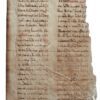
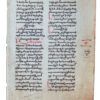
Leaf from an Armenian Medical Manuscript (Herbal and Pharmacological Treatise)
[Armenia, Eastern Anatolia or Persia, late 15th to early 16th century]
21cm x 14.5cm
Single leaf on laid paper, written in a clear and practiced Armenian bolorgir bookhand in black ink, with rubricated initials and sectional markers in red, text arranged in two columns of approximately 20–24 lines per column. The paper bears a watermark in the form of a shield, probably of Italian origin, reflecting the extensive use of imported Venetian and Fabriano papers in Armenian manuscript production of the late medieval and early modern period. Minor marginal wear and age toning consistent with its age, but overall in excellent, legible, and highly presentable condition.
This leaf derives from a scientific and medical manuscript belonging to the rich Armenian tradition of practical medicine and herbal pharmacology. The text comprises a sequence of therapeutic prescriptions, each introduced by rubricated initials marking new remedies. These entries describe treatments for specific ailments—including disorders of the head, stomach, and humoral imbalance—and provide detailed instructions for the preparation and administration of medicines derived from herbs, roots, and compounded natural substances. Typical remedies include the grinding of plant materials, infusion in water or wine, and regulated oral administration, reflecting the sophisticated and methodical nature of Armenian medical practice.
Armenian medicine occupied an important position within the wider intellectual world of the Near East, synthesizing indigenous traditions with the authoritative medical systems of classical Greek and Arabic authors, particularly Galen and Avicenna. Medical manuscripts such as this were practical working documents, used by physicians and scholars, and copied for continued use across Armenian communities in Eastern Anatolia, Persia, and beyond. Their survival provides important evidence for the transmission of scientific knowledge and the continuity of learned medical traditions in the Armenian world.
Manuscripts of this type are considerably scarcer than liturgical Armenian texts and are especially prized by collectors interested in the history of medicine, scientific manuscripts, and the intellectual heritage of the Christian East. The present leaf is notable for its clarity of script, well-preserved rubrication, and attractive format, making it both an important historical witness and an aesthetically appealing example of Armenian scholarly manuscript culture.
Product Enquiry
Related products
C14th -C16th manuscripts
Single leaf from the so-called ‘Carondelet Breviary’ 1458 from the scribe Jean d’Aussert
£600.00

C14th -C16th manuscripts
£350.00
C14th -C16th manuscripts
Historiated initial OT prophet, Italy c.1320 (Emilia-Romagna)
£2,500.00
C14th -C16th manuscripts
£8,000.00
![Leaf from Baldo degli Ubaldi (1327–1400), Sextum codicis librum commentaria [Italy, late 15th century]](https://stephenbutler.com/wp-content/uploads/2023/07/IMG_0101-515x618.jpg "Leaf from Baldo degli Ubaldi (1327–1400), Sextum codicis librum commentaria [Italy, late 15th century]")
C14th -C16th manuscripts
£800.00


Arabic and Ottoman
£1,900.00

C14th -C16th manuscripts
£900.00
C14th -C16th manuscripts
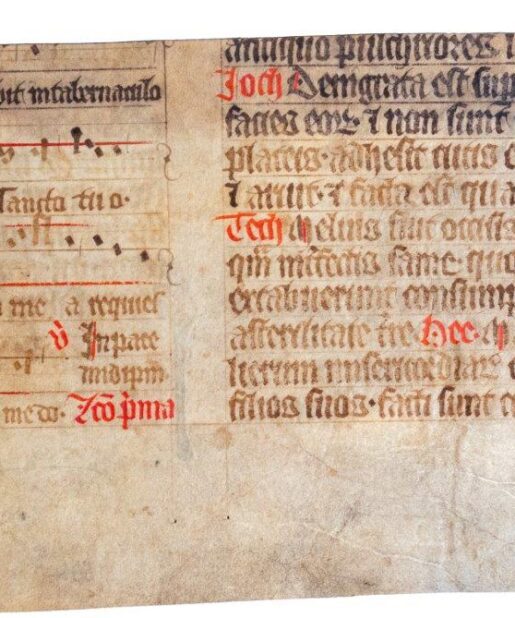
A C14th cutting from a Noted Breviary with music on a 4-line stave arranged around a red clef line
£280.00