

![A possibly unique and unknown manuscript from the library of Sir Thomas Phillipps. Anonymous Dominican compiler, Liber de fructibus penitentiae (alias Flores de penitentia or Summa aurea) [Southern France (Provence?), 14th century (1st half)]](https://stephenbutler.com/wp-content/uploads/2025/04/IMG_1518.jpg "A possibly unique and unknown manuscript from the library of Sir Thomas Phillipps. Anonymous Dominican compiler, Liber de fructibus penitentiae (alias Flores de penitentia or Summa aurea) [Southern France (Provence?), 14th century (1st half)]")
![A possibly unique and unknown manuscript from the library of Sir Thomas Phillipps. Anonymous Dominican compiler, Liber de fructibus penitentiae (alias Flores de penitentia or Summa aurea) [Southern France (Provence?), 14th century (1st half)]](https://stephenbutler.com/wp-content/uploads/2025/04/IMG_1510.jpg "A possibly unique and unknown manuscript from the library of Sir Thomas Phillipps. Anonymous Dominican compiler, Liber de fructibus penitentiae (alias Flores de penitentia or Summa aurea) [Southern France (Provence?), 14th century (1st half)]")
![A possibly unique and unknown manuscript from the library of Sir Thomas Phillipps. Anonymous Dominican compiler, Liber de fructibus penitentiae (alias Flores de penitentia or Summa aurea) [Southern France (Provence?), 14th century (1st half)]](https://stephenbutler.com/wp-content/uploads/2025/04/IMG_1511.jpg "A possibly unique and unknown manuscript from the library of Sir Thomas Phillipps. Anonymous Dominican compiler, Liber de fructibus penitentiae (alias Flores de penitentia or Summa aurea) [Southern France (Provence?), 14th century (1st half)]")
![A possibly unique and unknown manuscript from the library of Sir Thomas Phillipps. Anonymous Dominican compiler, Liber de fructibus penitentiae (alias Flores de penitentia or Summa aurea) [Southern France (Provence?), 14th century (1st half)]](https://stephenbutler.com/wp-content/uploads/2025/04/IMG_1512.jpg "A possibly unique and unknown manuscript from the library of Sir Thomas Phillipps. Anonymous Dominican compiler, Liber de fructibus penitentiae (alias Flores de penitentia or Summa aurea) [Southern France (Provence?), 14th century (1st half)]")
![A possibly unique and unknown manuscript from the library of Sir Thomas Phillipps. Anonymous Dominican compiler, Liber de fructibus penitentiae (alias Flores de penitentia or Summa aurea) [Southern France (Provence?), 14th century (1st half)]](https://stephenbutler.com/wp-content/uploads/2025/04/IMG_1513.jpg "A possibly unique and unknown manuscript from the library of Sir Thomas Phillipps. Anonymous Dominican compiler, Liber de fructibus penitentiae (alias Flores de penitentia or Summa aurea) [Southern France (Provence?), 14th century (1st half)]")
![A possibly unique and unknown manuscript from the library of Sir Thomas Phillipps. Anonymous Dominican compiler, Liber de fructibus penitentiae (alias Flores de penitentia or Summa aurea) [Southern France (Provence?), 14th century (1st half)]](https://stephenbutler.com/wp-content/uploads/2025/04/IMG_1514.jpg "A possibly unique and unknown manuscript from the library of Sir Thomas Phillipps. Anonymous Dominican compiler, Liber de fructibus penitentiae (alias Flores de penitentia or Summa aurea) [Southern France (Provence?), 14th century (1st half)]")
![A possibly unique and unknown manuscript from the library of Sir Thomas Phillipps. Anonymous Dominican compiler, Liber de fructibus penitentiae (alias Flores de penitentia or Summa aurea) [Southern France (Provence?), 14th century (1st half)]](https://stephenbutler.com/wp-content/uploads/2025/04/IMG_1515.jpg "A possibly unique and unknown manuscript from the library of Sir Thomas Phillipps. Anonymous Dominican compiler, Liber de fructibus penitentiae (alias Flores de penitentia or Summa aurea) [Southern France (Provence?), 14th century (1st half)]")
![A possibly unique and unknown manuscript from the library of Sir Thomas Phillipps. Anonymous Dominican compiler, Liber de fructibus penitentiae (alias Flores de penitentia or Summa aurea) [Southern France (Provence?), 14th century (1st half)]](https://stephenbutler.com/wp-content/uploads/2025/04/IMG_1516.jpg "A possibly unique and unknown manuscript from the library of Sir Thomas Phillipps. Anonymous Dominican compiler, Liber de fructibus penitentiae (alias Flores de penitentia or Summa aurea) [Southern France (Provence?), 14th century (1st half)]")
![A possibly unique and unknown manuscript from the library of Sir Thomas Phillipps. Anonymous Dominican compiler, Liber de fructibus penitentiae (alias Flores de penitentia or Summa aurea) [Southern France (Provence?), 14th century (1st half)]](https://stephenbutler.com/wp-content/uploads/2025/04/IMG_1517.jpg "A possibly unique and unknown manuscript from the library of Sir Thomas Phillipps. Anonymous Dominican compiler, Liber de fructibus penitentiae (alias Flores de penitentia or Summa aurea) [Southern France (Provence?), 14th century (1st half)]")
![A possibly unique and unknown manuscript from the library of Sir Thomas Phillipps. Anonymous Dominican compiler, Liber de fructibus penitentiae (alias Flores de penitentia or Summa aurea) [Southern France (Provence?), 14th century (1st half)]](https://stephenbutler.com/wp-content/uploads/2025/04/IMG_1519.jpg "A possibly unique and unknown manuscript from the library of Sir Thomas Phillipps. Anonymous Dominican compiler, Liber de fructibus penitentiae (alias Flores de penitentia or Summa aurea) [Southern France (Provence?), 14th century (1st half)]")
![A possibly unique and unknown manuscript from the library of Sir Thomas Phillipps. Anonymous Dominican compiler, Liber de fructibus penitentiae (alias Flores de penitentia or Summa aurea) [Southern France (Provence?), 14th century (1st half)]](https://stephenbutler.com/wp-content/uploads/2025/04/IMG_1520.jpg "A possibly unique and unknown manuscript from the library of Sir Thomas Phillipps. Anonymous Dominican compiler, Liber de fructibus penitentiae (alias Flores de penitentia or Summa aurea) [Southern France (Provence?), 14th century (1st half)]")







![A possibly unique and unknown manuscript from the library of Sir Thomas Phillipps. Anonymous Dominican compiler, Liber de fructibus penitentiae (alias Flores de penitentia or Summa aurea) [Southern France (Provence?), 14th century (1st half)]](https://stephenbutler.com/wp-content/uploads/2025/04/IMG_1576-100x100.jpg "A possibly unique and unknown manuscript from the library of Sir Thomas Phillipps. Anonymous Dominican compiler, Liber de fructibus penitentiae (alias Flores de penitentia or Summa aurea) [Southern France (Provence?), 14th century (1st half)]")
![A possibly unique and unknown manuscript from the library of Sir Thomas Phillipps. Anonymous Dominican compiler, Liber de fructibus penitentiae (alias Flores de penitentia or Summa aurea) [Southern France (Provence?), 14th century (1st half)]](https://stephenbutler.com/wp-content/uploads/2025/04/IMG_1667-2-100x100.jpg "A possibly unique and unknown manuscript from the library of Sir Thomas Phillipps. Anonymous Dominican compiler, Liber de fructibus penitentiae (alias Flores de penitentia or Summa aurea) [Southern France (Provence?), 14th century (1st half)]")
Anonymous Dominican compiler, Liber de fructibus penitentiae (alias Flores de penitentia or Summa aurea)
[Southern France (Provence?), 14th century (1st half)]
Text
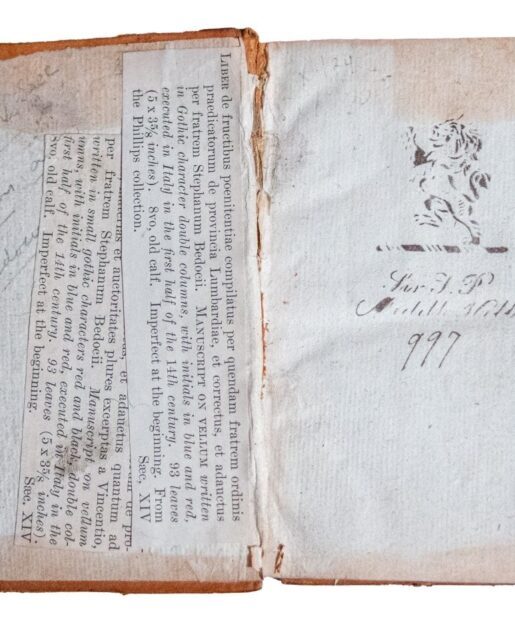
The volume lacks its first quire and the second is misbound after the third; it starts imperfectly in chapter 3 and ends ‘[…] non cesset, salutaris operatio perseueret. Amen.’, followed by an interesting explicit: ‘Explicit liber de fructibus poenitentiae compilatus per fratrem [followed by a blank space] ordinis predicatorum, de provincia Lumbardie, et correctus, et adauctus, quantum ad titulos, materias et auctoritates
plures excerptus a Vincentio, per fratrem Stephanum Bedocii de provincia Provincie’. Here we see that the scribe did not know the name of the author, so he left a space in the hope that it might be filled-in at some later date. He states in some detail that the text has been revised and corrected by brother Stephanus Bedocius – who was perhaps the scribe himself – of the (Dominican) province of Provence.
The main text is followed by a list of contents, of which only the second half survives on the back flyleaf, one flyleaf having been lost: it begins ‘De meditacione dei circa beneficia communia – [fol.] 58’ and ends ‘De labore manuum – [fol.] ciij’ Old discussions of the text include J. Quétif and J. Echard, Scriptores Ordinis Praedicatorum, 2 vols. (Paris, 1719–21), I, pp. 239–40; and A. Teetaert, ‘Quelques
Summae de poenitentia anonymes dans la Bibliothèque Nationale de Paris,’ in Miscellanea Giovanni Mercati II, Studi e Testi, 122 (Vatican City, 1946), pp. 311–43.
More recently, it has been inventoried by Morton W. Bloomfield, Incipits of Latin Works on the Virtues and Vices, 1100–1500 A.D., Mediaeval Academy of America Publications, 88 (Cambridge, MA, 1979), p. 426 no. 4996, listing more than twenty manuscripts. Here it is noted that ‘There are perhaps several redactions of this work, or several works under the same incipit’, i.e. a prologue beginning ‘Quoniam
peccantibus post baptismum mortaliter sola penitentia remedium est ad vitam …’ and a main text beginning, ‘Rabanus [or Ambrosius] super Matth. 21: Omnis, inquit, arbor que non facit fructus bonos …’ (cf. Thomas Kaeppeli, Scriptores ordinis praedicatorum medii aevi, 4 vols (S. Sabina: Rome, 1970–1993), IV, no. 4008).
The authorship is uncertain. The work is often mistakenly attributed to Vincent of Beauvais, due to the fact that he wrote a work with a similar title, prologue, and division into fifteen parts, on which the present work is based. It has also been ascribed to an unidentified Dominican ‘Frater P’ or ‘Frater Stephanus’. He apparently composed the work before 1303, when the province of Lombardy was divided into two: upper and lower.
There is therefore new work to be done to distinguish the different texts, or to ascertain how the various versions of the text relate to one another. The colophon of the present manuscript suggests that it is perhaps a unique version. Assuming that he was French, the scribe/reviser’s first name would have been Etienne, and the surname Bédoc can be found in Provence to the present day.
Decoration
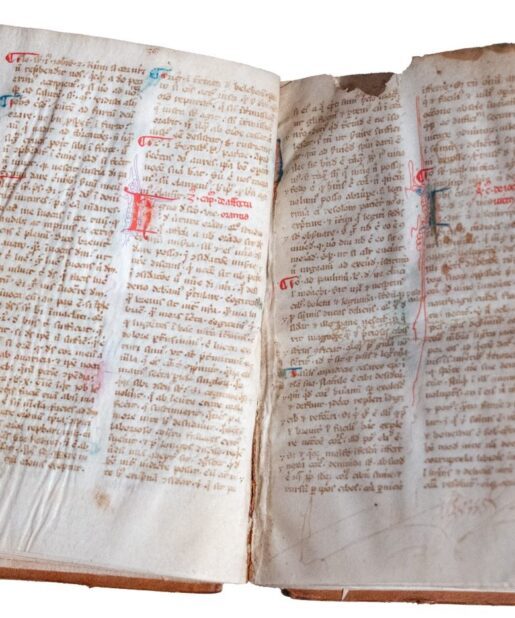
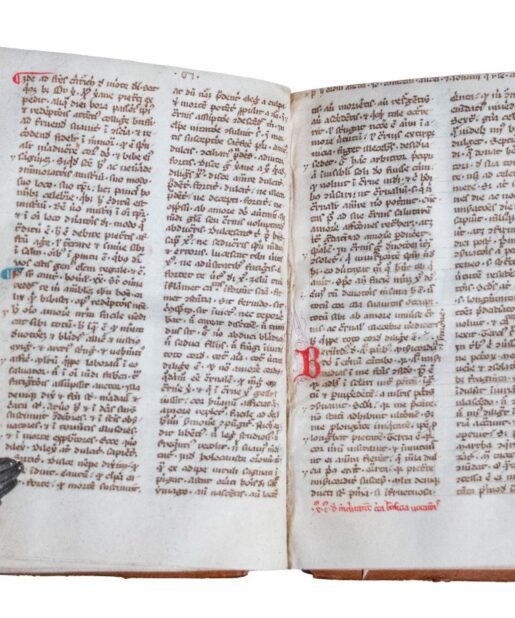
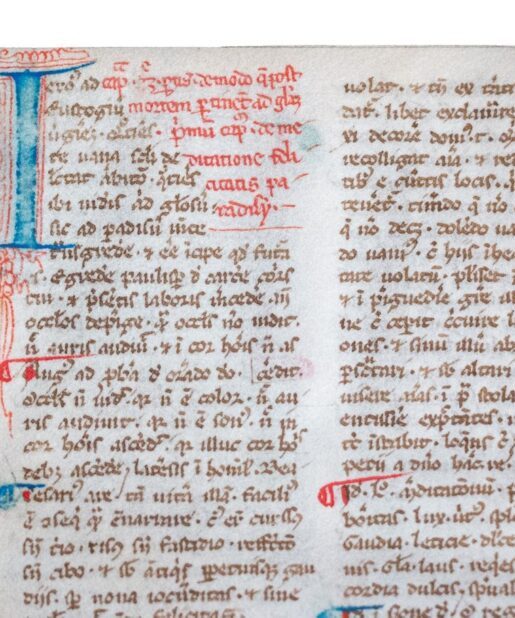
The beginning of each of the surviving fifteen books is introduced by a four- to eight-line initial, and each chapter introduced by a three-line initial, alternately in red with purple flourishing, or blue with red flourishing; paraphs are alternately red or blue. The blue often smudged, and occasionally corroded through the leaf.
Physical Description
Parchment; the leaves c. 125 × 95 mm
i (paper) + 93 + I (original parchment) + i (paper) contemporary ink foliation in arabic numerals up to 99, then roman numerals, showing that the first quire is out of sequence: 25–36, 13–24, 37–99, c–cv
COLLATION: 1–512 (fols. 25–72), 612-1 (last leaf missing; fols. 73–83), 712 (fols. 85–96), 810 (or 10, -1, +1?) (fols. 97–105 and flyleaf); quire signatures on the first rectos of some quires from the the 3rd onwards
RULING: Plummet-ruled for two columns of 35 lines per page, c. 100 × 75 mm
SCRIPT: Written in a very small, highly abbreviated gothic script; rubrics in red
BINDING: Bound in 18th-century French(?) speckled medium brown leather over pasteboards, the spine tooled in gilt with foliate ornaments and a black leather title-piece lettered in gilt: ‘VIM. [sic] A. | BEDOCI | DE.FRUC | PCENIT [sic] | M.S. | XIV.S’
Provenance
1. Previously attributed to Italy, the manuscript was instead probably made in the south of France, where Italian influence was strong, especially in Avignon during the Avignon Papacy (1309–1376); this is suggested by several features including the fact that the reviser of the text was apparently from Provence; the pen flourishing uses purple, common in southern France; and the script uses the distinctly non-Italian feature of the crossed Tironian ‘et’ symbol.
2. Anonymous (French?) owner: sold by Sotheby’s, A catalogue of the Hebrew, Greek and Latin Antient Manuscripts, the property of Abbé Celotti, 14 March 1825, lot 395, as ‘The Property of Another Foreigner’; bought by:
3. Sir Thomas Phillipps (1792–1872); acquired very early in his collecting career: the first flyleaf with his ‘Sir T. P., Middle Hill’ stenciled crest and handwritten number ‘997’; includedin his Catalogus Librorum Manuscriptorum in Bibliotheca D. Thomæ Phillipps, Bart., A.D. 1837 (Privately printed), no. 997; offered for sale twenty-five years after his death, at Sotheby’s, Bibliotheca Phillippica: Catalogue of a Further Portion of the Famous Collection […] of the late Sir Thomas Phillipps, 5 June 1899, lot 1157; apparently unsold, and re-offered by Sotheby’s, Bibliotheca Phillippica: Catalogue of a Further Portion of the […] Manuscripts and Autograph Letters of Thomas Phillipps, 27 April, 1903, together with another manuscript, as lot 111
4. Private collection, USA.
Bibliography
Unpublished.
Product Enquiry
Related products

C14th -C16th manuscripts
Finely produced illuminated leaf from a French Psalter, c.1480
£550.00


C14th -C16th manuscripts
£950.00

C14th -C16th manuscripts
Leaf from an Armenian Medical Manuscript (Herbal and Pharmacological Treatise) C15th-C16th
£1,500.00

C14th -C16th manuscripts
£900.00

C14th -C16th manuscripts
£350.00
C14th -C16th manuscripts
£8,000.00


C14th -C16th manuscripts
Unknown codex by humanist Bernardius Florentius, 1476, Florence, Italy
£23,000.00