

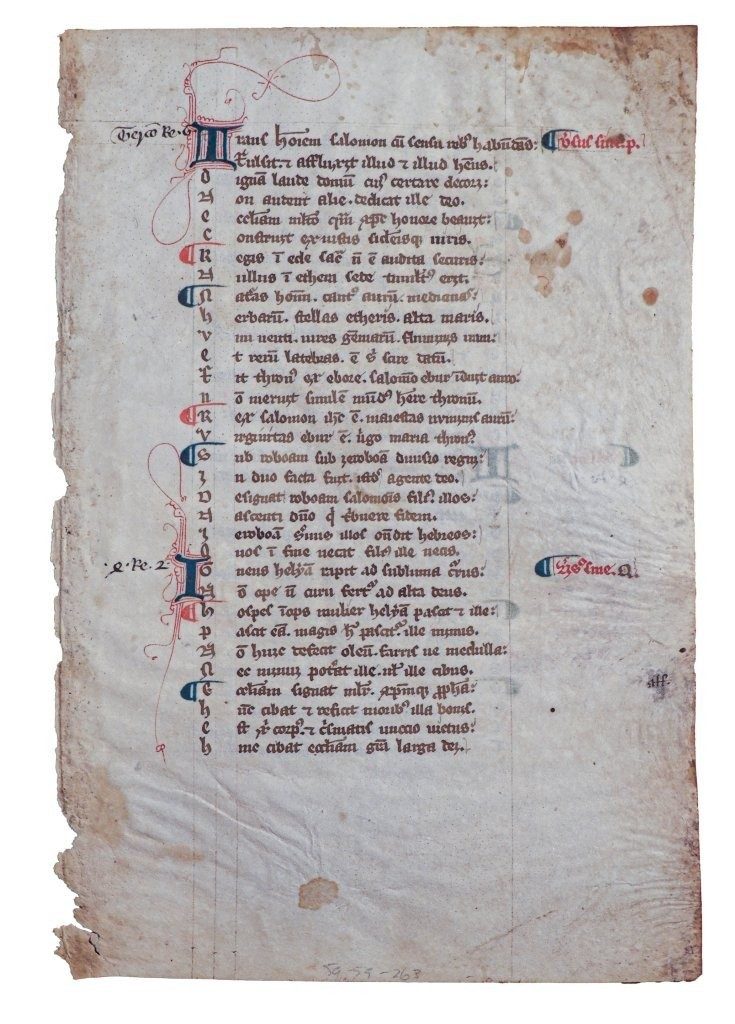
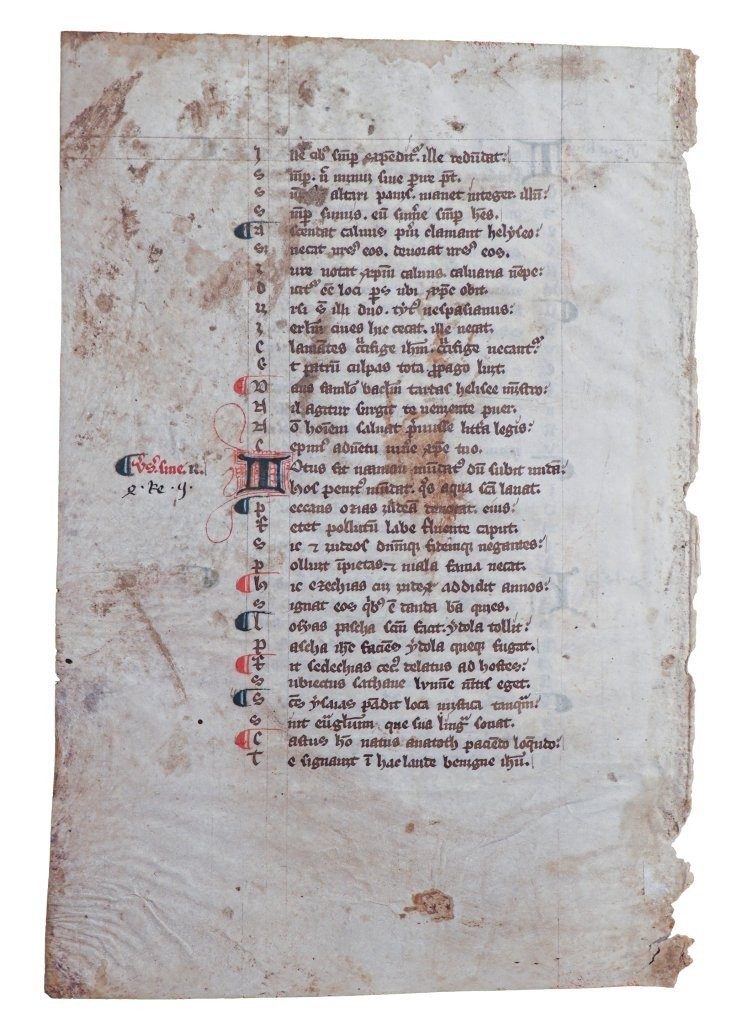
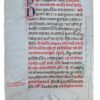
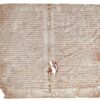
RIGA, Petrus. Leaf from a Large English Manuscript of Aurora, in the First Redaction of Aegidius of Paris. Latin verse on vellum
[England, second half of 14th century (c. 1375)]
285mm x 198mm
Description
Single leaf, with 32 lines in a small and rounded English gothic hand much influenced by secretarial forms, paragraph marks set off in outer margin, script within ruled guide lines.
Condition
Leaf in very good, fresh condition.
Text
This text, alongside the Bible and the works of Peter Lombard, was one of the fundamental textbooks used in the 13th-century universities. The author was a canon of Rheims cathedral, and most probably died in 1209 . It is a distillation of the historical passages of the Bible in verse, with a commentary and allegorical discussion. The leaf now in the University of South Carolina importantly reveals that the text here is the first redaction by Aegidius of Paris, composed c. 1200 (see P.E. Beichner, Aurora: Petri Rigae Biblia Versificata, 1965).
Author
Petrus Riga was a medieval Latin poet and author who lived in the 12th century. He is best known for his poem “Aurora,” which is a Christian allegory about the creation of the world and the history of humanity. The poem is written in hexameter verse and consists of over 4,000 lines. “Aurora” draws heavily from biblical stories and teachings, as well as classical mythology, and it was widely popular during
the medieval period. Petrus Riga’s work represents an important contribution to medieval literature, and “Aurora” remains a significant example of Christian allegory and poetic storytelling from the time period.
Provenance
1. The parent manuscript was owned by the Grosvenor family, Dukes of Westminster; their sale Sotheby’s, 11 July 1966, lot 229 (when it had 267 leaves but was already missing a gathering and 13 leaves).
2. Francis Edwards, bookseller, acquired in the Sotheby’s sale, removing three damaged leaves that had had their initials cut out and advertising the rest of the codex in a number of his subsequent catalogues.
3. Codex completely dispersed, perhaps in North America. One from the collection of Bernard Rosenthal (1920-2017) of San Francisco, appeared as Quaritch cat. 1348, Bookhands of the Middle Ages VIII (2007), no. 96, and others reside in Marquette University in Milwaukee, as well as the University of South Carolina, their early MS. 125.4. 53.
Product Enquiry
Related products
C14th -C16th manuscripts
Historiated initial OT prophet, Italy c.1320 (Emilia-Romagna)
£2,500.00
![Bifolium from St Simon of Cascia, De gestis domini salvatoris, in Latin, decorated manuscript on vellum [Southern Netherlands, 14th century]](https://stephenbutler.com/wp-content/uploads/2024/09/IMG_1181-515x618.jpg "Bifolium from St Simon of Cascia, De gestis domini salvatoris, in Latin, decorated manuscript on vellum [Southern Netherlands, 14th century]")
![Bifolium from St Simon of Cascia, De gestis domini salvatoris, in Latin, decorated manuscript on vellum [Southern Netherlands, 14th century]](https://stephenbutler.com/wp-content/uploads/2024/09/IMG_1179-515x618.jpg "Bifolium from St Simon of Cascia, De gestis domini salvatoris, in Latin, decorated manuscript on vellum [Southern Netherlands, 14th century]")
C14th -C16th manuscripts
£2,000.00


Arabic and Ottoman
£1,900.00
C14th -C16th manuscripts
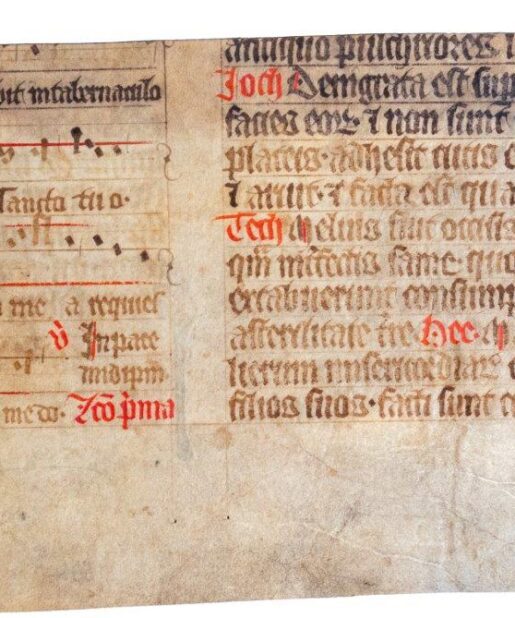
A C14th cutting from a Noted Breviary with music on a 4-line stave arranged around a red clef line
£280.00
![Leaf from an English Illuminated Psalter In Latin, manuscript on vellum [England (probably East Anglia), mid-14th century]](https://stephenbutler.com/wp-content/uploads/2026/05/IMG_7534-515x618.jpg "Leaf from an English Illuminated Psalter In Latin, manuscript on vellum [England (probably East Anglia), mid-14th century]")
![Leaf from an English Illuminated Psalter In Latin, manuscript on vellum [England (probably East Anglia), mid-14th century]](https://stephenbutler.com/wp-content/uploads/2026/05/C57A7557-515x618.jpg "Leaf from an English Illuminated Psalter In Latin, manuscript on vellum [England (probably East Anglia), mid-14th century]")
C14th -C16th manuscripts
£2,750.00
C14th -C16th manuscripts
£7,500.00

C14th -C16th manuscripts
£1,500.00