

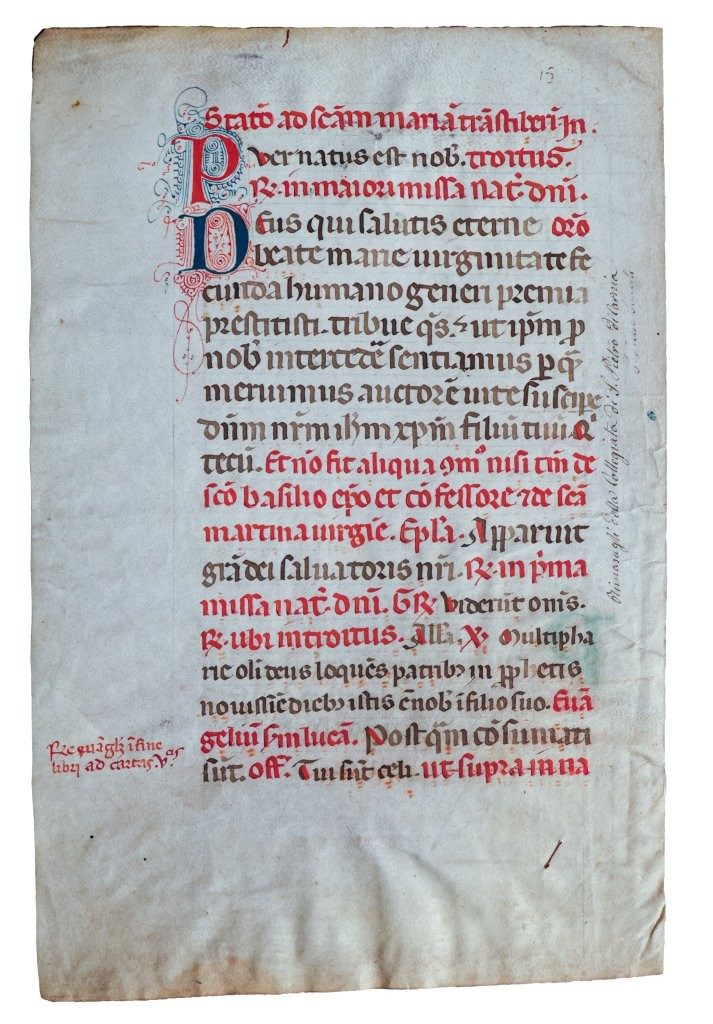
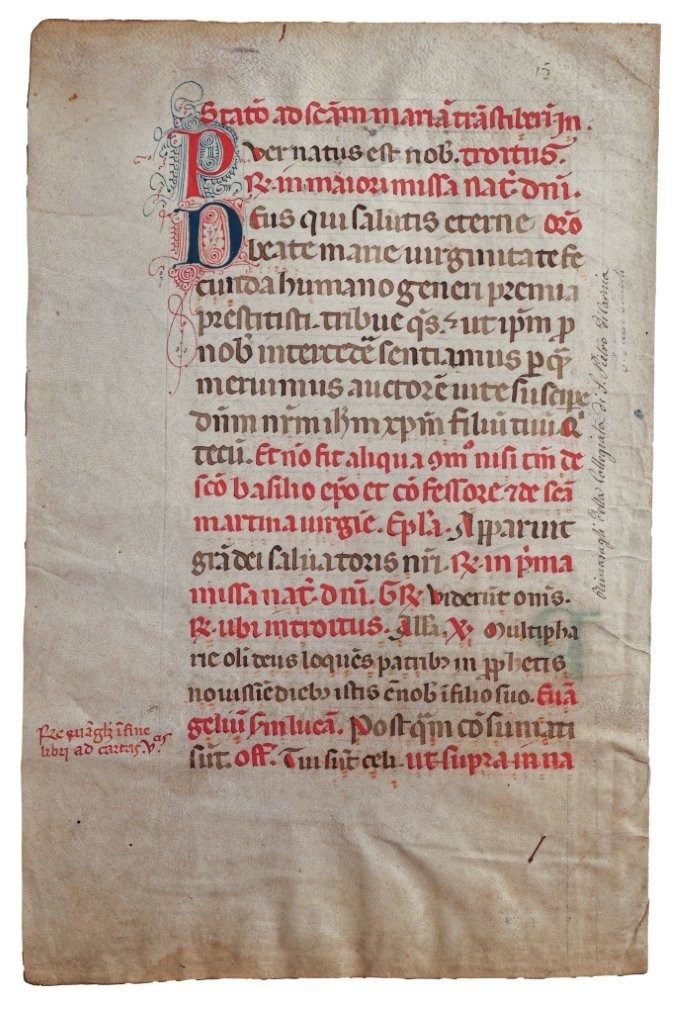
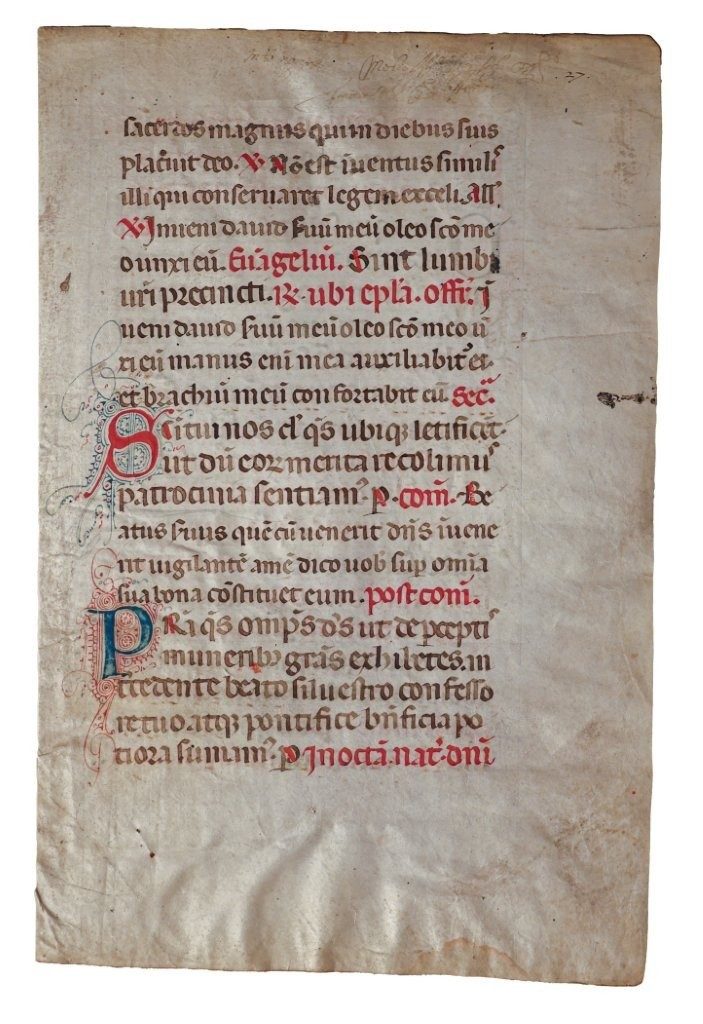
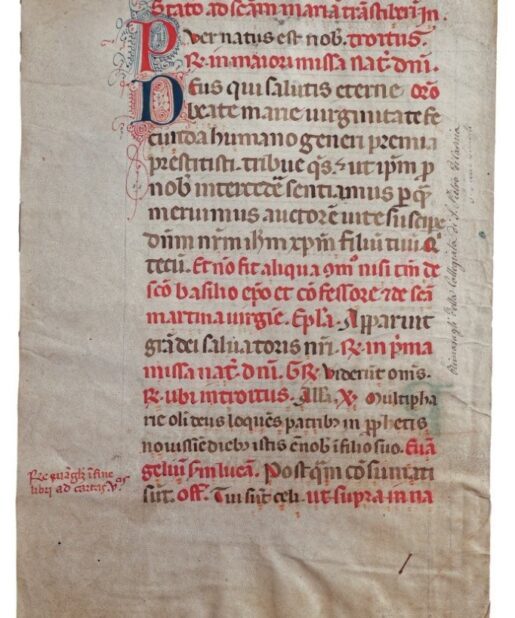
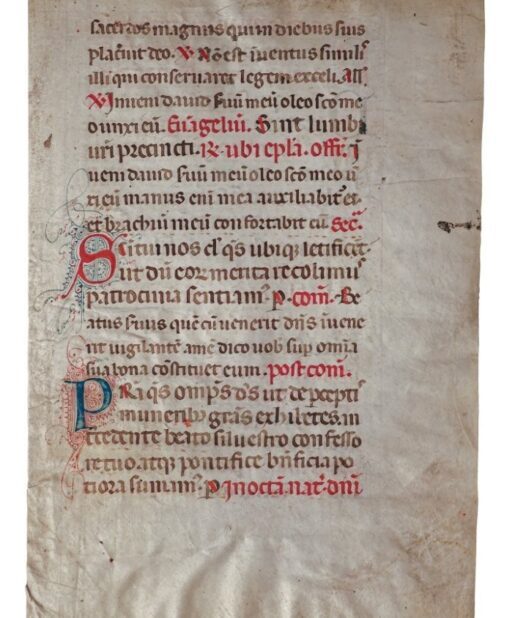

SAINT NICHOLAS. Leaf from a Medieval Breviary In Latin, manuscript on vellum
Northern France or the Low Countries, c. 1300–1350
240mm x 180mm
Description
Written in a clear Gothic textualis in brown ink, with alternating red and blue pen-flourished initials and rubrication marking divisions of the nocturns.
Condition
With minor age toning consistent with use.
Fine leaf from a medieval Breviary containing lessons from the Office of Saint Nicholas (6 December).
Text
The text opens with “Beatus Nicolaus…” and includes references to the saint’s episcopate and miracles. St Nicholas, Bishop of Myra (4th century), was among the most beloved saints of medieval Christendom.
Celebrated for his generosity, protection of the innocent, and miraculous interventions on behalf of sailors and children, his cult spread rapidly across Europe from the 11th century onward. Churches, guilds, and entire cities placed themselves under his patronage. The rubrics indicating “in prima nocturna” confirm that this leaf formed part of the Night Office (Matins), when the saint’s life and miracles were read aloud in choir.
Product Enquiry
Related products
C14th -C16th manuscripts
£8,000.00
C14th -C16th manuscripts
£7,500.00

C14th -C16th manuscripts
£900.00
![Leaf from Baldo degli Ubaldi (1327–1400), Sextum codicis librum commentaria [Italy, late 15th century]](https://stephenbutler.com/wp-content/uploads/2023/07/IMG_0101-515x618.jpg "Leaf from Baldo degli Ubaldi (1327–1400), Sextum codicis librum commentaria [Italy, late 15th century]")
C14th -C16th manuscripts
£800.00


C14th -C16th manuscripts
A substantial fragment of Jean Buridan on late C14th watermarked paper on 47 leaves
![Two illuminated historiated initials on a C15th leaf – Prologue to Job [Bible]](https://stephenbutler.com/wp-content/uploads/2023/11/2E2A0165-515x618.jpg "Two illuminated historiated initials on a C15th leaf – Prologue to Job [Bible]")
![Two illuminated historiated initials on a C15th leaf – Prologue to Job [Bible]](https://stephenbutler.com/wp-content/uploads/2023/11/2E2A0146-3-515x618.jpg "Two illuminated historiated initials on a C15th leaf – Prologue to Job [Bible]")
C14th -C16th manuscripts
Two illuminated historiated initials on a C15th leaf – Prologue to Job [Bible]
£1,500.00


Arabic and Ottoman
£1,900.00