

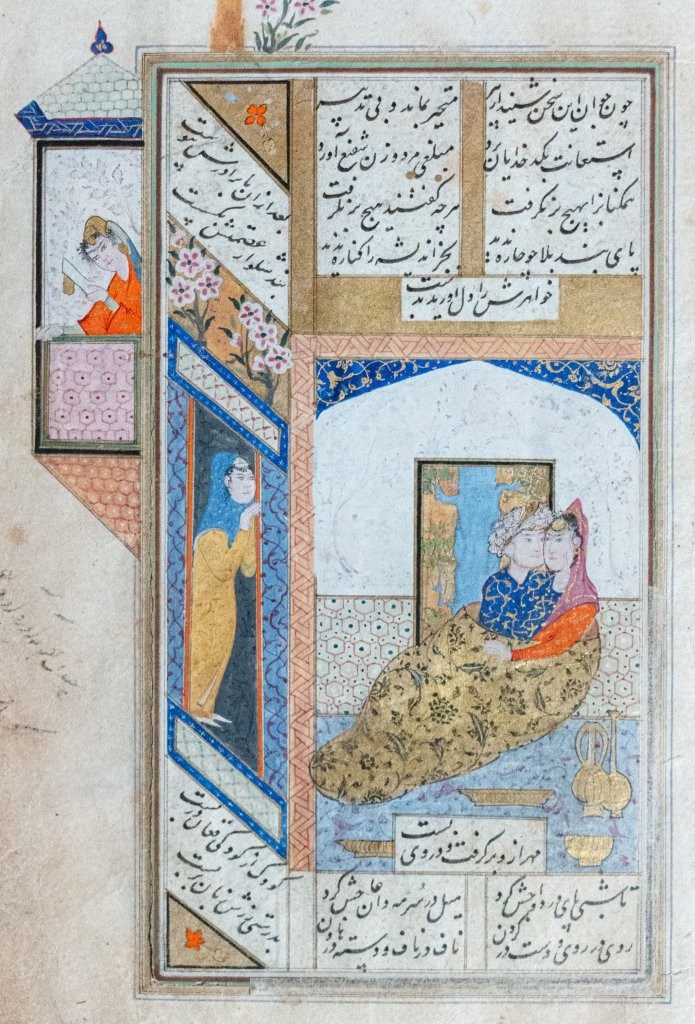
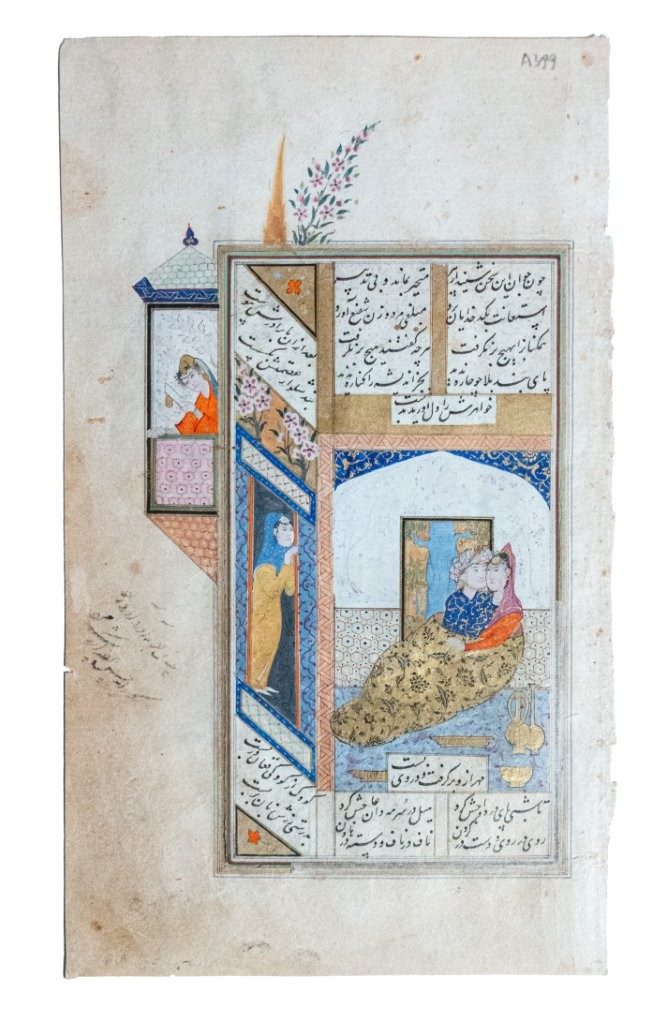

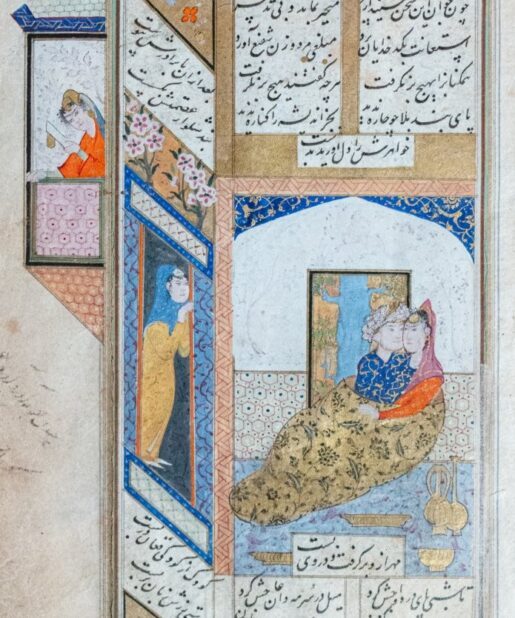
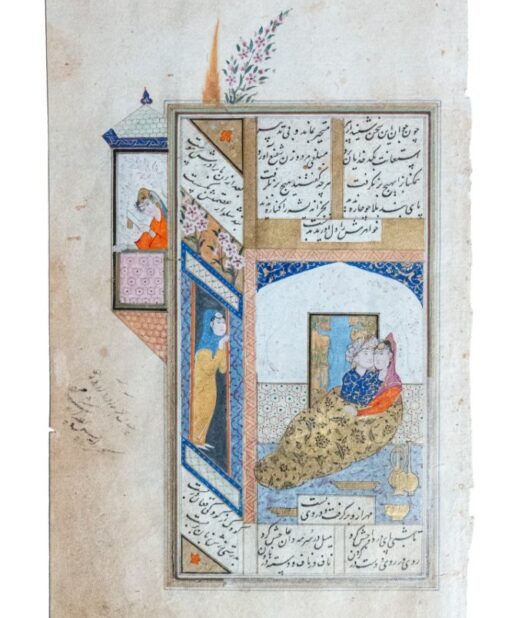
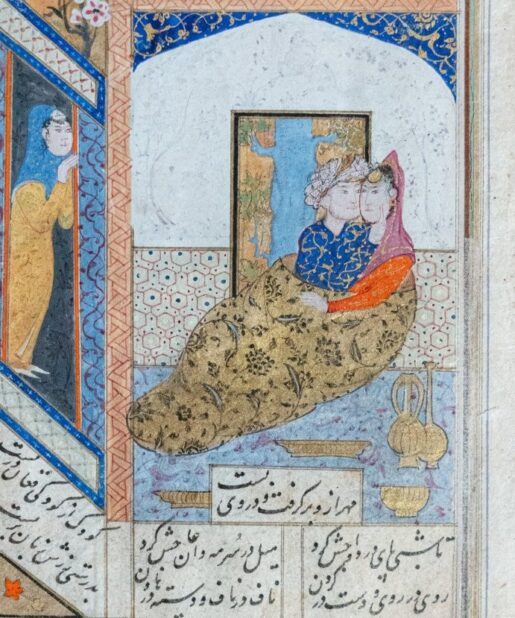
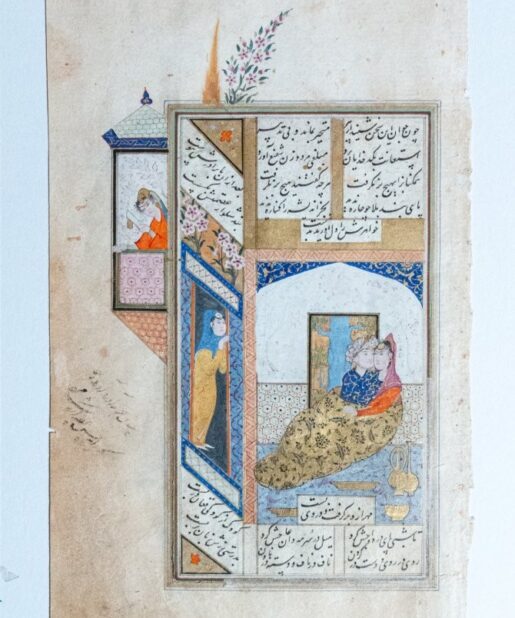


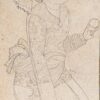
Shīrīn reads Khusraw’s letter. Nizami, Khamsa. Persian miniature from a manuscript of Nizami or a related romance, Safavid period.]
Iran, probably Isfahan or Shiraz, late 16th to early 17th century (c.1580–1620).
Opaque watercolour, ink, and gold on paper, image c. 19 × 12 cm; with 6 lines of nasta‘liq in black ink, divided into panels with gold rules and decorated margins, floral motifs and architectural setting with three figures.
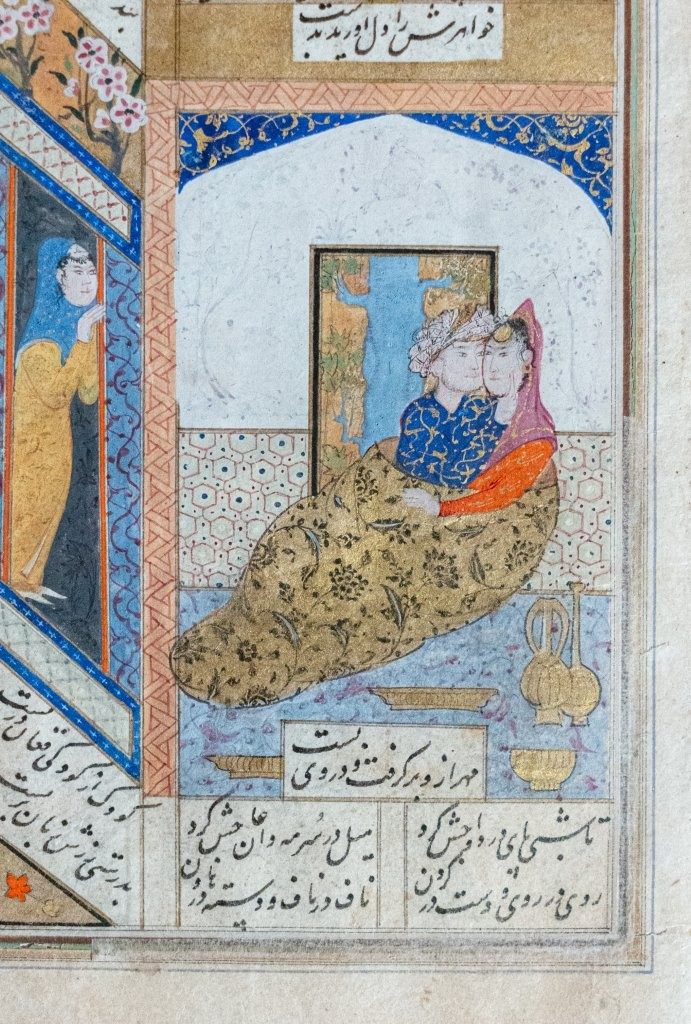
A fine Persian miniature depicting an amorous couple within an interior, possibly illustrating a scene from Nizami’s Khamsa—likely the Khusrav u Shirin or Haft Paykar. The composition shows a royal lover and his beloved embracing, seated under a gold-patterned textile before a window opening onto a stylised landscape. At left, a female attendant peers in from an upper window, holding a letter or mirror—an emblem of surveillance and romantic intrigue common in Persian literary illustration. Below and to the side, another attendant or confidante looks on from the doorway.
The miniature is framed by six panels of Persian verse in elegant nasta‘liq, written diagonally and horizontally within compartments of burnished gold and illuminated borders with blue and pink floral ornament. The verses, metrically rhymed, are typical of Nizami’s romantic or ethical narrative style, evoking divine destiny and human passion.
Executed with delicate brushwork, subtle modulation of colour, and lavish gilding, the painting exemplifies late Safavid manuscript art, when poetic manuscripts were prized luxury objects and intimate expressions of courtly refinement.
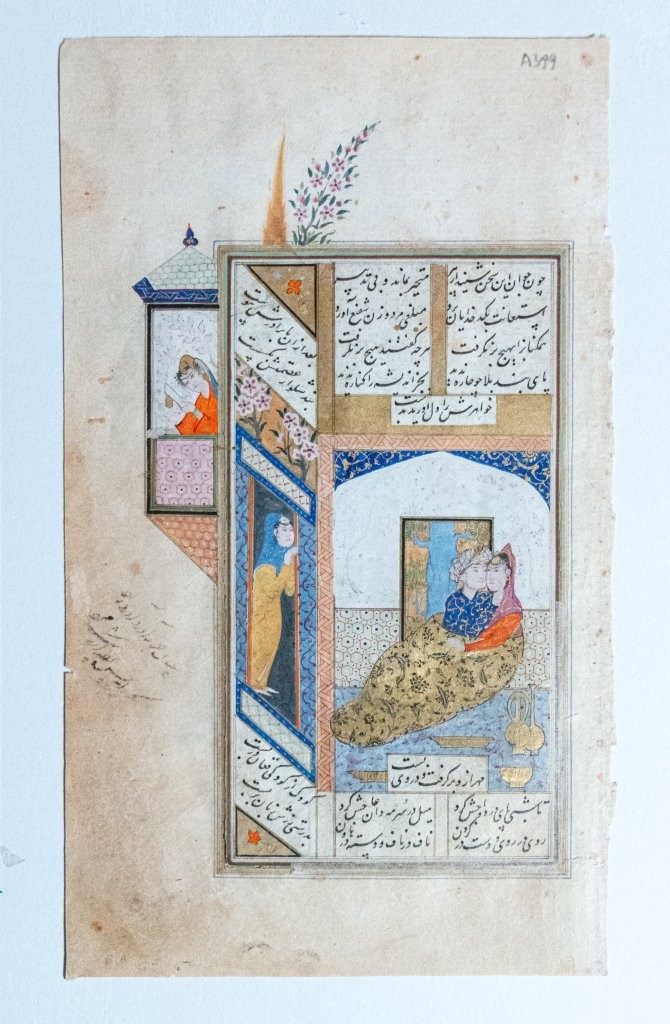
Mounted on later card and set within a blue mat. A representative example of Persian book painting from the high Safavid era, notable for its controlled sensuality, fine calligraphy, and architectural perspective.
Script and Layout
The script is nastaʿlīq, beautifully written, typical of late-Safavid or early-Mughal manuscripts.
We can see six lines of verse, arranged in two columns of Persian couplets (bayt), framed by gold.
The poetic meter and diction clearly belong to classical Persian narrative verse, almost certainly from Nizāmī Ganjavī’s Khamsa, most likely Khusraw u Shīrīn — the story of King Khusraw and Princess Shīrīn — given the miniature’s subject of a lover and beloved in a chamber.
Approximate Translation
“When that fairy heard these words,
the master of the house rose to his feet.
He sighed for the pain of separation,
and (like a slave) purchased affliction.
Bewildered, she remained wakeful and restless;
Men and women brought their plea of faith.
What was forbidden to her before was now gone,
and (love’s) essence became her sufficiency.”
This passage matches the Khusraw u Shīrīn episode in which Shīrīn receives Khusraw’s message (through a letter or intermediary), feels torn between modesty and love, and later consents to see him.
The female figure at the window holding a letter visually fits this scene.
Thus, this miniature probably illustrates the moment when Shīrīn reads Khusraw’s letter, or when they first embrace after correspondence — a classic episode found in 16th–17th century Persian copies of Nizāmī’s Khamsa
Product Enquiry
Related products


C14th -C16th manuscripts
£350.00


C14th -C16th manuscripts
A substantial fragment of Jean Buridan on late C14th watermarked paper on 47 leaves
C14th -C16th manuscripts
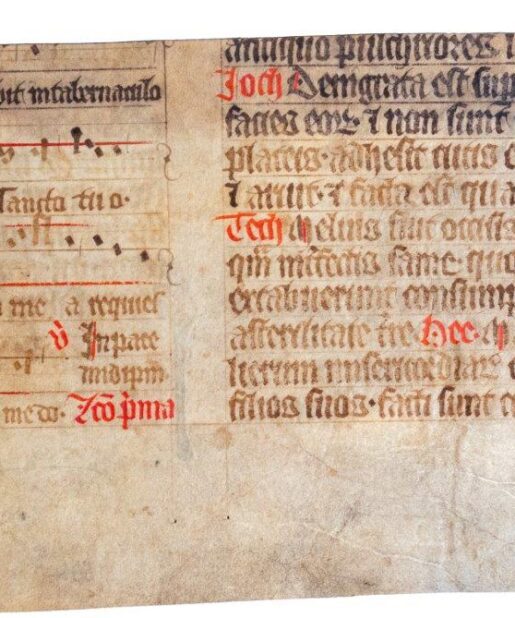
A C14th cutting from a Noted Breviary with music on a 4-line stave arranged around a red clef line
£280.00


![Leaf from an English Illuminated Psalter In Latin, manuscript on vellum [England (probably East Anglia), mid-14th century]](https://stephenbutler.com/wp-content/uploads/2026/05/IMG_7534-515x618.jpg "Leaf from an English Illuminated Psalter In Latin, manuscript on vellum [England (probably East Anglia), mid-14th century]")
![Leaf from an English Illuminated Psalter In Latin, manuscript on vellum [England (probably East Anglia), mid-14th century]](https://stephenbutler.com/wp-content/uploads/2026/05/C57A7557-515x618.jpg "Leaf from an English Illuminated Psalter In Latin, manuscript on vellum [England (probably East Anglia), mid-14th century]")
C14th -C16th manuscripts
£2,750.00