

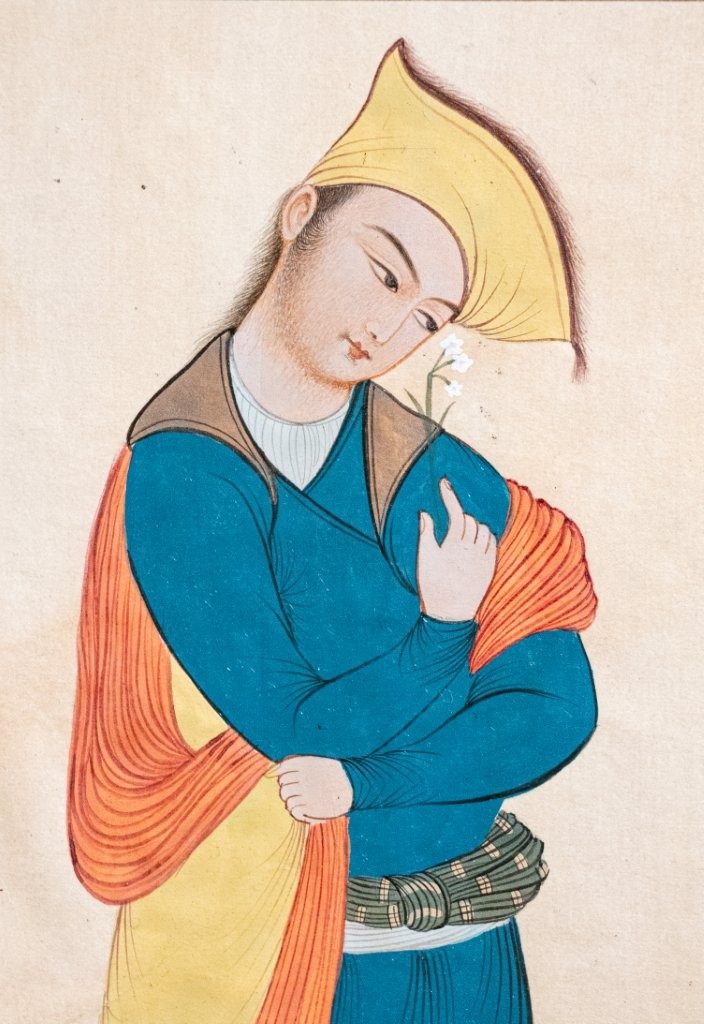
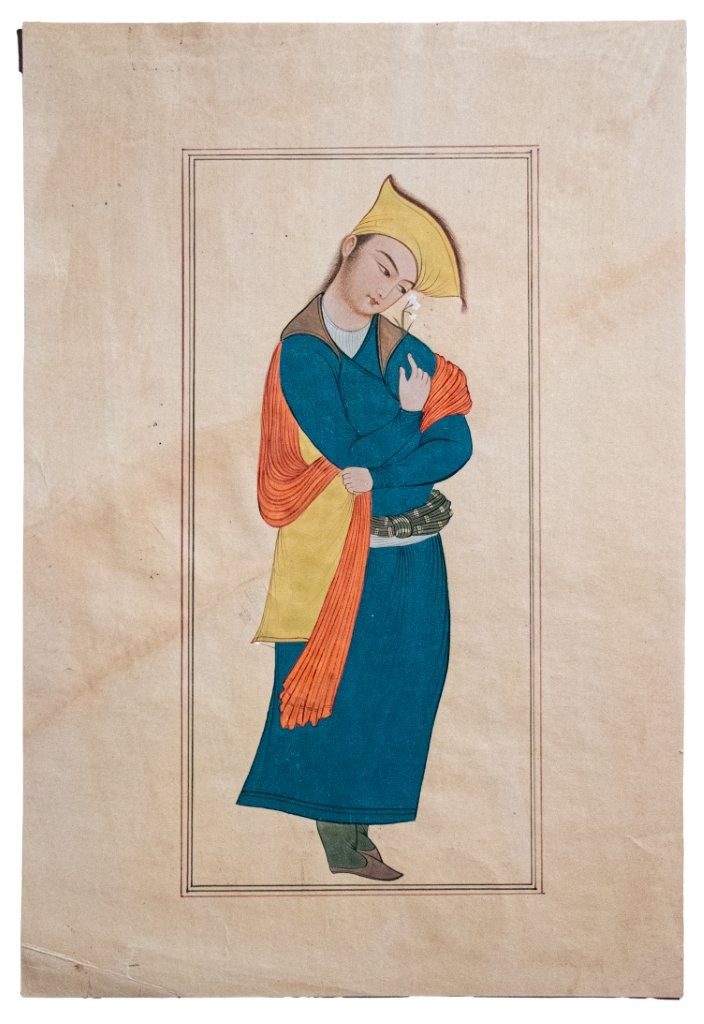
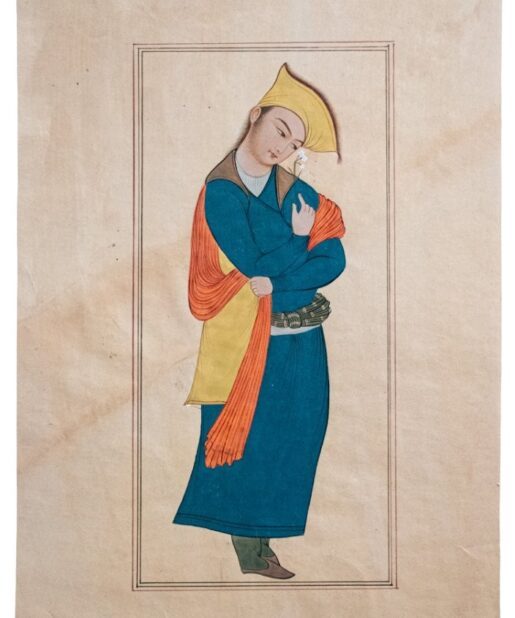

Portrait of a Youth Holding a Flower; Iran, late Safavid to early Zand period, circa 1700–1770 Ink, opaque watercolour, and gold on paper, laid down on album page
Ink, opaque watercolour, and gold on paper, laid down on album page
Page: approx. 224mm × 152mm; Image: 171mm × 81mm
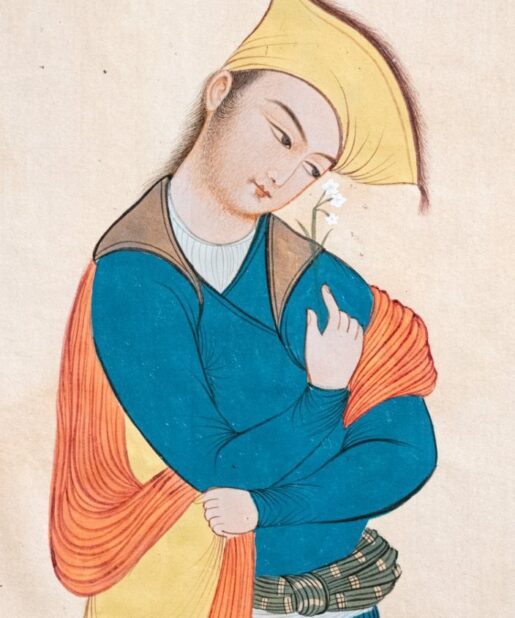
The painting depicts a solitary youth standing in three-quarter pose, holding a sprig of white blossoms in one hand while the other rests gently across his chest. He wears a vibrant turquoise-blue coat with a layered sash and an ochre-yellow shawl draped over his shoulder, rendered with fine linear modelling. His tapered hat, softly feathered hair, delicately shadowed eyes, and faint moustache evoke the refined aesthetic of late Safavid portraiture.
The composition is executed in a restrained palette dominated by ultramarine, vermilion, and gold, framed within a ruled border on an unadorned sheet. The elegantly simplified ground and lack of architectural or vegetal setting correspond closely to the album leaf (muraqqaʿ) tradition cultivated in Isfahan in the later 17th century and preserved into the Zand era.
Justification for Attribution and Dating
Several stylistic elements support an attribution to the late Safavid or early Zand period:
1. Facial Type:
Almond-shaped eyes with fine contouring and subtle blush
Softly graduated shading on jaw and cheekbone:
Naturalistic treatment closer to the Reza Abbasi school than to later Qajar stylisation
2. Costume and Colour
The youth’s tunic and sash are typical of late Safavid / Zand aristocratic fashion
Extensive use of ultramarine blue, a pigment more common in 17th–18th century work than later Qajar works, which employ more chrome-based pigments
The layered shawl and belt knot resemble garments seen in portraits dated c. 1700–1750
3. Format and Composition
Standing figure isolated against a plain background within a fine ruled border
No arabesque decoration, floral fields, or architectural panels characteristic of later Qajar painting
Consistent with album paintings executed for private courtly patrons during the later Safavid and Zand eras
4. Comparison with Known Examples
The portrait may be compared to:
A Safavid youth attributed to Muhammad Zaman, c. 1700 (Topkapi, H.2151, fol. 69)
A Zand-period single figure in the Harvard Art Museums (1960.181)
Album portraits sold at Sotheby’s, Arts of the Islamic World, 2021, Lots ___ and ___, dated to c. 1720–1760
These parallels reinforce the attribution to a transitional period between the late Safavid school and the early Zand ateliers active in Shiraz and Isfahan.
Condition
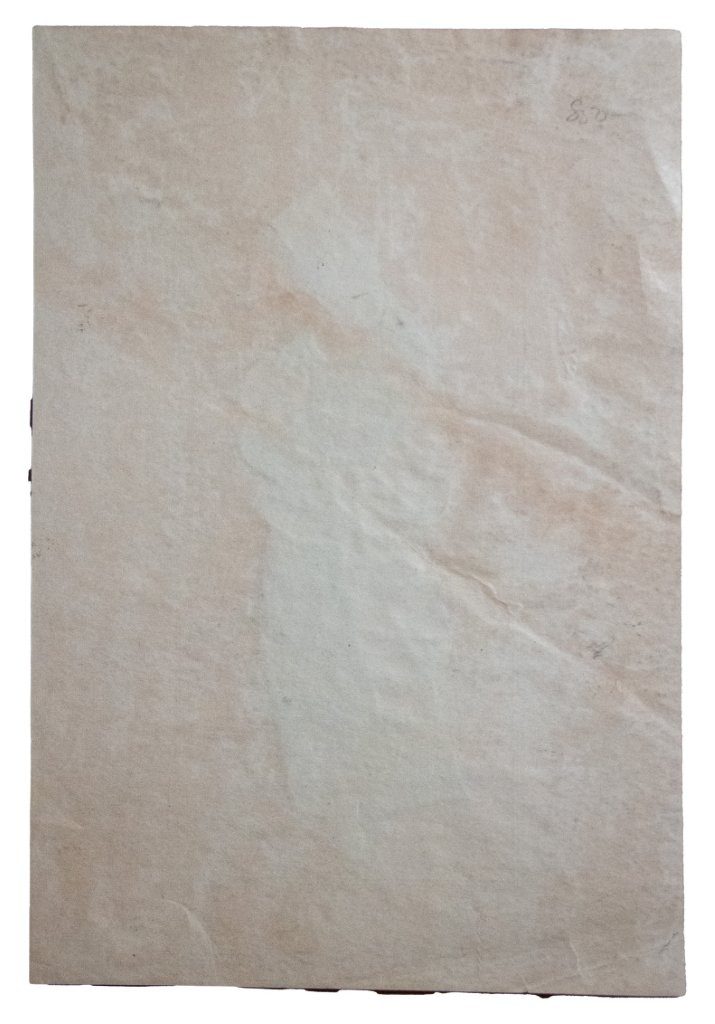
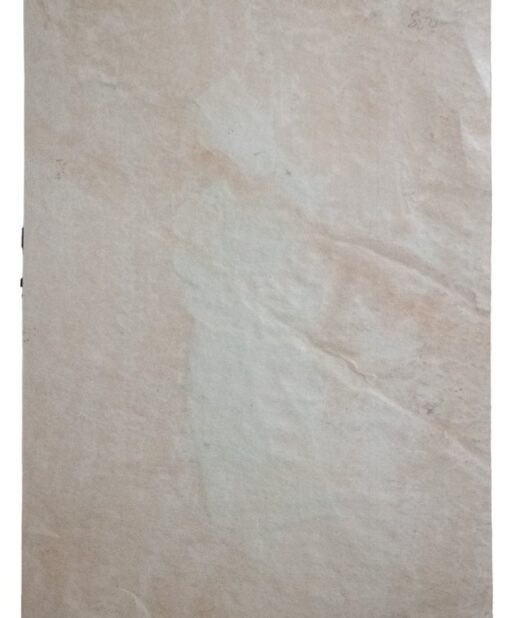
Overall excellent condition with strong colours and only light marginal creasing and toning. No retouching detected under magnification.
Bibliography
Bibliography (Selected) • Canby, Sheila. Persian Painting. London: British Museum Press, 1993. • Carboni, Stefano & Komaroff, Linda. The Persian Book of Kings: Art and Society in Medieval Iran. New York, 2014. • Welch, Anthony. Shiraz at the Time of Karim Khan Zand. Ithaca, 1976. • Roxburgh, David J. The Persian Album, 1400–1600. Yale University Press, 2005. • Titley, Norah. Miniatures from Persian Manuscripts. London: British Library, 1983.
Product Enquiry
Related products

C14th -C16th manuscripts
£950.00


C14th -C16th manuscripts
£8,000.00
C14th -C16th manuscripts
£7,500.00
![Leaf from an English Illuminated Psalter In Latin, manuscript on vellum [England (probably East Anglia), mid-14th century]](https://stephenbutler.com/wp-content/uploads/2026/05/IMG_7534-515x618.jpg "Leaf from an English Illuminated Psalter In Latin, manuscript on vellum [England (probably East Anglia), mid-14th century]")
![Leaf from an English Illuminated Psalter In Latin, manuscript on vellum [England (probably East Anglia), mid-14th century]](https://stephenbutler.com/wp-content/uploads/2026/05/C57A7557-515x618.jpg "Leaf from an English Illuminated Psalter In Latin, manuscript on vellum [England (probably East Anglia), mid-14th century]")
C14th -C16th manuscripts
£2,750.00
C14th -C16th manuscripts
A C14th cutting from a Noted Breviary with music on a 4-line stave arranged around a red clef line
£280.00
Arabic and Ottoman
Shīrīn reads Khusraw’s letter. A fine C16th Persian miniature of ‘Two Lovers’ from Nizami’s, Khamsa.
£5,000.00


C14th -C16th manuscripts
Complete gathering of 8 leaves from a Book of Hours, Flanders or northern France c.1450-1475
£1,800.00