


This piece has been placed.
Many works of comparable significance pass through our hands each year.
If you’re seeking something similar, please send us an enquiry or browse recent acquisitions.
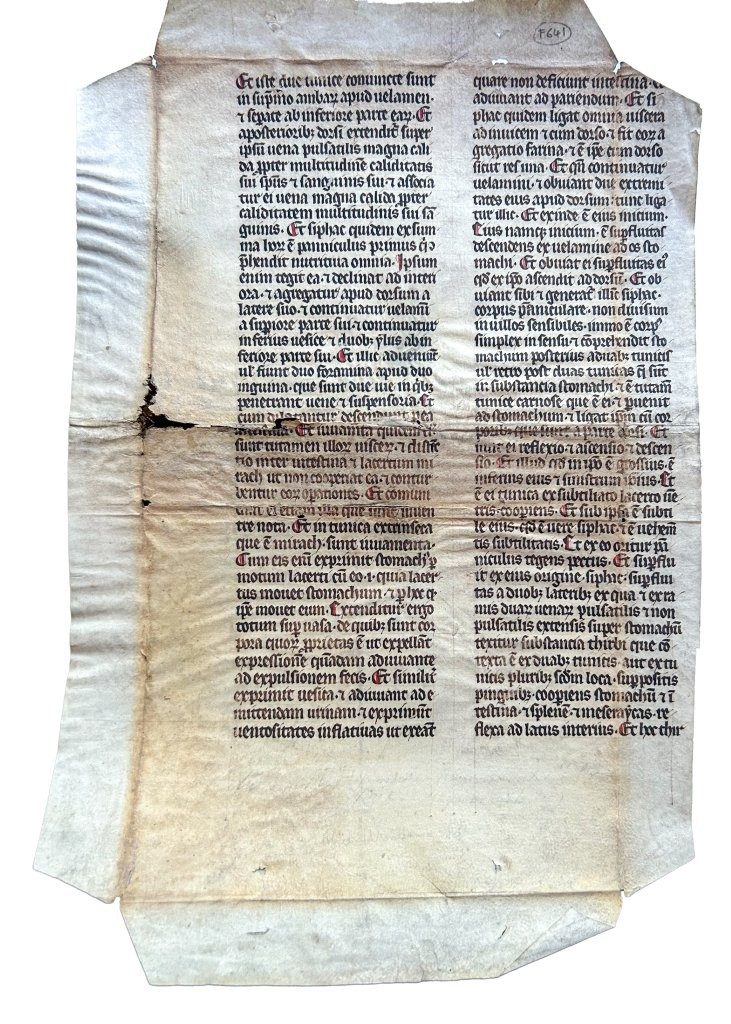
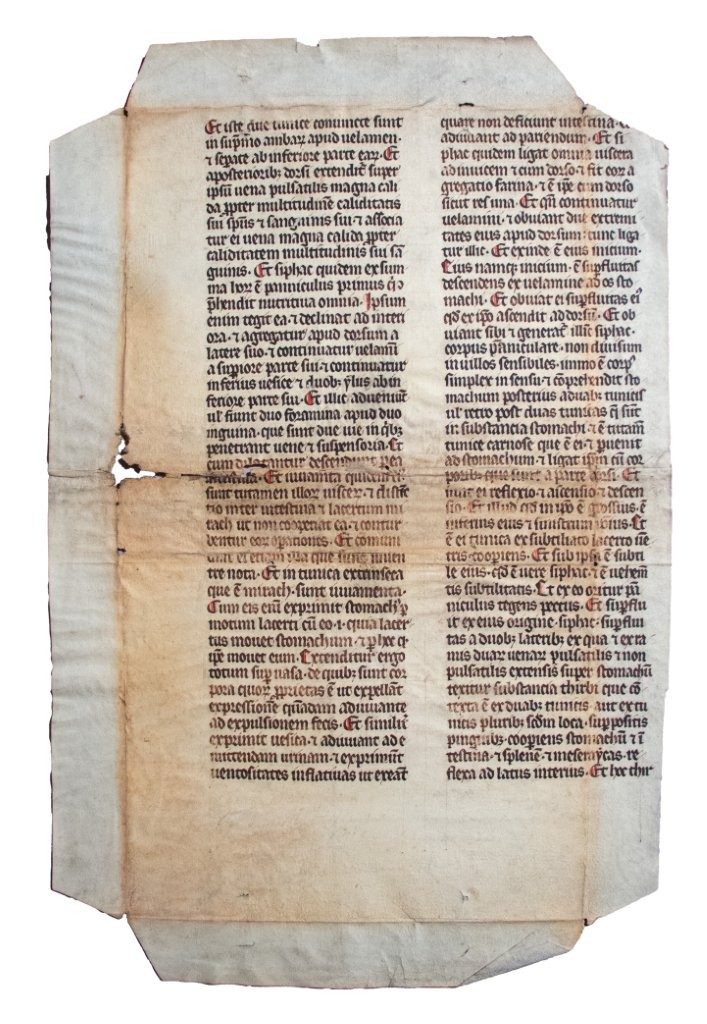
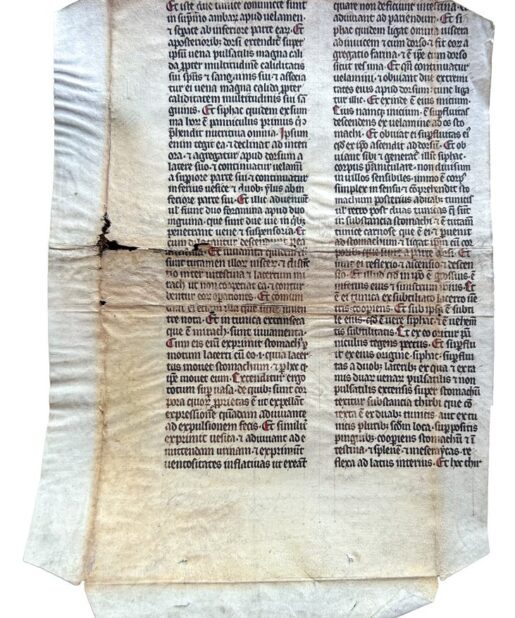
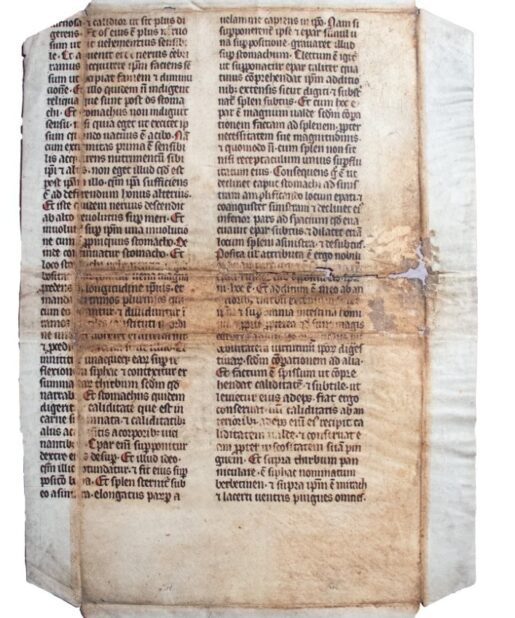
C13th manuscript leaf of Avicenna’s ‘Liber canonis de medicinis’ on parchment, France
£1,800.00
Avicenna [Ibn Sīnā, 980–1037] Liber canonis de medicinis, liber III. In Latin, manuscript on parchment. French, 13th century
Leaf 405 x 260 mm. Writing area 280 x 180 mm.
Description: Text in Gothic script on a double column of 41 lines. The decoration includes the capital letters touched in red ink. Recovered from binding with abrasions, and discolorations especially at verso.
A large single leaf from a medieval Latin translation of Avicenna’s Canon of Medicine, one of the most influential medical texts of the Middle Ages. The present fragment, recovered from a later binding, preserves part of Book III of the Liber Canonis, concerning the anatomy and physiology of
the human body. The recto opens with a discussion of the membranes and veins:
“Et istae duae tunicae coniuncte sunt in supremo ambarum apud velamen: et separate ab inferiore parte earum. Et a posterioribus dorsi extenditur super ipsum vena pulsanti magna calida propter multitudinem caliditatis sui spiritus et sanguinis sui: et associatur ei vena magna calida propter
caliditatem multitudinis sui sanguinis…”
Avicenna (Ibn Sīnā, 980–1037), the Persian polymath, composed the Canon in Arabic in the early 11th century. Its encyclopedic scope, systematic structure, and integration of philosophy with empirical medicine established it as the standard reference in both the Islamic world and medieval Europe for over six centuries.
The section reproduced in this fragment reflects Avicenna’s synthesis of Galenic physiology with his own observations, which would be come foundational to both Islamic and European medical traditions. T he Canon was translated into Latin in the 12th century by Gerard of Cremona, and
it rapidly became the central medical authority in the medieval West, studied in universities from Montpellier and Paris to Bologna and Oxford.
Manuscripts such as this were standard reference works for physicians well into the Renaissance.
Product Enquiry
Related products
C12th - C13th manuscripts
£1,900.00

C14th -C16th manuscripts
£350.00
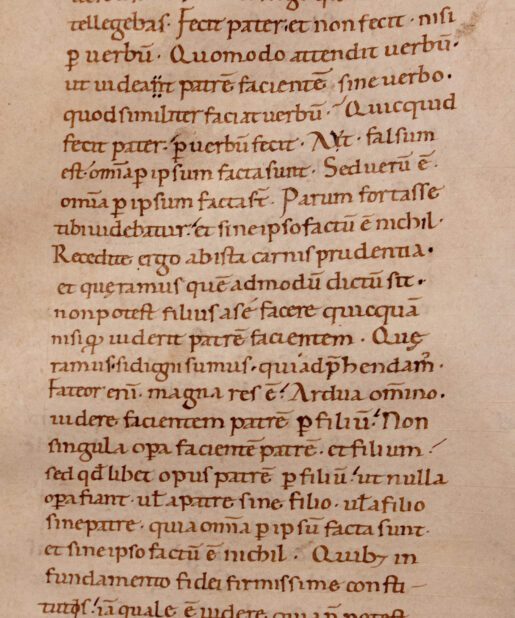
![Two leaves from a Ferial Psalter, in Latin, decorated manuscript on vellum [Germany, mid-12th century]](https://stephenbutler.com/wp-content/uploads/2025/10/IMG_1173-515x618.jpg "Two leaves from a Ferial Psalter, in Latin, decorated manuscript on vellum [Germany, mid-12th century]")
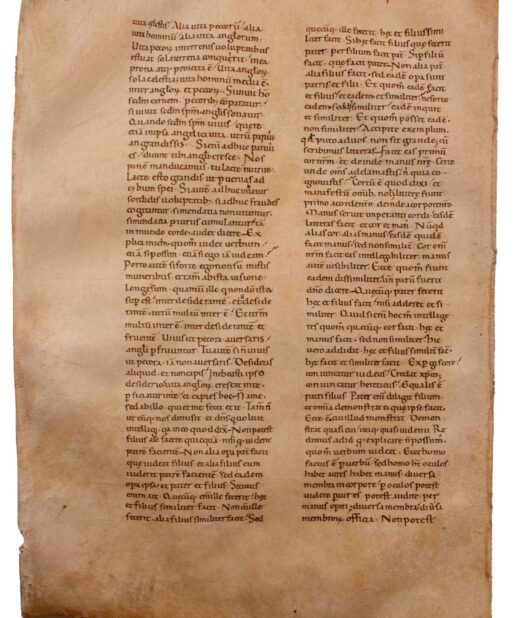
![Two leaves from a Ferial Psalter, in Latin, decorated manuscript on vellum [Germany, mid-12th century]](https://stephenbutler.com/wp-content/uploads/2025/10/IMG_1172-515x618.jpg "Two leaves from a Ferial Psalter, in Latin, decorated manuscript on vellum [Germany, mid-12th century]")
C12th - C13th manuscripts
£2,500.00
![A single leaf; Augustine’s Enarrationes in Psalmos, for Psalm 41:6-8 [manuscript]](https://stephenbutler.com/wp-content/uploads/2021/06/IMG_2115-scaled-515x618.jpg "A single leaf; Augustine’s Enarrationes in Psalmos, for Psalm 41:6-8 [manuscript]")
![A single leaf; Augustine’s Enarrationes in Psalmos, for Psalm 41:6-8 [manuscript]](https://stephenbutler.com/wp-content/uploads/2021/06/IMG_2112-scaled-515x618.jpg "A single leaf; Augustine’s Enarrationes in Psalmos, for Psalm 41:6-8 [manuscript]")
£3,750.00


C14th -C16th manuscripts
Illuminated inital 1500 huge leaf on vellum, from Siena or Florence.
£750.00
![Fragmentary leaf of a Glossed Gospels, in Latin, manuscript on vellum [France(?), 12th century (3rd? quarter)]](https://stephenbutler.com/wp-content/uploads/2024/09/IMG_1175-515x618.jpg "Fragmentary leaf of a Glossed Gospels, in Latin, manuscript on vellum [France(?), 12th century (3rd? quarter)]")
C12th - C13th manuscripts
£1,600.00


C12th - C13th manuscripts
£4,850.00