



This piece has been placed.
Many works of comparable significance pass through our hands each year.
If you’re seeking something similar, please send us an enquiry or browse recent acquisitions.
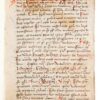
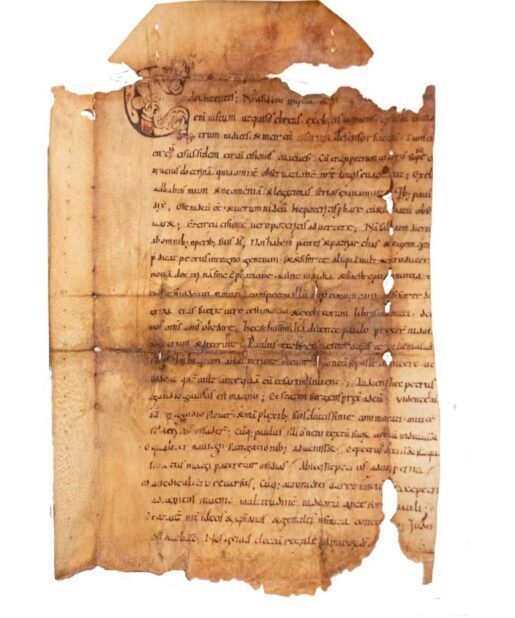
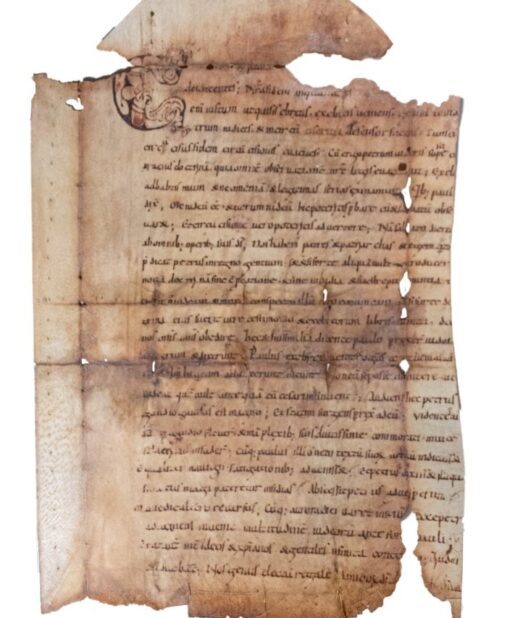
Isidore of Seville (c. 560–636), Etymologiae, Book X, chapters 236–246, with added liturgical rubric.

£9,000.00
Isidore of Seville (c. 560–636), Etymologiae, Book X, chapters 236–246, with added liturgical rubric.
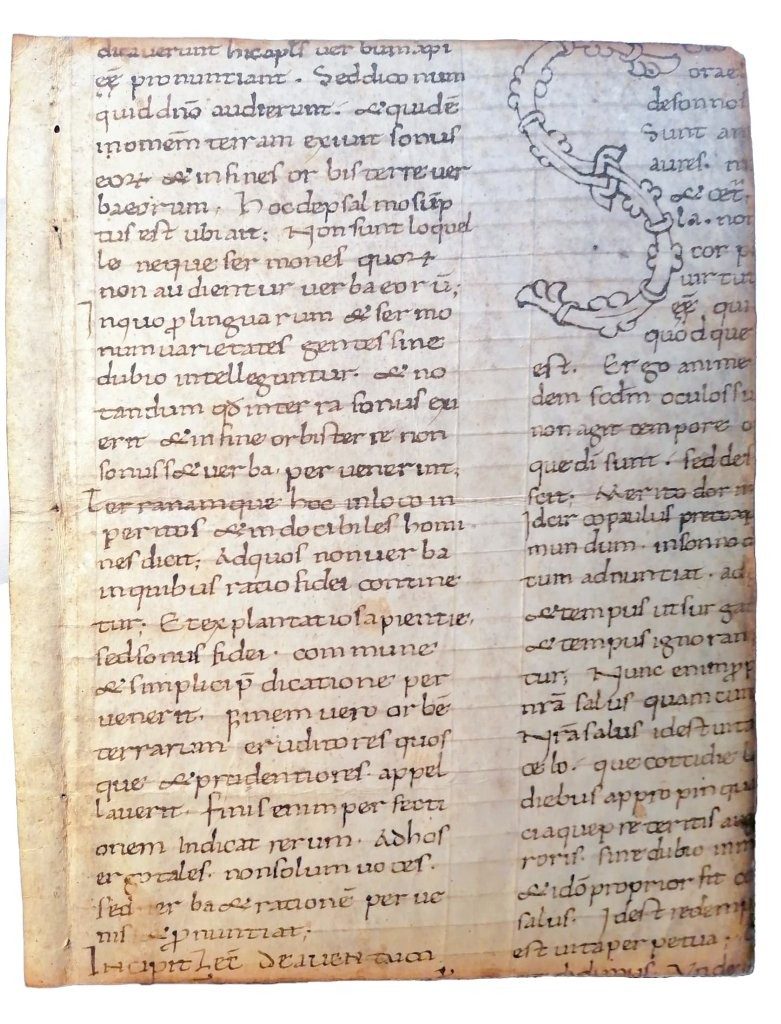
Single manuscript leaf on parchment. Written in a fine Carolingian minuscule, France or Northern Italy, c. 900.
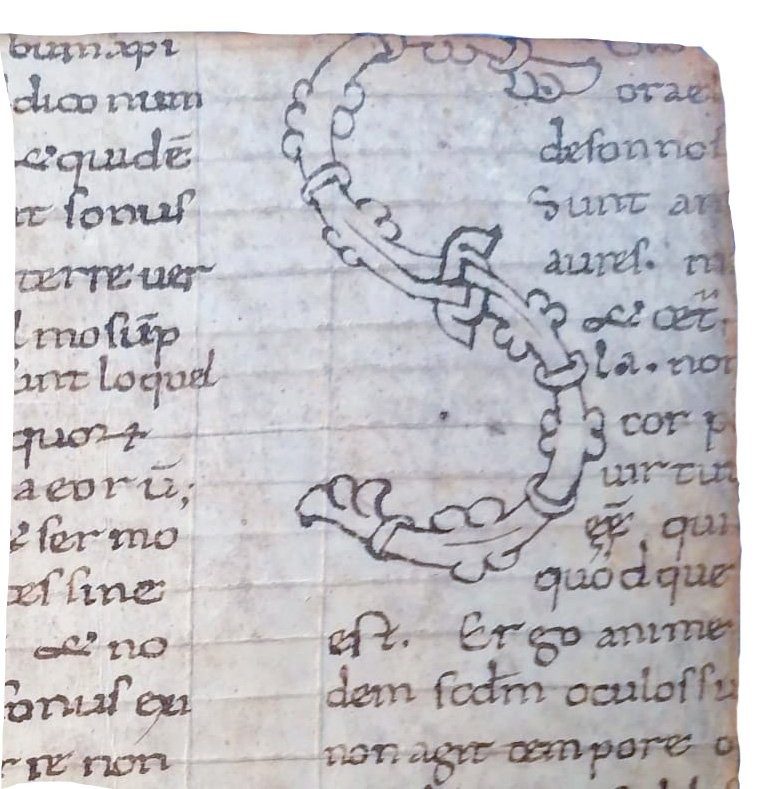
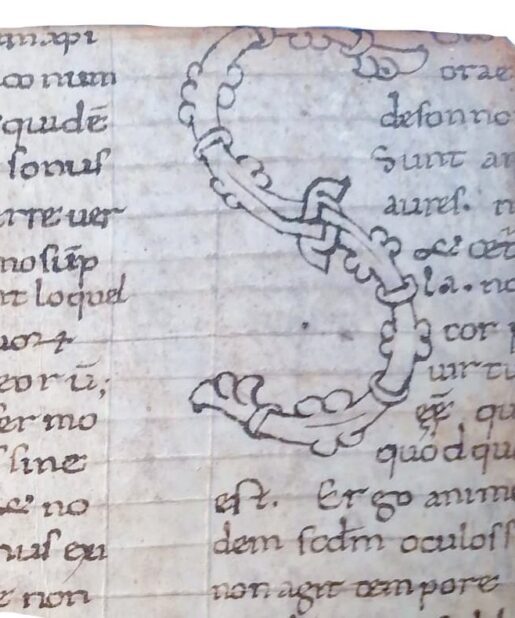
Single leaf (235 × 180 mm), double column, c. 31 lines per column, in a rounded and regular Carolingian minuscule with generous spacing. Ink in a fine brown tone, ruled in drypoint. With a decorative pen-drawn initial “S” in the margin, typical of early Carolingian book art.
Text
This leaf preserves a continuous portion of Isidore’s Etymologiae, Book X (De vocabulis, “On Words”), chapters 236–246, the section defining key concepts of Christian theology and morality:
- Recto (cols. I–II): “Fides dicta est, quia fit quod dicitur… Incredulitas est cum non creditur quod dicitur… Indocibilis est qui doceri non potest” (X.236–242).
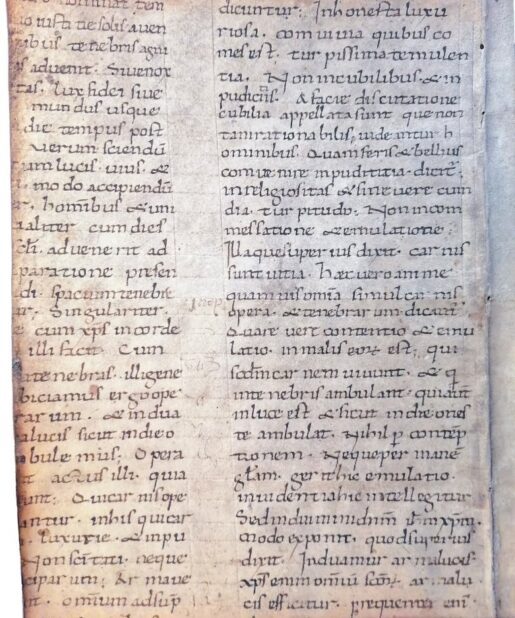
- Verso (col. II): “Pudicitia est servata castitas corporis et mentis. Impudicitia est contra naturam vel extra legitimum thorum coitus…” (X.245–246).
At the end of recto col. I appears the added rubric: “Incipit lectio de aventu” (for de adventu), indicating that the manuscript was adapted for liturgical use, with Isidore’s definitions presented as lectiones.
Thus the leaf represents Isidore’s Etymologiae in a liturgical context, an unusual and fascinating adaptation.
Script and Date
A fully developed Carolingian minuscule, with rounded, open forms, closed “g”, tall ascenders that broaden at the top, and balanced word-spacing. Features point securely to the late 9th century, c. 870–900.
Importance
Isidore’s Etymologiae was the encyclopedia of the Middle Ages, copied in hundreds of manuscripts and consulted in every major Carolingian scriptorium. Its definitions of fides, incredulitas, pudicitia, and impudicitia were central to medieval theology and moral teaching.
The added rubric “Incipit lectio de aventu” shows how monastic communities adapted Isidore’s text for liturgical purposes — an unusual witness to the reception and use of Isidore in the early medieval church.
Condition
Minimal darkening at the margins, slight trimming at outer edges, otherwise excellent condition with clear ink and intact ruling.
Provenance
Re-used as binder’s waste in the covering of a 16th-century printed book; recovered and preserved as a detached leaf.
Bibliography
- Isidore of Seville, Etymologiae, Book X, ed. W. M. Lindsay (Oxford, 1911).
- Patrologia Latina, vol. 82, cols. 383–385.
- M. C. Díaz y Díaz, Isidoriana (León, 1965).
- R. Collins, Isidore of Seville and the Formation of Medieval Culture (Oxford, 2000).
Product Enquiry
Related products
Pre- C12th manuscripts
Coming soon; a selection of C8th, C9th, and C10th manuscripts
C12th - C13th manuscripts
£1,200.00
![Leaf of Passionale in Latin [Italy, 12th century, first half] Lives of St Felicity and St Clement](https://stephenbutler.com/wp-content/uploads/2021/01/IMG_0696-515x618.jpg "Leaf of Passionale in Latin [Italy, 12th century, first half] Lives of St Felicity and St Clement")
C12th - C13th manuscripts
Leaf of Passionale in Latin [Italy, 12th century, first half] Lives of St Felicity and St Clement
£1,200.00

C14th -C16th manuscripts
£350.00
![A leaf from a Psalter, in Latin, manuscript on vellum [Germany, 11th century]](https://stephenbutler.com/wp-content/uploads/2024/09/IMG_1171-515x618.jpg "A leaf from a Psalter, in Latin, manuscript on vellum [Germany, 11th century]")
![A leaf from a Psalter, in Latin, manuscript on vellum [Germany, 11th century]](https://stephenbutler.com/wp-content/uploads/2024/09/IMG_1170-515x618.jpg "A leaf from a Psalter, in Latin, manuscript on vellum [Germany, 11th century]")
![Commentary on Aristotle, Categoriae, and the same authors translation of Perihermenias BOETHIUS [MS] C.13th](https://stephenbutler.com/wp-content/uploads/2013/08/IMG_8383-515x618.jpg "Commentary on Aristotle, Categoriae, and the same authors translation of Perihermenias BOETHIUS [MS] C.13th")
![Commentary on Aristotle, Categoriae, and the same authors translation of Perihermenias BOETHIUS [MS] C.13th](https://stephenbutler.com/wp-content/uploads/2013/08/IMG_8379-515x618.jpg "Commentary on Aristotle, Categoriae, and the same authors translation of Perihermenias BOETHIUS [MS] C.13th")
C12th - C13th manuscripts
£3,800.00