


The Last Surviving Relic of a book recorded in the Library of Bobbio; Pseudo-Marcellus, Italy C10th
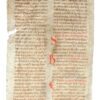
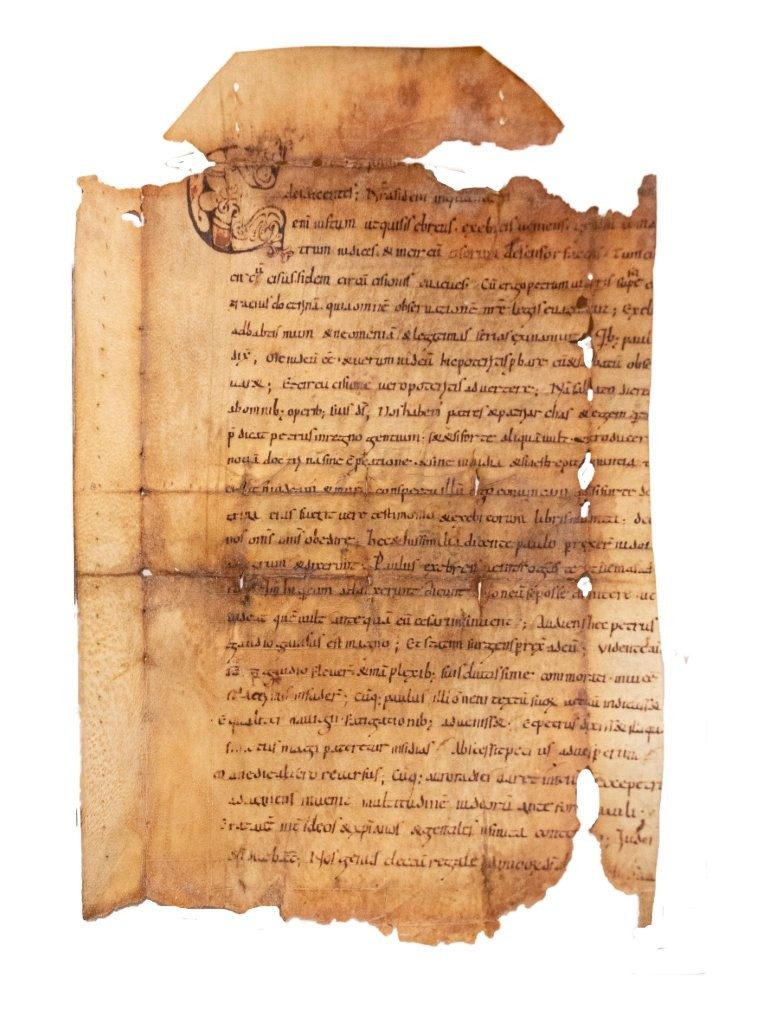
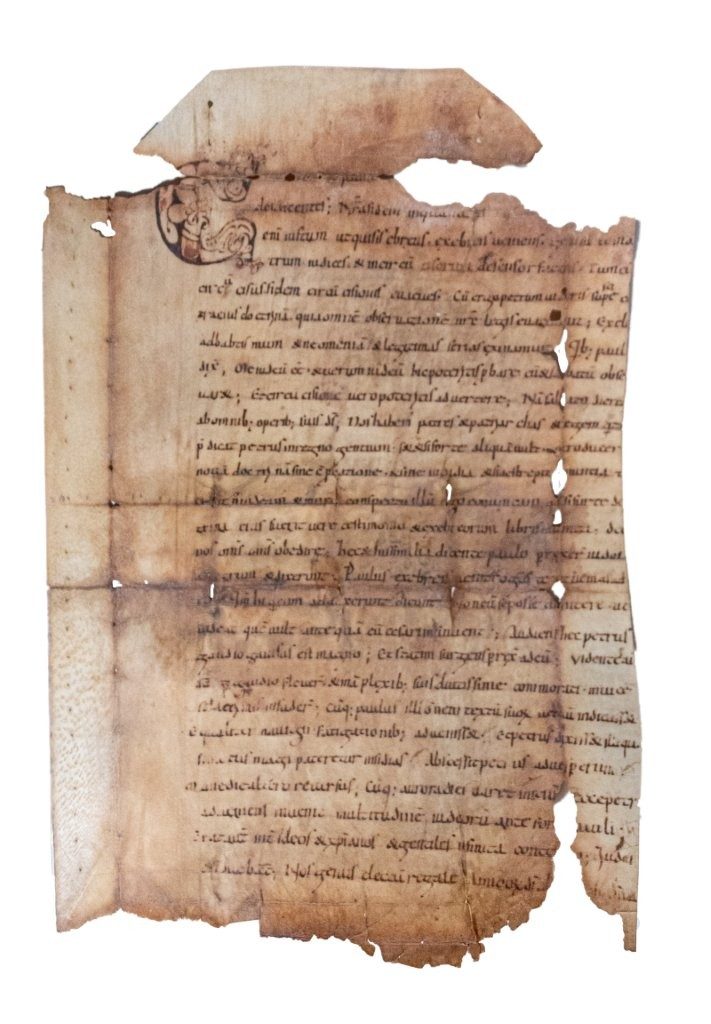
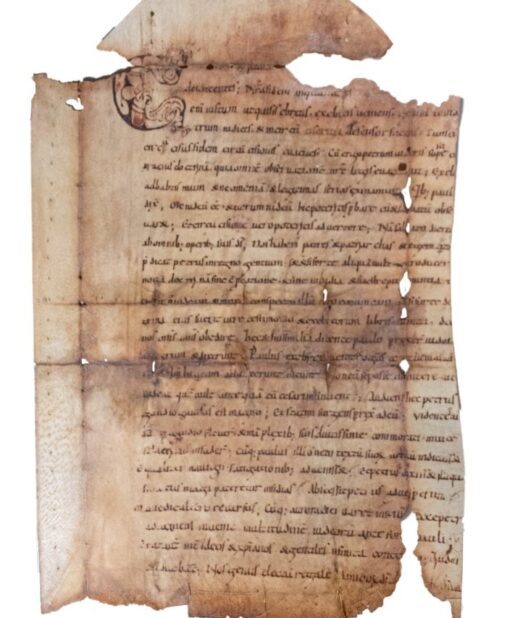
PSEUDO-MARCELLUS. Passio sanctorum Petri et Pauli. Decorated manuscript on parchment. [Italy (probably Bobbio), 10th century]
290 x 200 mm.
Description
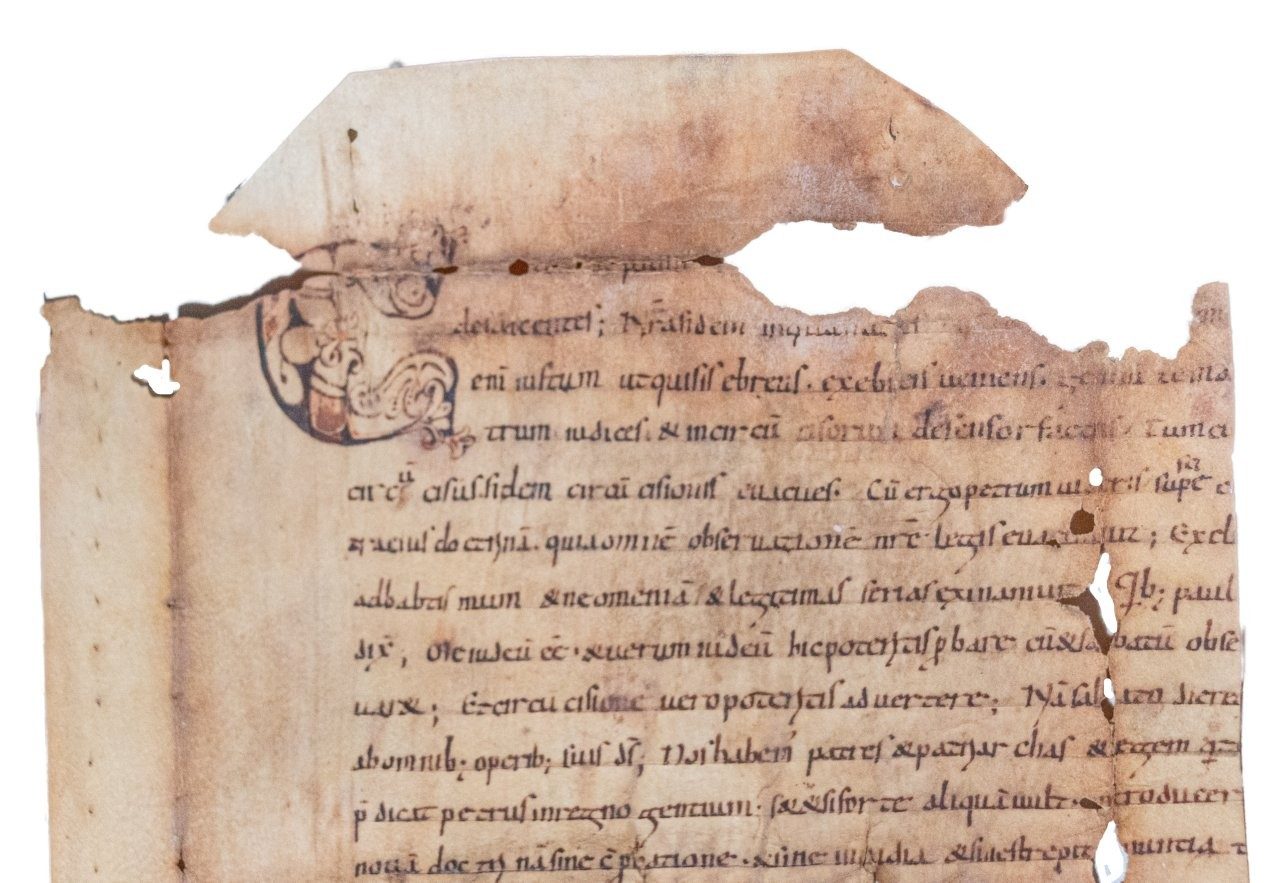
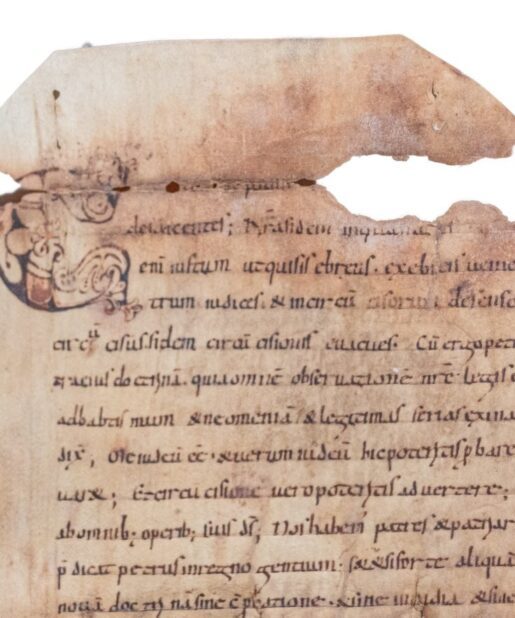
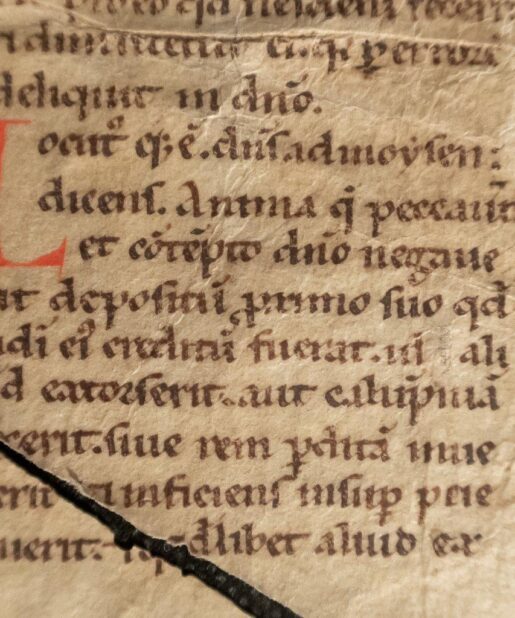
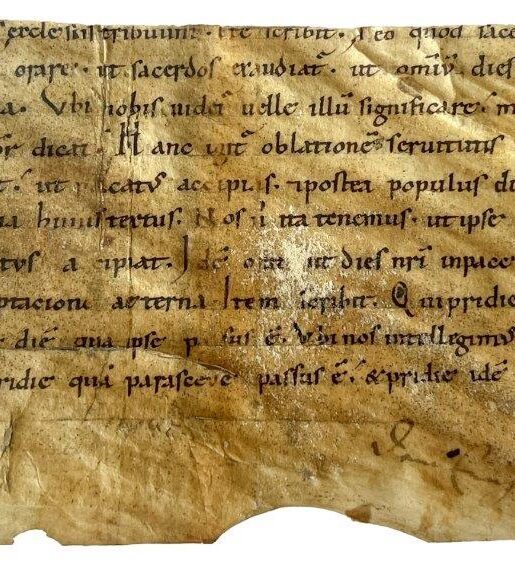
Single leaf, with single column of 27 lines in local variant of an angular Carolingian minuscule which leans to right and has noted lateral compression, with et-ligature used integrally within words, ligature for ‘ri’ formed from an ‘r’ with a final flick of the pen descending far below the line, the hand also preserving Insular-derived features in long ‘r’ and a flourished ‘g’.
Very faded red rubric at head of recto, one large acanthus-leaf initial in Insular-style penwork with pale orange-red wash, formed of elaborate scrolling leafy and petal designs.
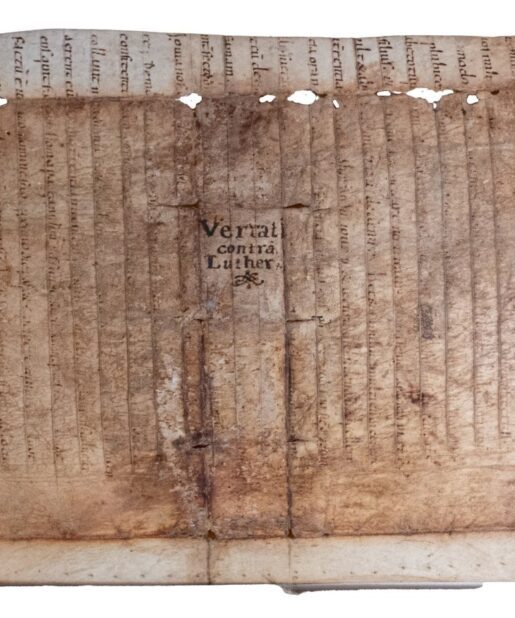
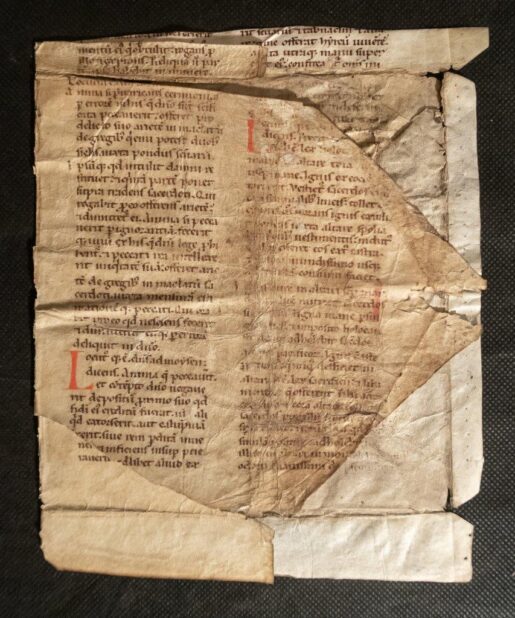
Reused on a later binding of a later printed book and hence with torn edges, holes, scuffs and folds, trimmed at outer vertical edge with loss of a few letters there, much of text rubbed away on reverse with later inscription “Verrati / Contra / Luther”, overall presentable condition.
In cloth-covered binding.
Apocryphal text based on the Acts of St. Peter, in Latin. A fine tenth-century witness to a rare and strange early medieval text; and probably the last surviving relic of a book recorded in the library of Bobbio.
Text
This is a strange late fifth- or early sixth-century narrative, apparently intended to project Paul into the events of the Acts of St. Peter, in which it describes his journey from the island of Gaudomeleta to Rome and erroneously states that Peter was Paul’s brother. It claims to have been written in part by one Marcellus; intended to be the namesake disciple of Simon Magus, whose confrontation with Peter is recorded in Acts 8:9- 24. It was known to Jacobus de Voragine, and widely disseminated in the West in the Middle Ages, appearing in two Anglo-Saxon translations (Ælfric’s Passio Apostolorum Petri et Pauli and Blickling homily no. 15, Spel Be Petrus & Paulus).
Provenance
1 Probably produced for use in the Benedictine Abbey of SS. Peter and Paul, Bobbio, in Emilia Romagna, Italy. The abbey was founded by St. Columban in 614, and by the tenth century housed one of the finest libraries in the West. While the form of the initial and other Insular influences in script here can be found in pre-Carolingian books produced in Irish foundations throughout Europe, the present leaf is north Italian, and in 1993 Prof. Rosamund McKitterick noted the parallels between this initial and those in tenth-century books produced at Bobbio.
2 Sotheby’s, 23 June 1993, lot 3.
3 Schøyen Collection, London and Oslo, their MS 1679.
Product Enquiry
Related products
Pre- C12th manuscripts
Coming soon; a selection of C8th, C9th, and C10th manuscripts
C12th - C13th manuscripts
£1,200.00

C14th -C16th manuscripts
£350.00
![Leaf from a Romanesque Portable Lectionary In Latin, manuscript on vellum [Italy, first half of the 11th century]](https://stephenbutler.com/wp-content/uploads/2026/05/C57A7942-515x618.jpg "Leaf from a Romanesque Portable Lectionary In Latin, manuscript on vellum [Italy, first half of the 11th century]")
![Leaf from a Romanesque Portable Lectionary In Latin, manuscript on vellum [Italy, first half of the 11th century]](https://stephenbutler.com/wp-content/uploads/2026/05/C57A7586-515x618.jpg "Leaf from a Romanesque Portable Lectionary In Latin, manuscript on vellum [Italy, first half of the 11th century]")


C12th - C13th manuscripts
Beautiful painted white vine initial, Augustine’s Commentary on John’s Gospel, Italy C12th
£3,800.00
C14th -C16th manuscripts
Finely produced illuminated leaf from a French Psalter c.1480
£550.00
![Saints Peter and Paul, in an illuminated historiated initial ‘N’, cut from a Gradual in Latin on parchment [Italy (Florence); 15th century (c.1470s)]](https://stephenbutler.com/wp-content/uploads/2022/02/IMG_6782-515x618.jpg "Saints Peter and Paul, in an illuminated historiated initial ‘N’, cut from a Gradual in Latin on parchment [Italy (Florence); 15th century (c.1470s)]")
![Saints Peter and Paul, in an illuminated historiated initial ‘N’, cut from a Gradual in Latin on parchment [Italy (Florence); 15th century (c.1470s)]](https://stephenbutler.com/wp-content/uploads/2022/02/IMG_6781-515x618.jpg "Saints Peter and Paul, in an illuminated historiated initial ‘N’, cut from a Gradual in Latin on parchment [Italy (Florence); 15th century (c.1470s)]")