

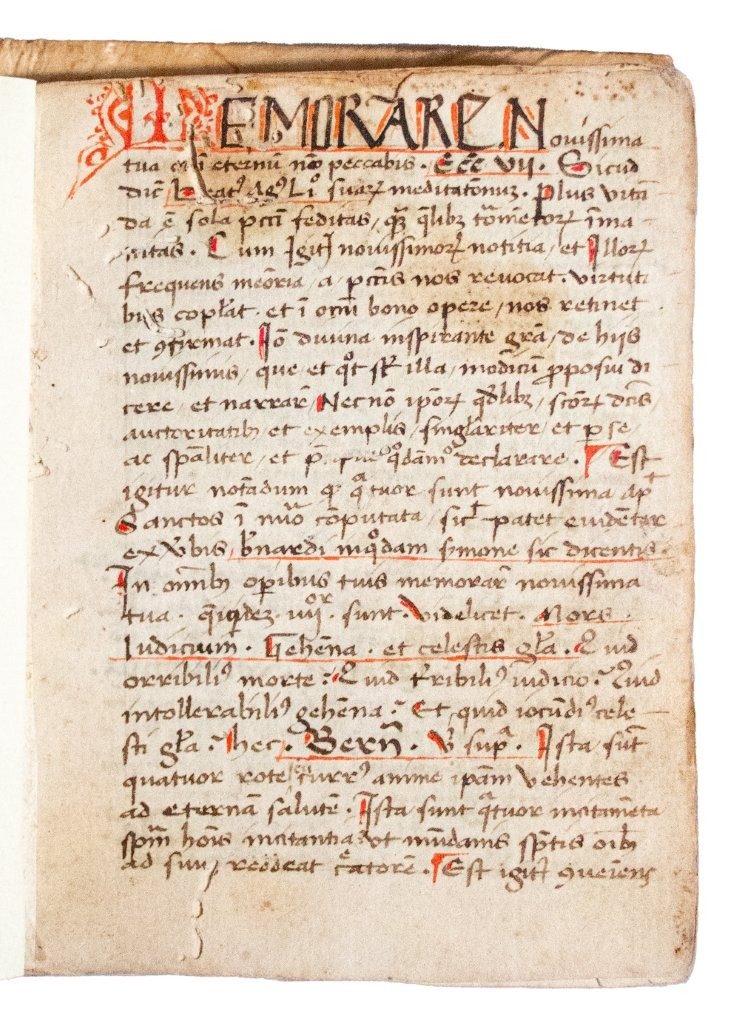
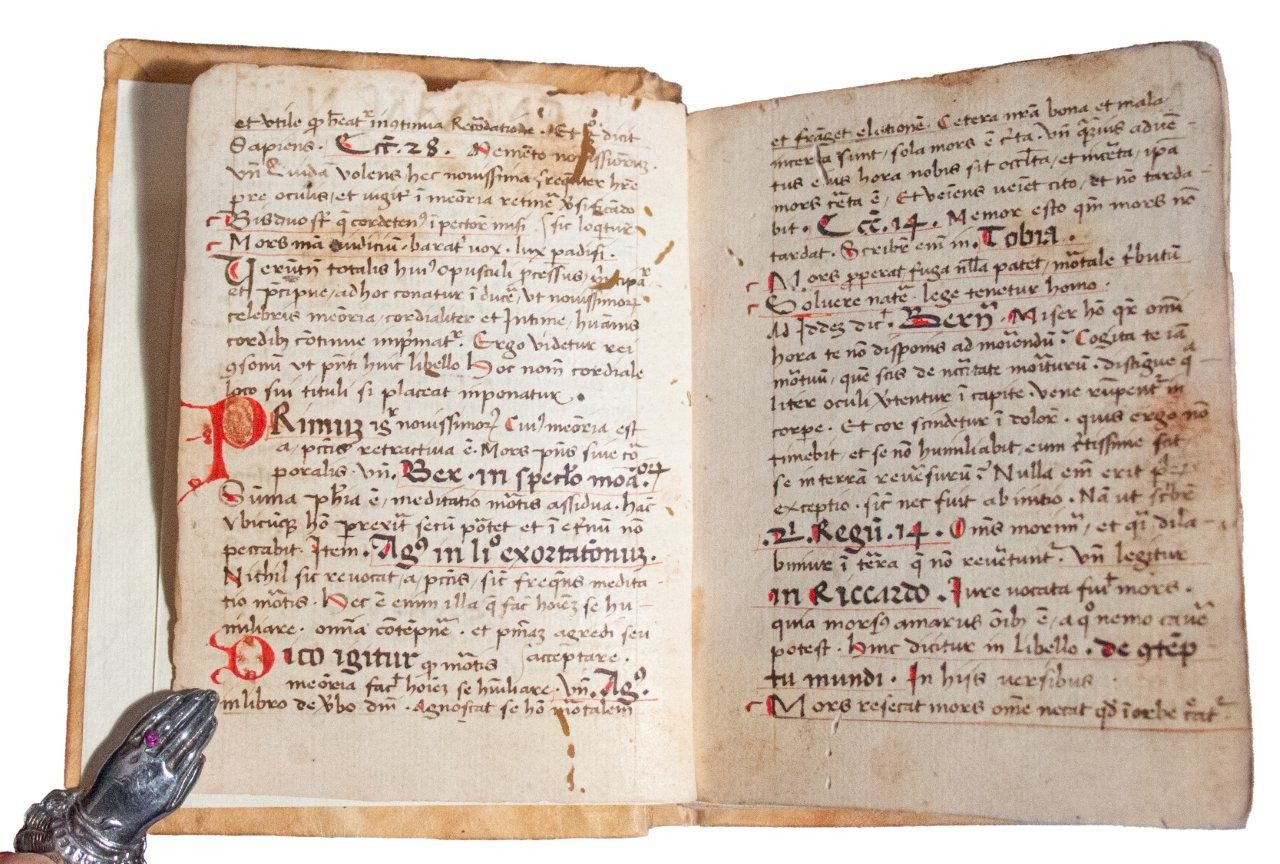
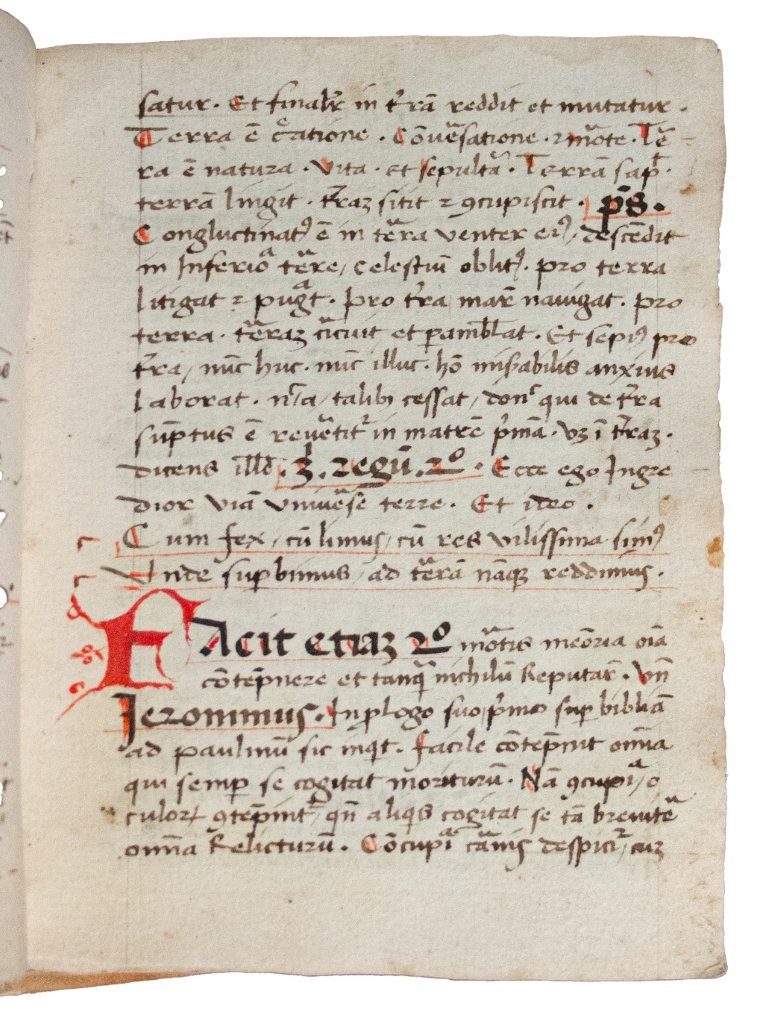
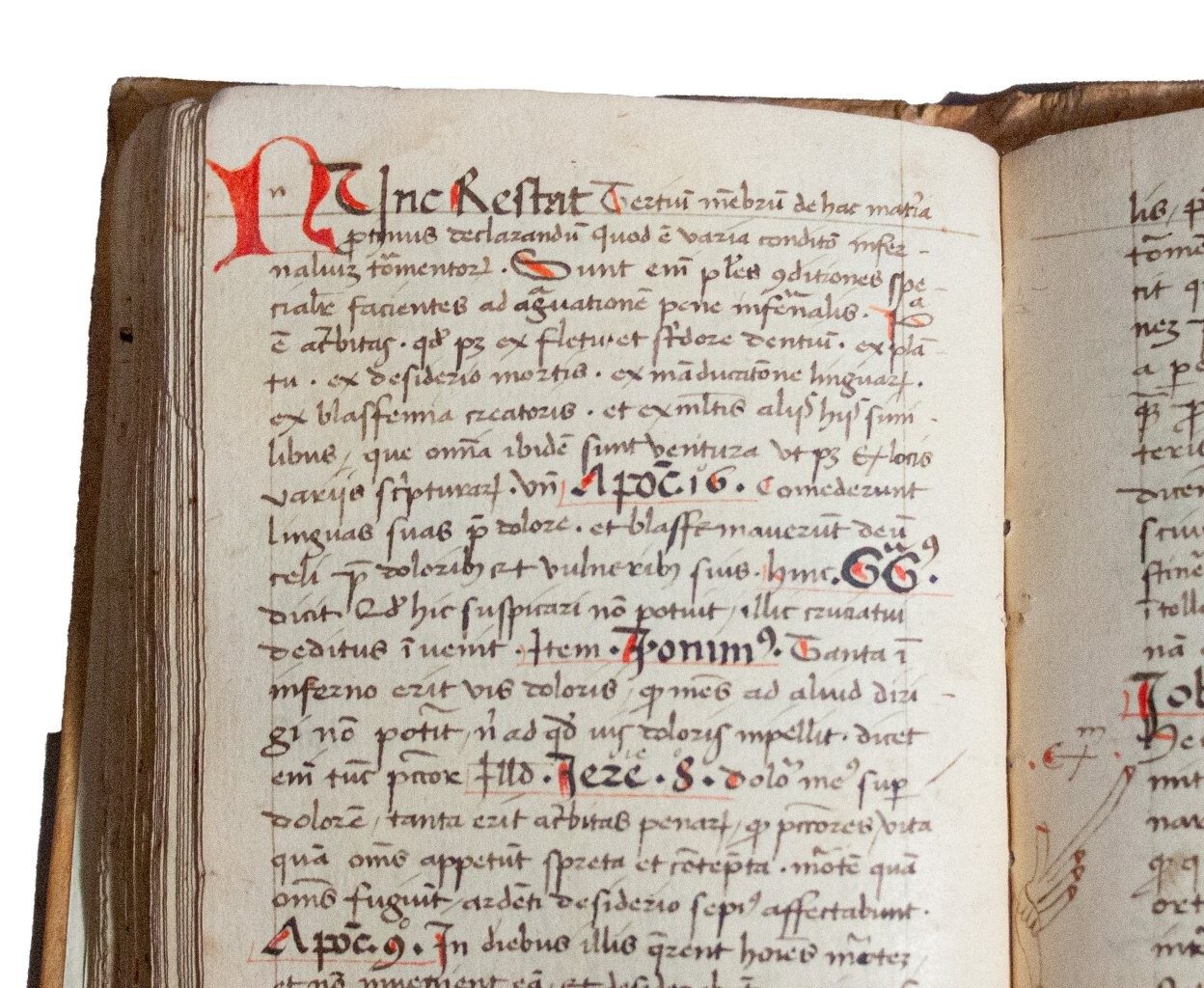
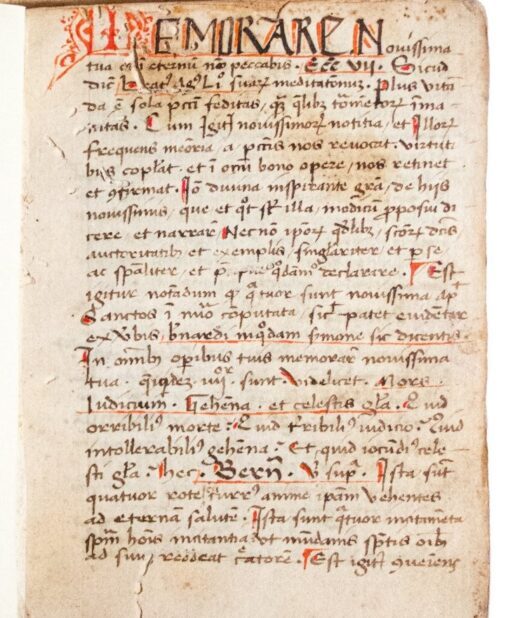
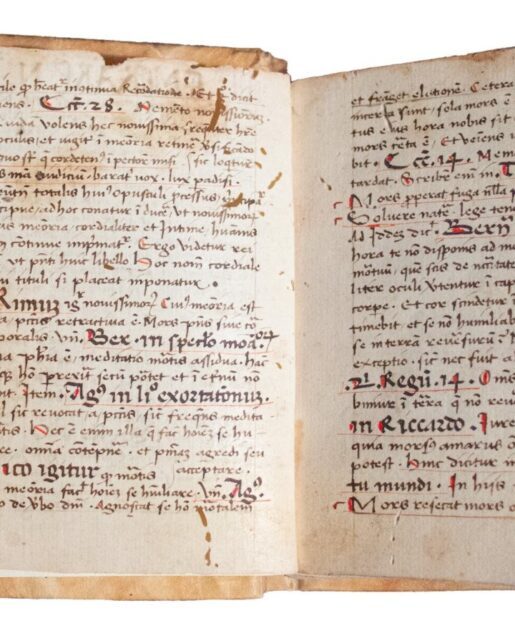
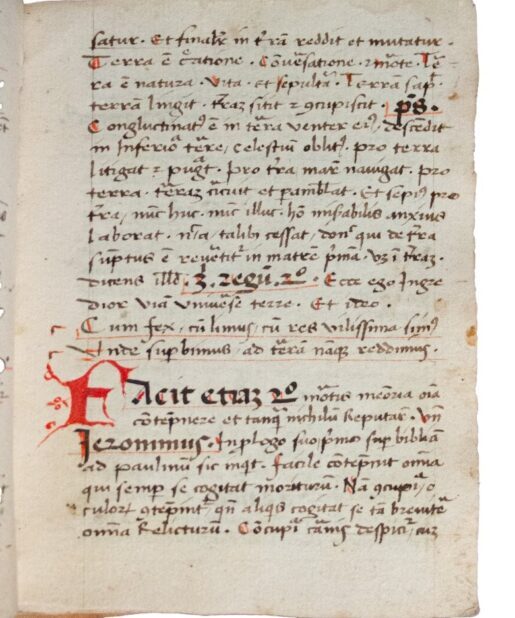
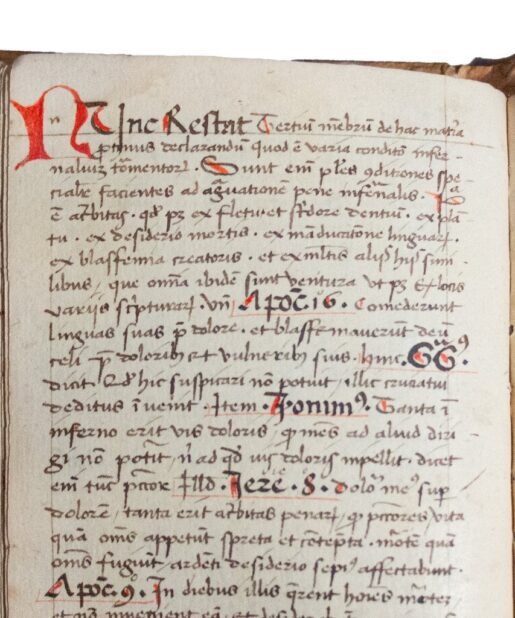
Gerard van der Vlyderhoven, Cordiale (‘For the heart’ on the four ultimate things of life: Death, Judgment, Eternal Glory and Hell), also known as De Quatuor Novissimis, in Latin, Italy, mid-C15th
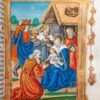
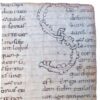
Gerard van der Vlyderhoven, Cordiale (‘For the heart’ on the four ultimate things of life: Death, Judgment, Eternal Glory and Hell), also known as De Quatuor Novissimis, in Latin, manuscript on paper
[Italy, fifteenth century (probably mid)]
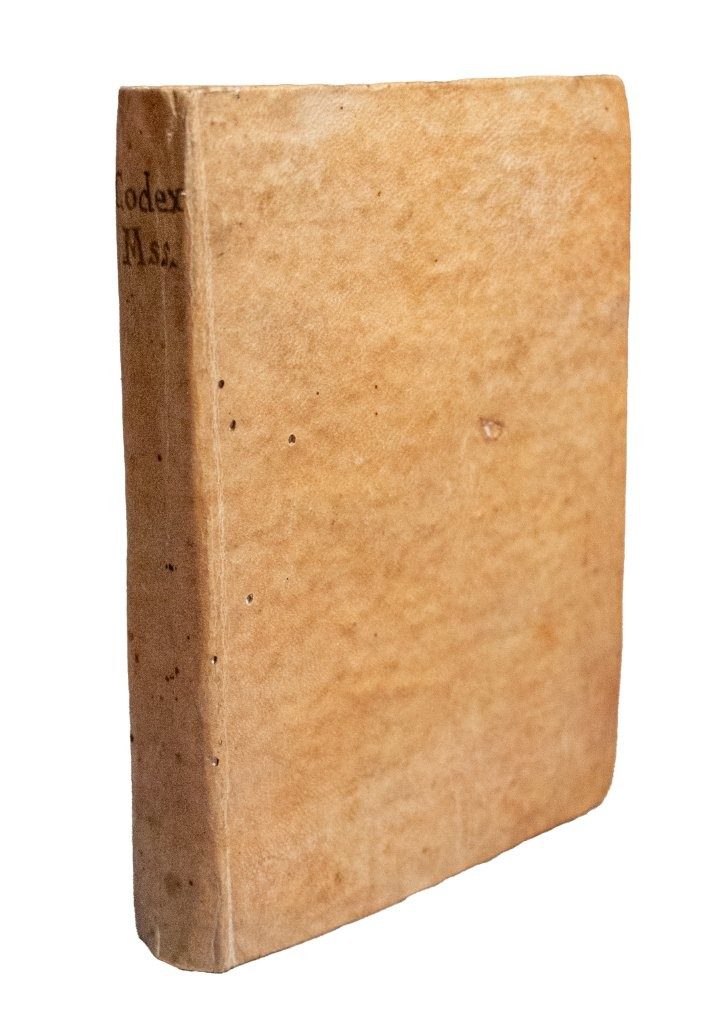
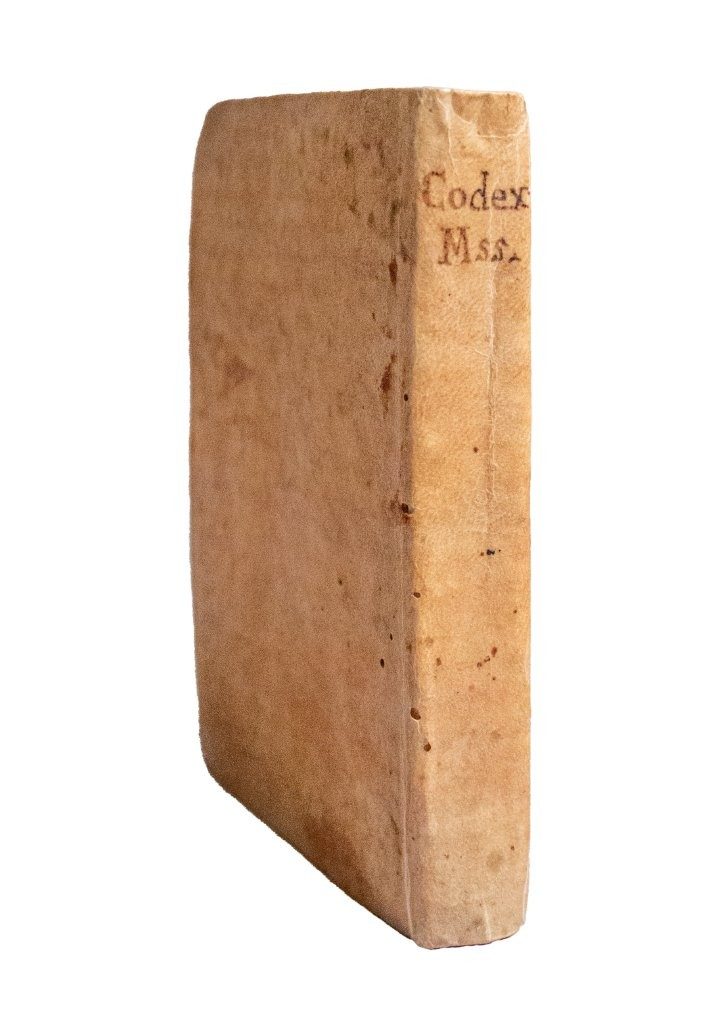
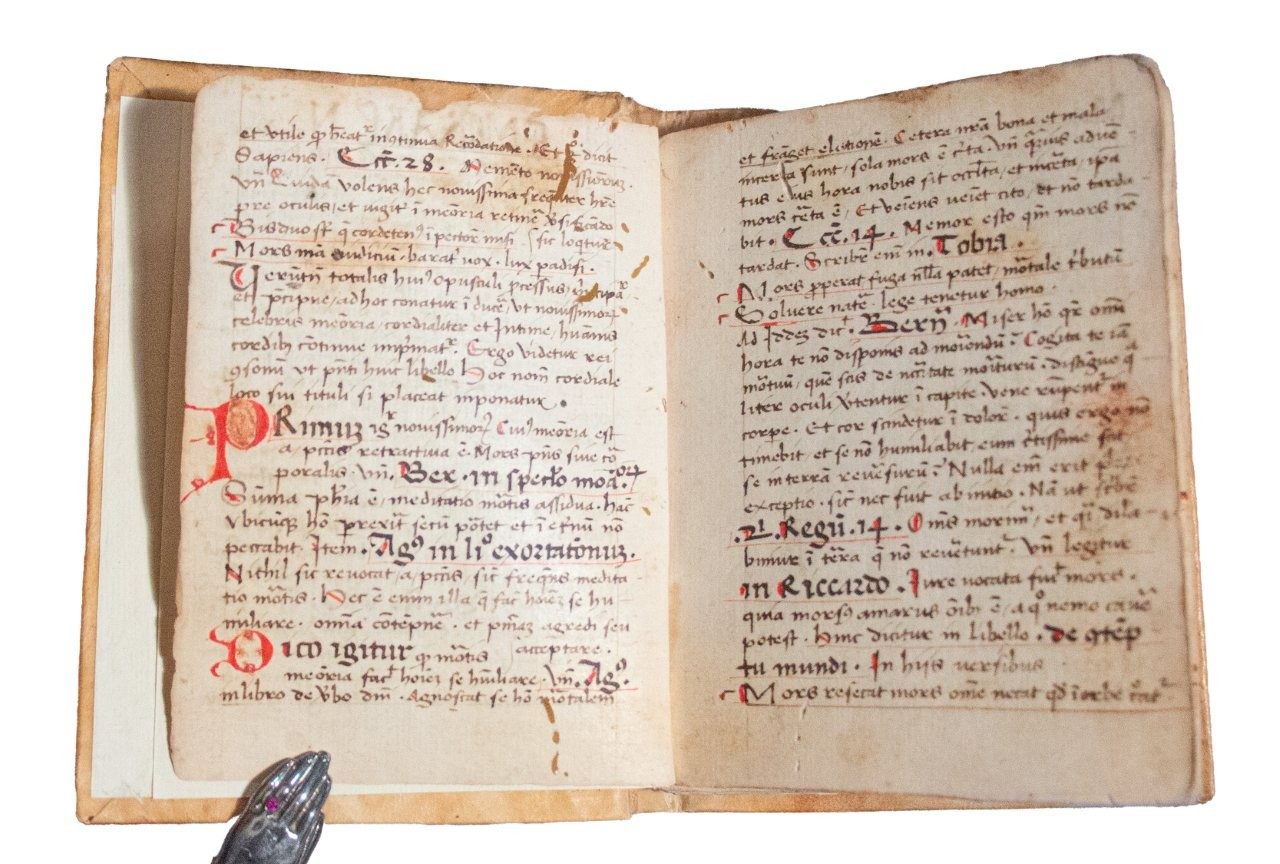
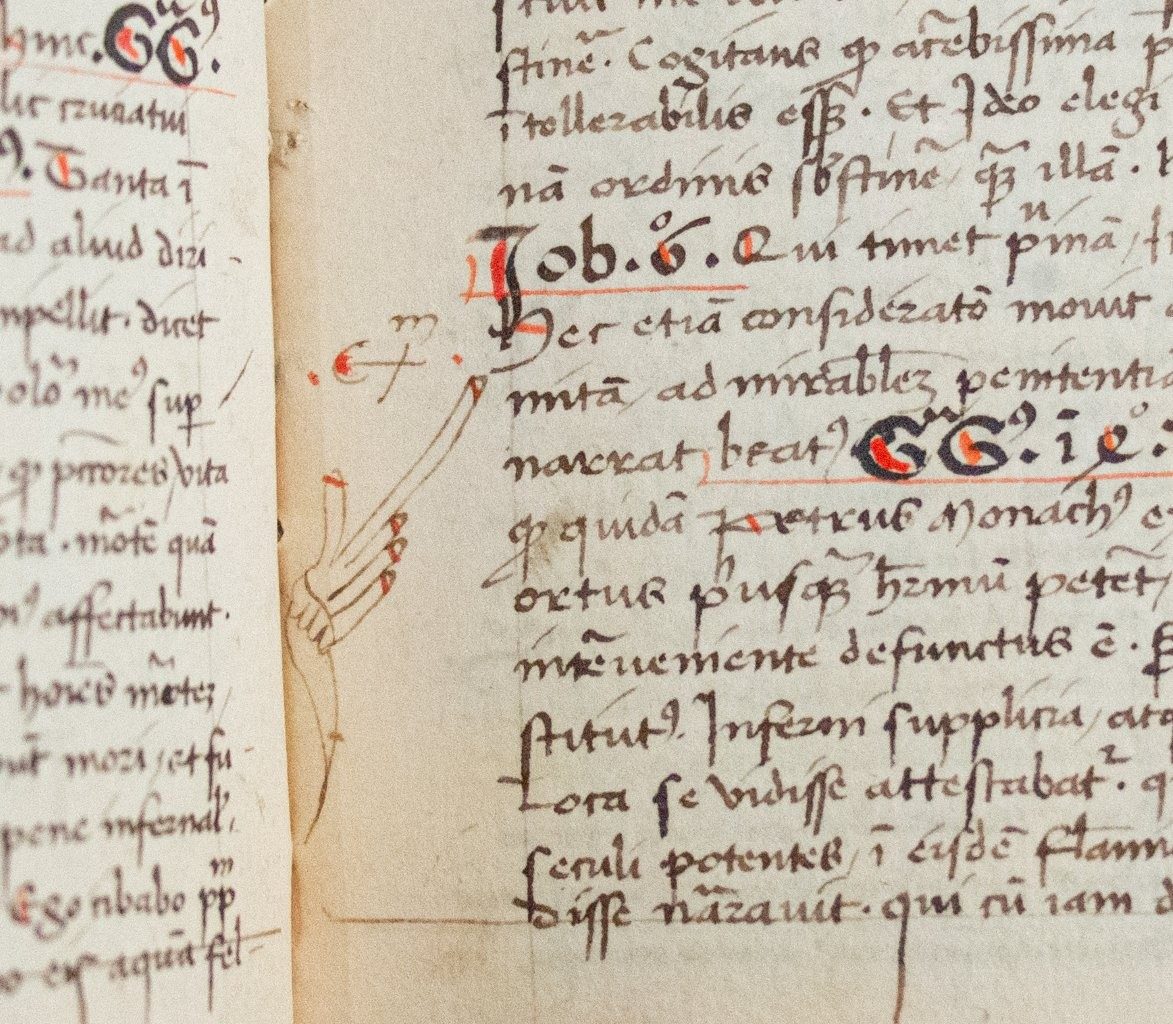
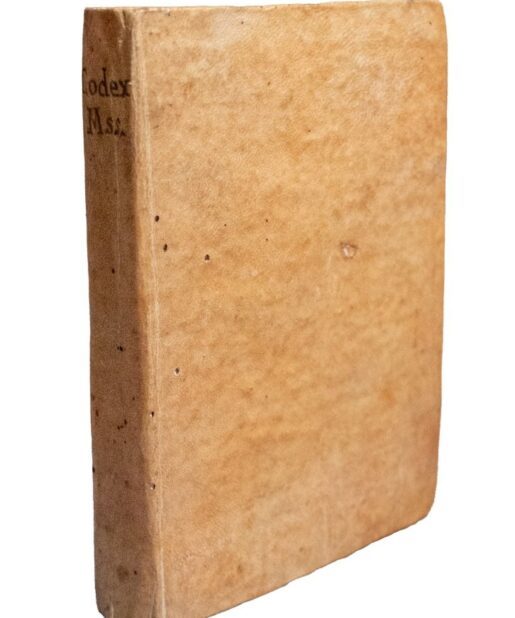
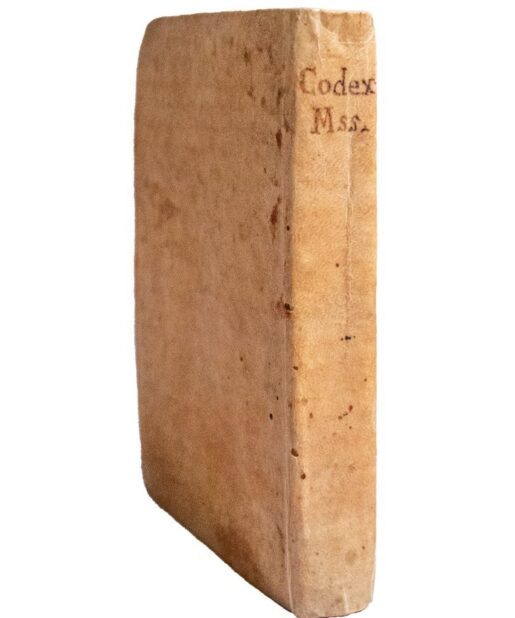
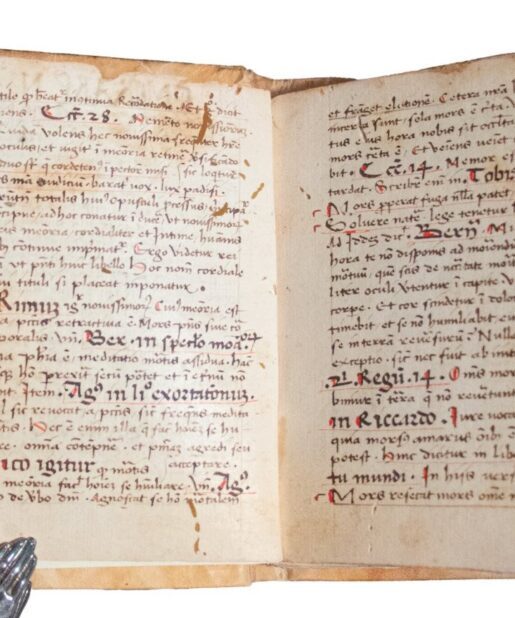
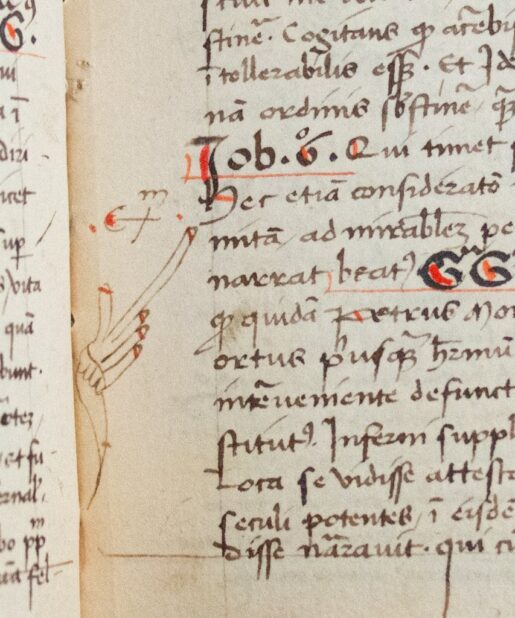
70 leaves (plus one modern paper endleaf at front, and three at back), complete, collation: i13 (first leaf a blank cancel), ii16, iii16, iv14, v11 (last 5 leaves blank cancels), text in single column of 23-24 lines of a small bookhand influenced by secretarial letterforms, opening words of important sections of text in larger version of same with capitals touched in red, explicit in capitals touched in red, quotations underlined in red, red paraph marks and initials, delicate ‘Nota’ marks and manicula marks in margins, innermost and outermost surfaces of quires strengthened with strips of vellum (apparently reused from an earlier charter), paper with chainlines but no watermarks, some leaves towards end almost loose in volume, first and last leaves with a few wormholes, some small spots and stains, 120 by 95mm.; loose in binding of vellum over thin pasteboards (perhaps nineteenth-century), ‘Codex Mss.’ on spine in modern pen, endleaves much wormed
Provenance:
- Copied for a devout in the fifteenth century, most probably from a manuscript. Numerous incunable editions exist, but where checkable these are set apart from the present witness by the arrangement of parts of the text in columns of lines as opposed to flowing prose and lack of certain prominent rubrics given by the printed text, as well as the ending of the text with “AMEN” here and variant colophon (“Expliciunt Quatuor Novissima. Deo Gratias A.M.E.N. finis Cordialis hic” here). In addition, Jacob Cornelis van Slee, in his 1896 assessment of the text, claimed to know of a pre-1500 Italian printing from Venice (‘Vliederhoven, Gerhard van’ in Allgemeine Deutsche Biographie 40, 1896, pp. 89-90), which might just have been the exemplar for the present manuscript. This was most probably the exceedingly rare printing made by “Vindel. de Spira” in Venice c. 1477 (Hain 5691; most probably Vindilinus/Wendelin de Spira/Speyer who operated alongside his brother Johannes in Venice in 1468-70, and thereafter alone there until 1477), but no copy is recorded on the ISTC and we have been unable to trace a copy for direct comparison.[1] That said, an anonymous edition produced in Speyer in 1471 is most likely to have been the model for the Venetian printing, and that shows significant variation from this manuscript in its arrangement and ending.[2]
- This codex re-emerging recently in a private Swedish collection, most probably acquired in Europe in first half of the twentieth century.
Text:
The probable author, Gerard van der Vlyderhoven (d. c. 1402), is identified by the colophons of the oldest manuscripts of the text. He was Procurator of the House of the Order of Teutonic Knights at Utrecht in the years 1380-1396, as well as a mystic author. This work explains how the consideration of the four subjects mentioned should prevent men from sinning, and it became one of the foundation-stones of the philosophy of the Devotio moderna movement in the Low Countries in the fifteenth century. It appears to have been proscribed collective reading in a number of monastic sites in that region, including, as the chronicler Jean Busch records, the crucial Windesheim Abbey during mealtimes. It was composed in the tradition of Dominican preaching materials and cites the Bible some 700 times alongside Church Fathers such as Jerome, Augustine, Johannes Chrysostom and Gregory the Great, as well as medieval theologians such as Bernhard of Clairvaux, Petrus Riga, Peter of Blois and Anselm, and the few Classical authors approved by the medieval Church, such as Seneca and the ‘Distichs of Cato’. For a modern study of the work, see Stefan Abel, ‘Memorare novissima tua. Vom Umgang mit der Zeit in Gerards van Vliederhoven ›Cordiale de quatuor novissimis‹ aus dem Umkreis der Devotio moderna’, in Die Zeit der letzten Dinge. Deutungsmuster und Erzählformen des Umgangs mit Vergänglichkeit in Mittelalter und Früher Neuzeit, Göttingen, 2020, pp. 165-94.
The text work was wildly popular and is recorded in 178 Latin manuscripts in institutional hands (listed by M. Dusch, De Veer Utersten: Das Cordiale de quatour novissimis von Gerhard von Vliederhoven, Cologne, 1975, pp. 40-57), overwhelmingly from the Low Countries and Germany. Only two listed by Busch potentially also record an Italian manuscript tradition (Dusch’s no. 22: Belluno, Bibi. Lolliniana, MS. 21, of the fifteenth century: G. Mazzatinti, Inventari dei manoscritti delle biblioteche d’Italia, II, 1892, p. 122; and no. 138: Ravenna, Bibl. Communale, MS. 84: ibid., IV, 1894, p. 162). In addition, while the variant titles of the work and the fact that some of those are shared with other devotional texts obfuscates the production of a comprehensive list, the Schoenberg database records another four codices in the trade records, that are likely to contain the work: (i) a late fifteenth-century copy once owned by Giacomo Manzoni (1816-89), and last seen in the auction of the library of Guiseppe Sangiorgi on 23 April 1894, lot 93; (ii) a Czech copy of c. 1406 offered by Erik von Scherling in Rotulus I:3 (1931), no. 1178; (iii) that in a compendium dated c. 1464 and from the Buxheim Charterhouse, offered by Jacques Rosenthal in 1899 and 1903; and (iv) another apparently different copy in another compendium from the Buxheim Charterhouse, dated 1459-61, and offered by the Munich bookdealer J. Halle, in his cat. 50 (1914), no. 28, and now in Harvard. Some forty incunable editions exist of either the Latin or the Dutch text, including important printings in Cologne in 1477 (by Petrus de Olpe)[3] and Deventer in 1494 (by Jacobus de Breda).[4] Translations into German, French (by Jean Mielot and Thomas le Roy), English (by Anthony Woodville), Spanish and Catalan existed by 1500.
The text opens with: “Memorare novissima tua et …”, and ends with: “… et intelligerent ac novissima providerent” (here followed by ‘AMEN’ and the colophon: “Expliciunt Quatuor / Novissima. Deo Gratias / A.M.E.N. / Finis Cordialis hic”).
_____________________________________________________________________________________________________________________________________
[1] One was recorded in the eighteenth century in the collection of M. Pierre-Antoine Bolongaro-Crevenna, his no. 889 in the sale-catalogue of his library (Catalogue des livres de la bibliothéque de M. Pierre-Antoine Bolongaro-Crevenna, Amsterdam, 1789), where it is recorded that the book was printed without date, place or printer, but in the print-type used by ‘Vindelinus de Spira’ in Venice in 1477.
[2] See digitised copy in Munich: https://www.digitale-sammlungen.de/en/view/bsb00042234?page=,1
[3] See digitised copy in University of Jena: https://dhb.thulb.uni-jena.de/rsc/viewer/ufb_derivate_00000073/Inc_101_1_00001.tif?logicalDiv=log_ufb_derivate_00000073
[4] See digitised copy in Cologne Cathedral: https://digital.dombibliothek-koeln.de/ddbkhd/content/pageview/732742
Product Enquiry
Related products
C14th -C16th manuscripts
Single leaf from the so-called ‘Carondelet Breviary’ 1458 from the scribe Jean d’Aussert
£600.00


C12th - C13th manuscripts
Beautiful painted white vine initial, Augustine’s Commentary on John’s Gospel, Italy C12th
£3,800.00

![Leaf from Baldo degli Ubaldi (1327–1400), Sextum codicis librum commentaria [Italy, late 15th century]](https://stephenbutler.com/wp-content/uploads/2023/07/IMG_0101-515x618.jpg "Leaf from Baldo degli Ubaldi (1327–1400), Sextum codicis librum commentaria [Italy, late 15th century]")
C14th -C16th manuscripts
£800.00
![Saints Peter and Paul, in an illuminated historiated initial ‘N’, cut from a Gradual in Latin on parchment [Italy (Florence); 15th century (c.1470s)]](https://stephenbutler.com/wp-content/uploads/2022/02/IMG_6782-515x618.jpg "Saints Peter and Paul, in an illuminated historiated initial ‘N’, cut from a Gradual in Latin on parchment [Italy (Florence); 15th century (c.1470s)]")
![Saints Peter and Paul, in an illuminated historiated initial ‘N’, cut from a Gradual in Latin on parchment [Italy (Florence); 15th century (c.1470s)]](https://stephenbutler.com/wp-content/uploads/2022/02/IMG_6781-515x618.jpg "Saints Peter and Paul, in an illuminated historiated initial ‘N’, cut from a Gradual in Latin on parchment [Italy (Florence); 15th century (c.1470s)]")
C12th - C13th manuscripts
Miniature Breviary leaf with unusual and handsome script, c.1280
£1,500.00
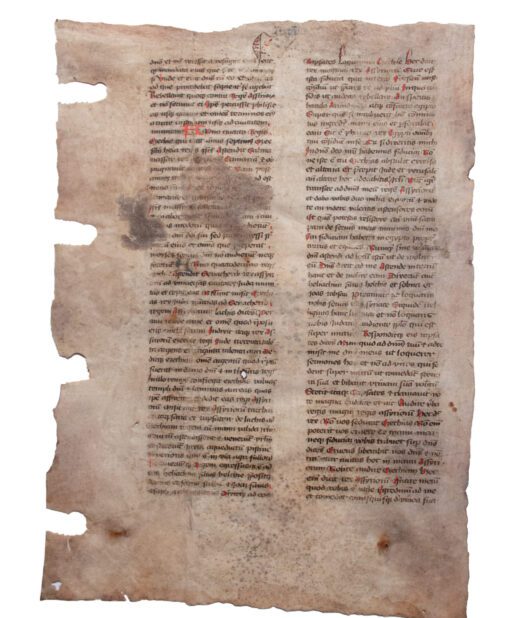
C14th -C16th manuscripts
Leaf from a Bible, II Kings 17, C15th manuscript in Latin on parchment
£750.00