


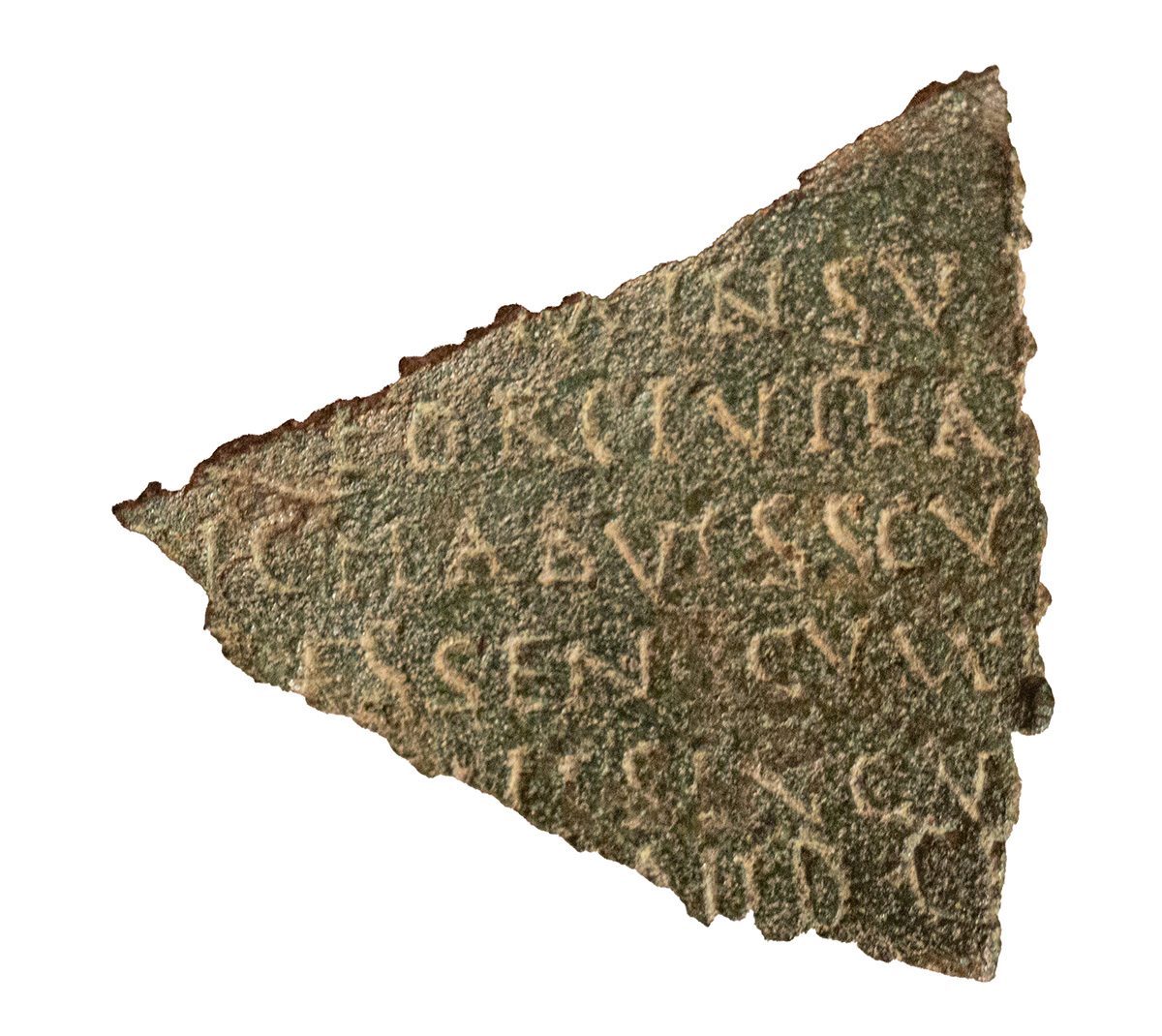


Roman Military Diploma Fragment (Hadrianic)

£850.00
Rome, early–mid 2nd century AD (reign of Hadrian, 117–138). Bronze triangular plate fragment from a veteran’s military diploma; 38 mm (c. 1½ in), 6.83 g. Text preserved on both faces (outer/extrinsic and inner/intrinsic). Uncleaned brown patina; edges anciently broken.
Rome, early–mid 2nd century AD (reign of Hadrian, 117–138).
Bronze triangular plate fragment from a veteran’s military diploma; 38 mm (c. 1½ in), 6.83 g. Text preserved on both faces (outer/extrinsic and inner/intrinsic). Uncleaned brown patina; edges anciently broken.
Text & identification
- Outer face (extrinsecus): legible portions of the standard grant clause, e.g. “… civitatem dedit et connubium cum uxoribus quas tunc habuissent (cum est civitas iis data) aut si qui caelibes essent, cum iis quas postea duxissent, dum taxat singuli singulas …” “[The emperor] granted Roman citizenship and legal marriage with the wives they then had (when citizenship was granted), or, if unmarried, with wives later taken—one each.”
- Inner face (intrinsecus): witness panel lines with abbreviated names/tribes (e.g., “… T / II H / NIDAC / R III …”), consistent with Hadrianic diplomas; layout matches the inner text recording date, veteran’s unit (auxiliary ala or cohors), and witnesses of the bronze exemplar.
Letter-forms, lineation and formulae closely parallel published Hadrianic diplomas (see C.A. Panto, Archeologo in Sardegna 2016, pp. 153–156; C.H. Opreanu, “A new military diploma … Parolissum,” Ephemeris Napocensis 2021, 295–308). The clause confirms honesta missio (honourable discharge), conferment of Roman citizenship and right of legal marriage.
Provenance
German art market before 2000; later with a European gentleman resident in the UK; private Surrey collection.
Significance
Compact but textually rich piece illustrating the integration of auxilia veterans into Roman citizenship under Hadrian, and preserving key legal language (“civitas” and “connubium”) that makes diplomas so evocative for law, military and provincial studies. A teaching-quality fragment with readable Latin.
Condition
Surface stable with good legibility; typical ancient breaks; no modern repairs.
Product Enquiry
Related products


£6,500.00
Rare Artefacts
£2,000.00
£3,500.00

Rare Artefacts
£600.00

Rare Artefacts
£7,000.00