

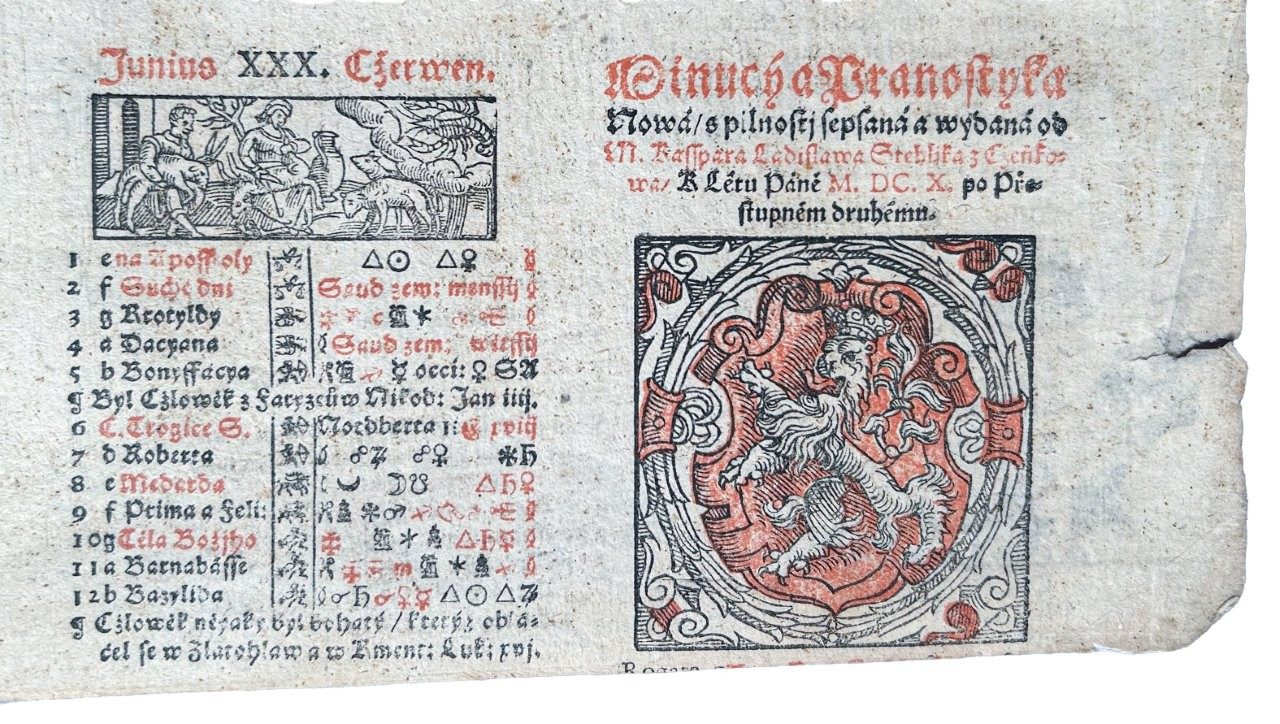
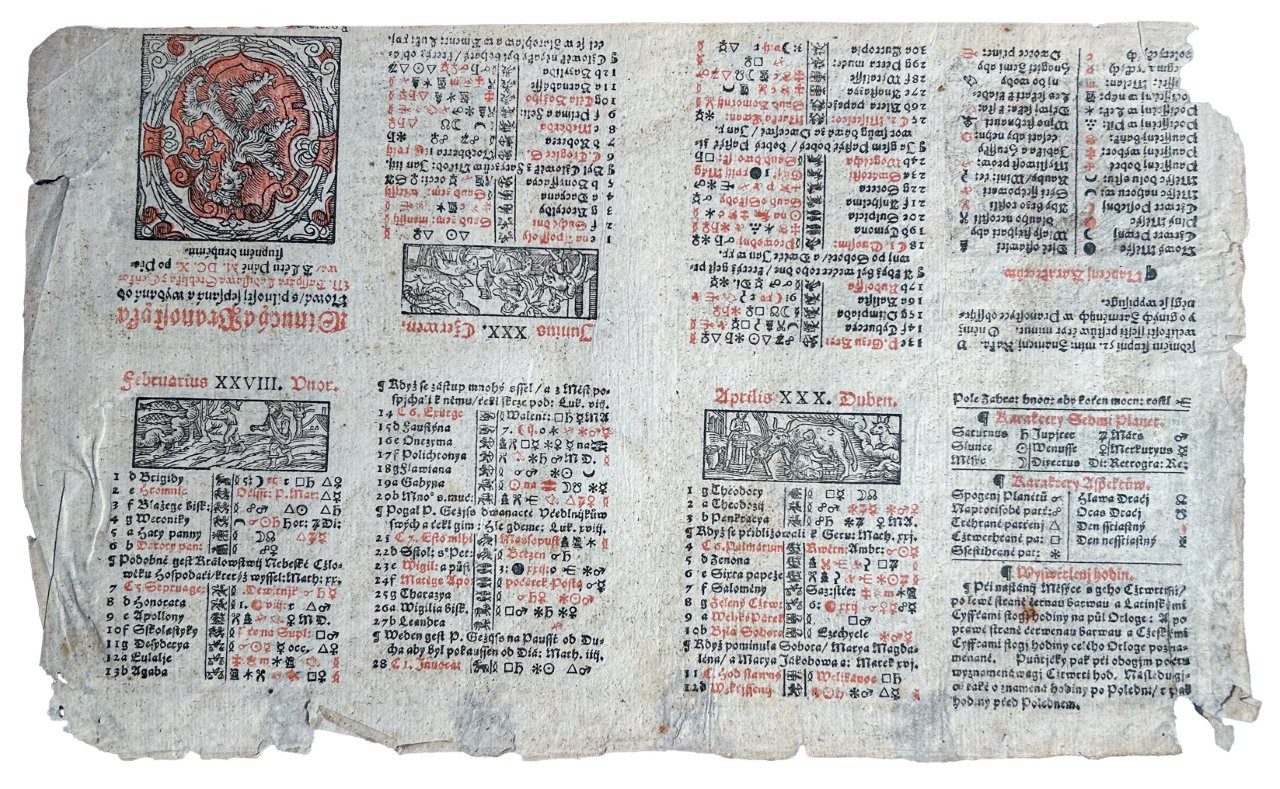
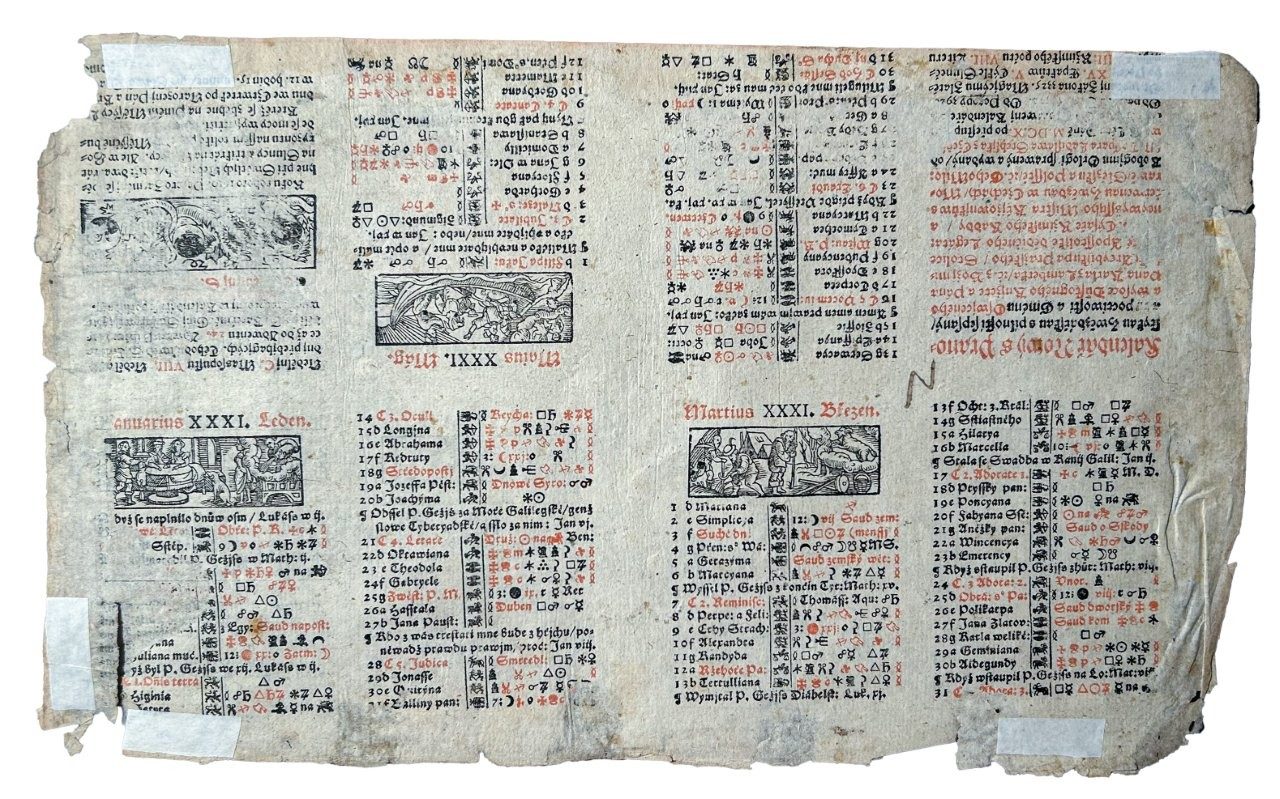


Czech printed annual calendar with astronomical prognostication for the year 1610, authored by M. Kašpar Ladislav Stehlík z Čeňkova (6 January 1571, Plzeň – 1613, ibid.), humanist, mathematician, astronomer, and imperial geometer at the court of Rudolf II in Prague.
Dimensions: 35 × 21 cm.
Preserved is a largely complete printed sheet from a small format vernacular pocket calendar of the early seventeenth century, comprising the months from January to June and thus the first half of the calendar year. The print exhibits the characteristic arrangement of Bohemian ephemeris publications of this period, including a daily calendar register with astrological and lunar symbols as well as accompanying prognostic texts. Within the monthly grid, symbols indicating the phases of the moon are visible, together with astronomical signs including those of the zodiac. In addition to the daily entries, the sheet contains prognostic textual elements intended to provide practical guidance for the course of the year and anticipated weather conditions. The typographical layout further includes distinctive astronomical markings of the type commonly employed in such calendars to indicate extraordinary celestial phenomena, including eclipse data.
The individual monthly sections are introduced by woodcut vignettes depicting month specific scenes, presumably representing seasonal activities or allegorical motifs associated with the respective period of the year. Such visual programmes in early modern vernacular calendars served to structure the annual cycle and to connect astronomical time reckoning with agricultural and practical frameworks of everyday life.
The title page names the author as:
M. Kašpara Ladiſlawa Stehlika z Cženowa
and specifies the intended year of use:
K létu Páně MDCX
The calendar is dedicated to Karl von Lamberg, Archbishop of Prague from 1607 to 1612, whose mention further confirms the chronological attribution.
Kašpar Ladislav Stehlík z Čeňkova was a Master of Arts educated at the Charles University who was active as a mathematician and astronomer within the scientific milieu of the Rudolfine court. Following the outbreak of plague in Prague in 1599, he relocated together with Tycho Brahe to the castle of Nové Benátky near Mladá Boleslav, where he assisted in the establishment of an astronomical observatory. Johannes Kepler and other scholars associated with the Prague academic environment were likewise active there at this time. In addition to his mathematical and astronomical pursuits, Stehlík was the author of vernacular annual calendars and belongs to the group of early modern prognosticators who disseminated astronomical knowledge in the form of practical ephemerides to a broader readership.
The present printed sheet was extracted from a later bookbinding and thus represents a securely attested case of secondary use as binding waste. The re use of obsolete ephemeris publications such as calendars and prognostications as binding material is well documented in the bookbinding practices of the early seventeenth century, as such prints rapidly lost their commercial value after the end of their year of use and were repurposed as inexpensive paper stock.
Several calendar publications by Kašpar Ladislav Stehlík are documented, including a Kalendář Hospodářský a Kancelářský for the year 1607 (printed 1606), now preserved in the Národní muzeum in Prague, as well as a further calendar for the year 1611, recorded in the Austrian National Library (Verbund ID AC10345006). For the year 1610, however, no complete copy is currently recorded in the major library catalogues (KVK). The present printed sheet may therefore, according to the current state of research, be regarded as the only known surviving witness of this particular calendar year.
Planar survivals of calendar sheets from such contexts are considerably rarer than the more commonly encountered cut binding fragments. Whereas complete examples of early modern pocket calendars are preserved only in limited numbers in institutional collections, a substantial portion of their original production survives exclusively in the form of fragments reused in later bindings. The present sheet thus documents not only a specific year within the Prague calendar production of the early seventeenth century but also the material practice of the secondary utilisation of printed ephemera in early modern bookbinding.
Product Enquiry
Related products


£9,800.00


£1,750.00


£1,800.00


£200.00


Bibliography
£275.00