

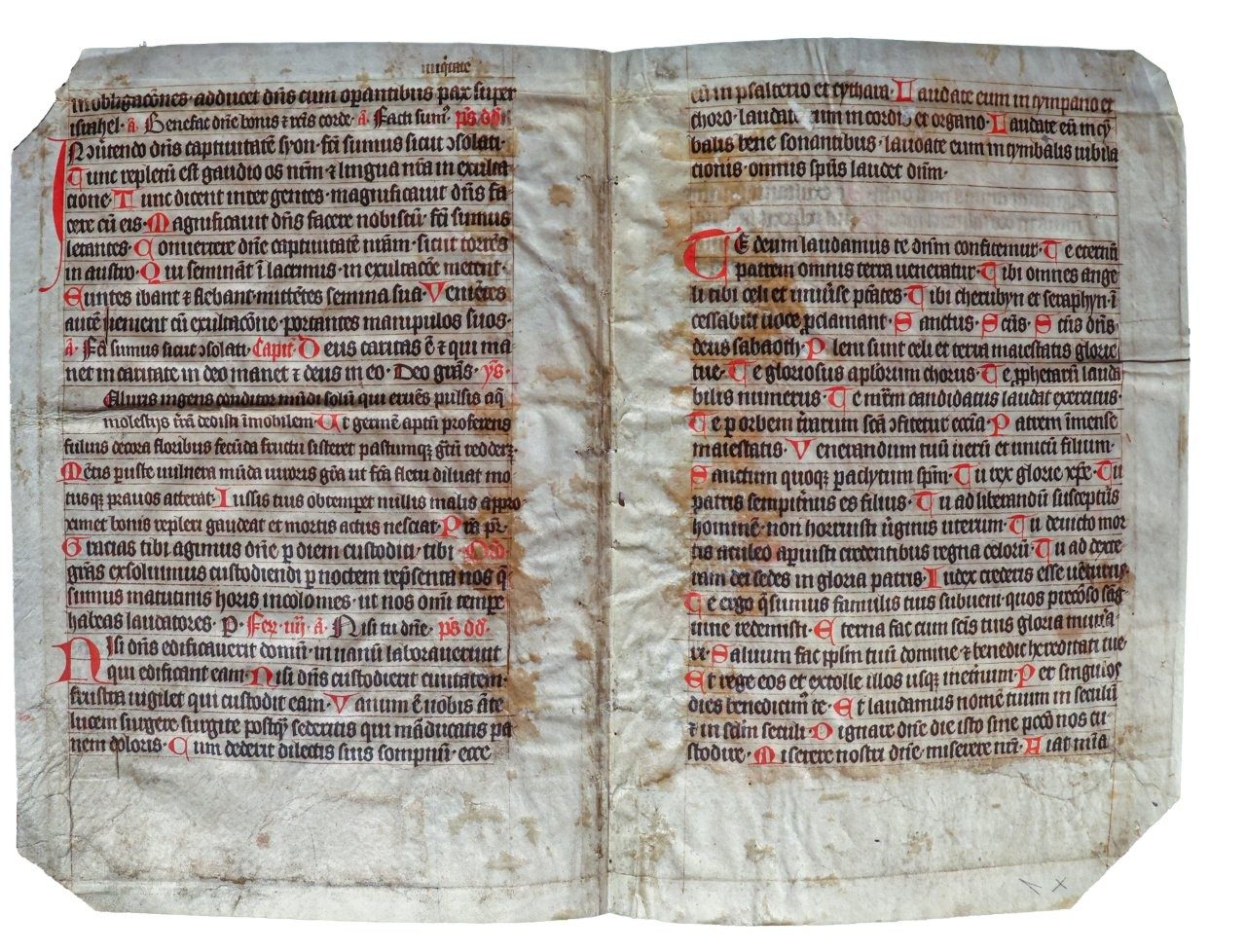
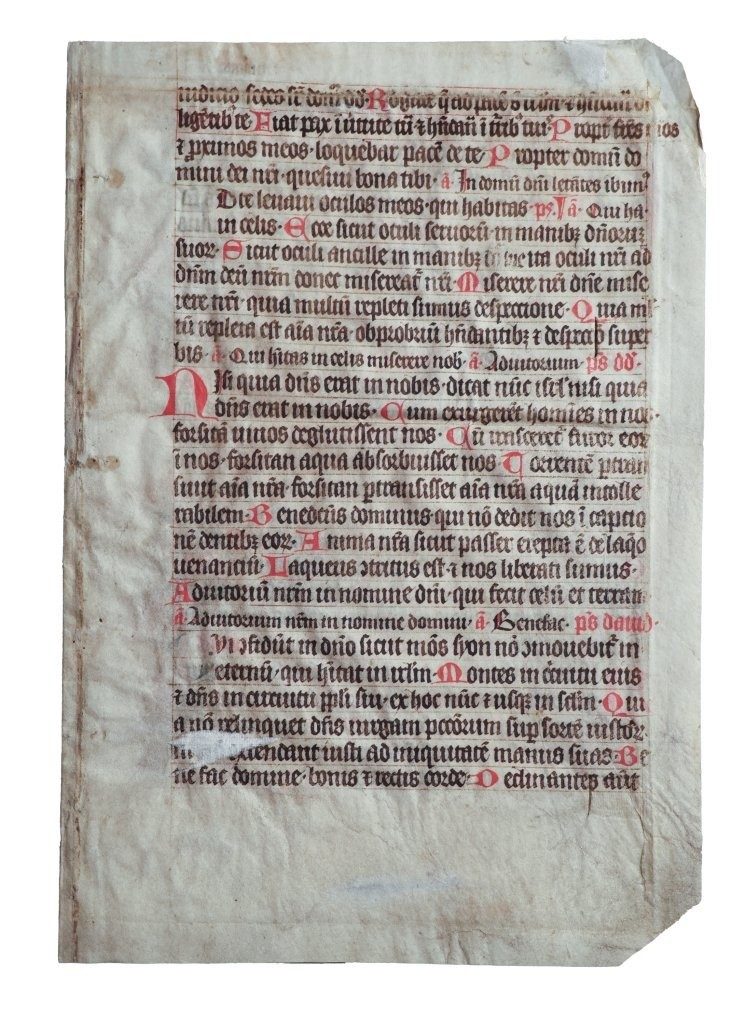
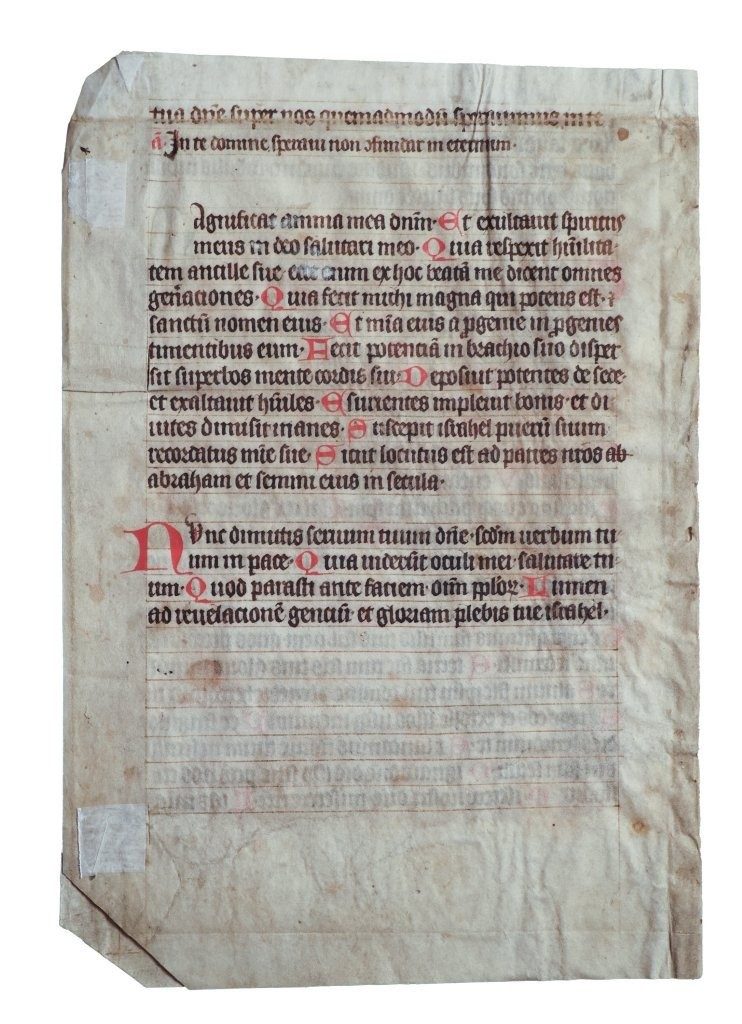
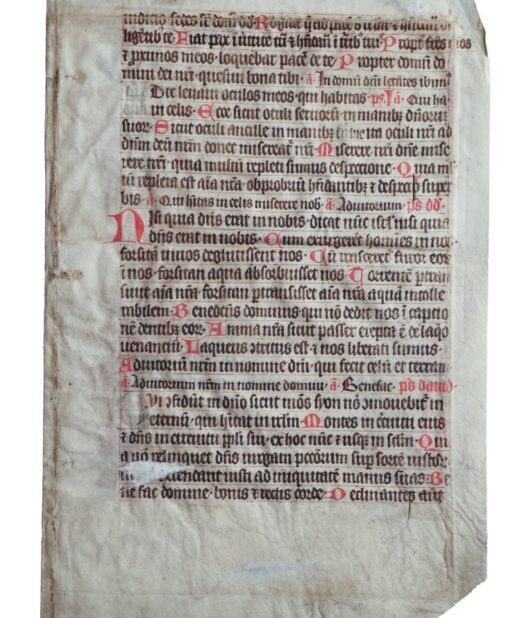
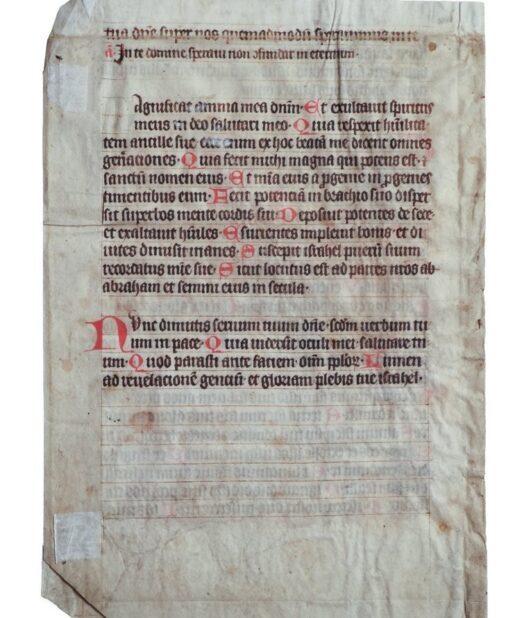


Magnificat Anima Mea Dominum. Bifolium from a 15th-Century Psalter Manuscript on vellum
Germany, 15th century
370mm x 240mm
Description
Bifolia from a mid-15thcentury Psalter, written in a clear early Gothic textualis in brown ink, with alternating red and blue pen-flourished initials and rubrication. The alternating red and blue initials with delicate penwork flourishes are characteristic of German manuscript production in this period.
The text includes the canticles Magnificat (Luke 1:46–55) and Nunc dimittis (Luke 2:29–32), the concluding Psalm 150 (Laudate Dominum in sanctis eius), and the great hymn Te Deum laudamus.
Psalters were among the most widely used devotional books of the Middle Ages, employed both in monastic recitation and private devotion. The inclusion of the Te Deum, sung on major feasts and occasions of
thanksgiving, lends particular resonance to this fragment. A handsome and coherent survival from the heart of medieval devotional life, preserving some of the most enduring texts of the Christian liturgical tradition.
Product Enquiry
Related products


C14th -C16th manuscripts
A substantial fragment of Jean Buridan on late C14th watermarked paper on 47 leaves
![Leaf from Baldo degli Ubaldi (1327–1400), Sextum codicis librum commentaria [Italy, late 15th century]](https://stephenbutler.com/wp-content/uploads/2023/07/IMG_0101-515x618.jpg "Leaf from Baldo degli Ubaldi (1327–1400), Sextum codicis librum commentaria [Italy, late 15th century]")
C14th -C16th manuscripts
£800.00


![Bifolium from St Simon of Cascia, De gestis domini salvatoris, in Latin, decorated manuscript on vellum [Southern Netherlands, 14th century]](https://stephenbutler.com/wp-content/uploads/2024/09/IMG_1181-515x618.jpg "Bifolium from St Simon of Cascia, De gestis domini salvatoris, in Latin, decorated manuscript on vellum [Southern Netherlands, 14th century]")
![Bifolium from St Simon of Cascia, De gestis domini salvatoris, in Latin, decorated manuscript on vellum [Southern Netherlands, 14th century]](https://stephenbutler.com/wp-content/uploads/2024/09/IMG_1179-515x618.jpg "Bifolium from St Simon of Cascia, De gestis domini salvatoris, in Latin, decorated manuscript on vellum [Southern Netherlands, 14th century]")
C14th -C16th manuscripts
£2,000.00
C14th -C16th manuscripts
Finely produced illuminated leaf from a French Psalter c.1480
£550.00


C14th -C16th manuscripts
£350.00
C14th -C16th manuscripts
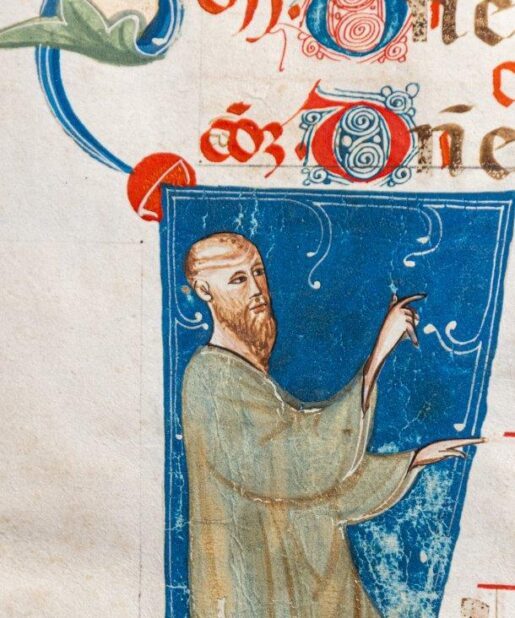
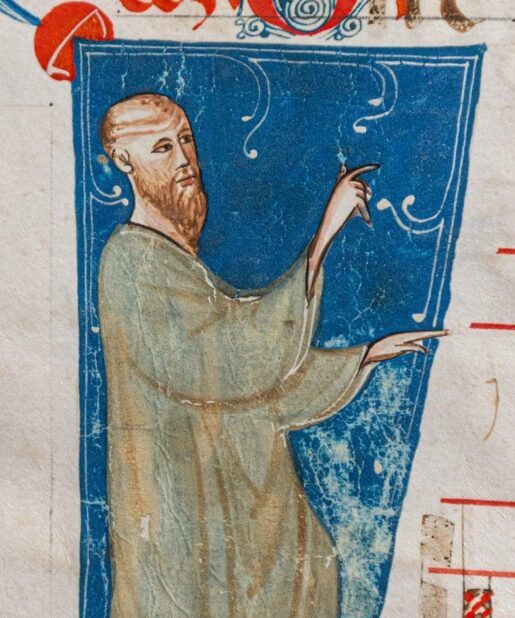
Historiated initial OT prophet, Italy c.1320 (Emilia-Romagna)
£2,500.00