
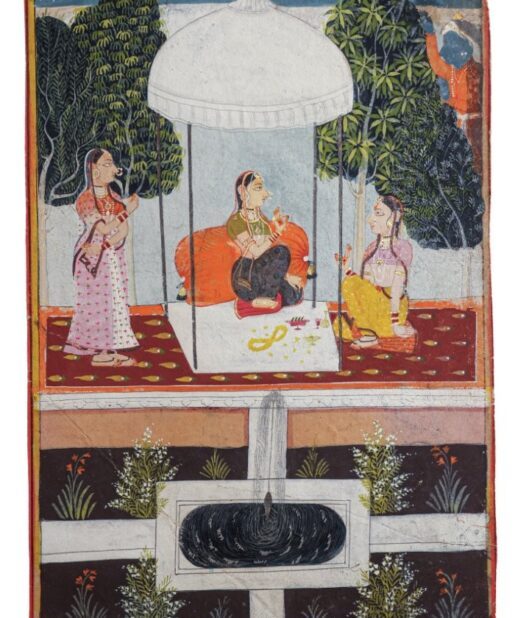

A Princess with her Ladies in a Walled Pleasure Garden, observed by a Secret Admirer Indian miniature on card, Mewar School (Udaipur), early eighteenth century
255mm x 172mm
A charming and finely composed miniature from the flourishing court ateliers of Mewar, depicting a noble princess enjoying the tranquillity of a formal palace garden attended by two ladies-in-waiting. Seated beneath an elegant white canopy upon a brilliant vermilion cushion, she delicately holds a flower while her attendants stand and kneel respectfully beside her, each similarly carrying blossoms in a scene imbued with quiet refinement and courtly grace.
The artist has contrasted the ordered geometry of the enclosed garden with luxuriant vegetation rising beyond its walls. In the foreground, a rectangular fountain anchors the composition, while carefully planted flowering borders evoke the charbagh tradition of Persian-inspired paradise gardens so favoured by Rajput courts. Towering trees frame the pavilion, their rhythmic foliage rendered in the distinctive stylised manner characteristic of early eighteenth-century Mewar painting.
The most engaging feature of the composition lies almost hidden among the foliage. At the upper right, a young man discreetly peers over the garden wall, his partially concealed figure introducing an element of intrigue and romantic narrative. Such subtle storytelling is a hallmark of Rajput painting, transforming what might otherwise appear a simple courtly portrait into a scene suggestive of longing, clandestine love, or poetic devotion.
The palette is particularly successful, balancing brilliant vermilions, delicate pinks, luminous whites, and deep greens against a midnight-blue sky enlivened with stars. Gold highlights lend richness to the jewellery and costumes, while the restrained architectural forms focus attention upon the elegant interaction of the figures.
Produced during one of the most accomplished periods of the Mewar school, when the ateliers of Udaipur developed a highly individual style combining bold colour, decorative rhythm, and lyrical narrative, the miniature exemplifies the courtly sophistication for which the Rajput schools remain celebrated.
Single leaf depicting a princess seated beneath a domed pavilion attended by two ladies in a formal enclosed garden, with fountain in the foreground and a concealed male figure observing over the garden wall; gouache heightened with gold on card; some light creasing and minor paint loss, together with water-staining to the upper right corner resulting in loss to the face of the concealed figure; margins trimmed;
Provenance
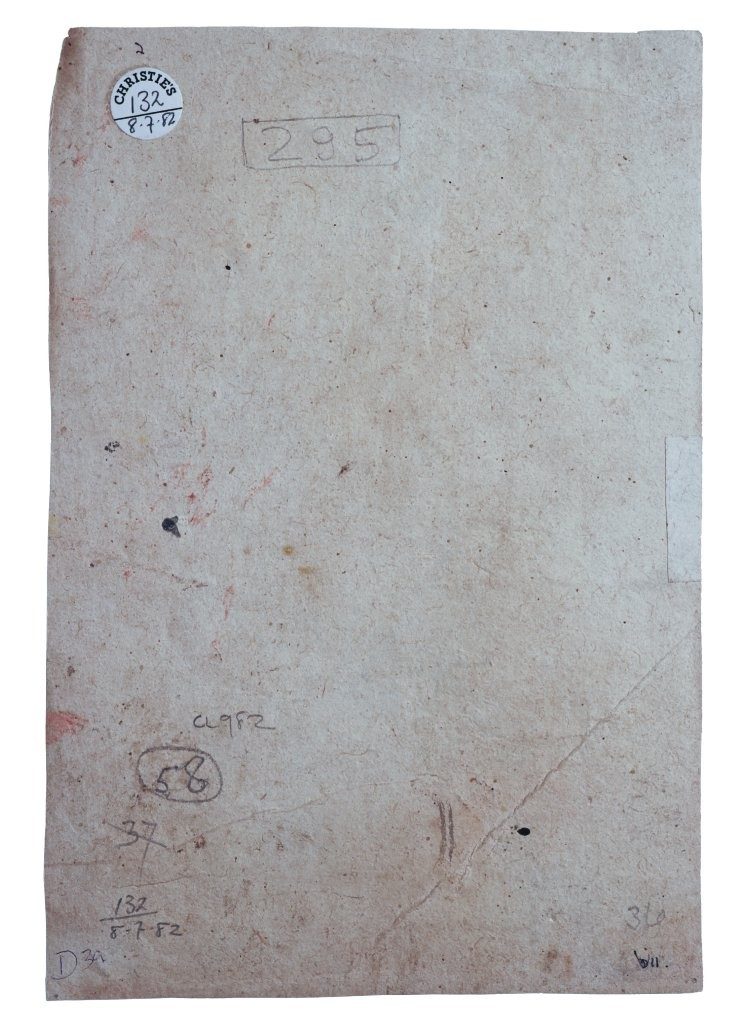
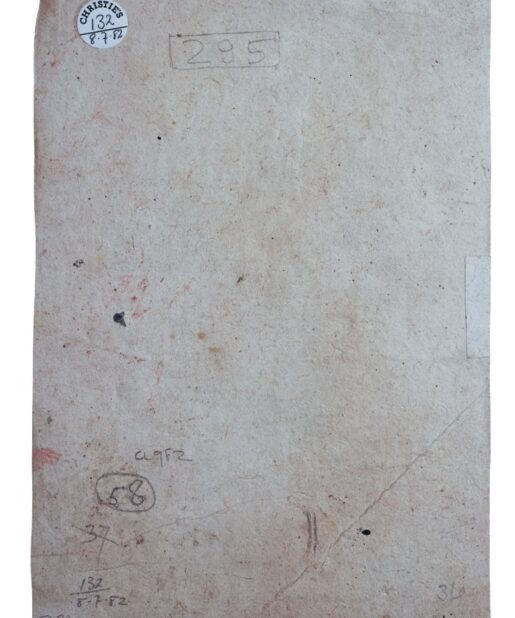
early Christie’s auction label to verso (8 July 1982, lot 132); 255 × 172 mm.


![Saints Peter and Paul, in an illuminated historiated initial ‘N’, cut from a Gradual in Latin on parchment [Italy (Florence); 15th century (c.1470s)] Saints Peter and Paul, in an illuminated historiated initial ‘N’, cut from a Gradual in Latin on parchment [Italy (Florence); 15th century (c.1470s)]](https://stephenbutler.com/wp-content/uploads/2022/02/IMG_6782-515x618.jpg)


![Commentary on Aristotle, Categoriae, and the same authors translation of Perihermenias BOETHIUS [MS] C.13th Commentary on Aristotle, Categoriae, and the same authors translation of Perihermenias BOETHIUS [MS] C.13th](https://stephenbutler.com/wp-content/uploads/2013/08/IMG_8383-515x618.jpg)