



Benedictine Prayer Book, including prayers to the Virgin Mary and a Litany of the Virgin, in Latin, illuminated manuscript on parchment
[Spain, late fifteenth or early sixteenth century]
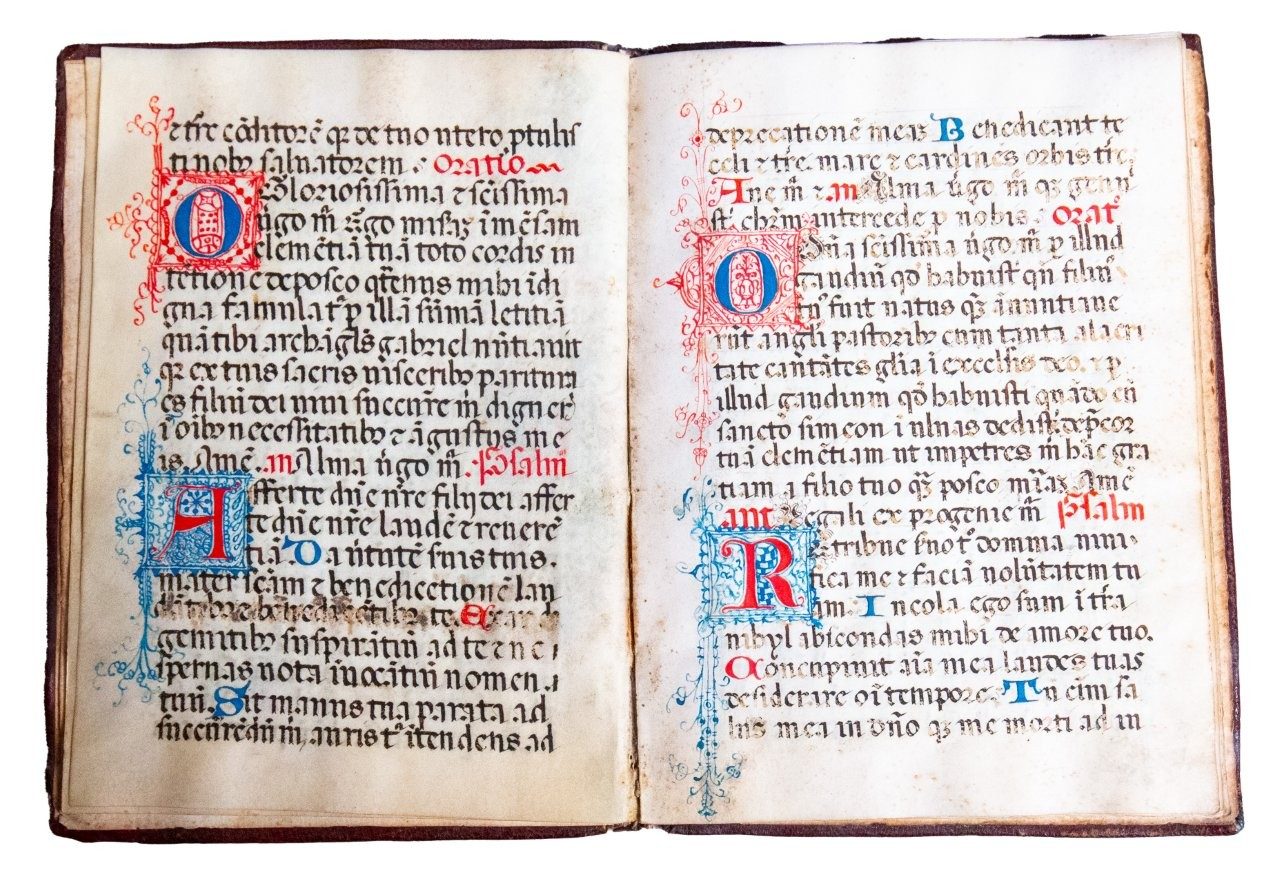
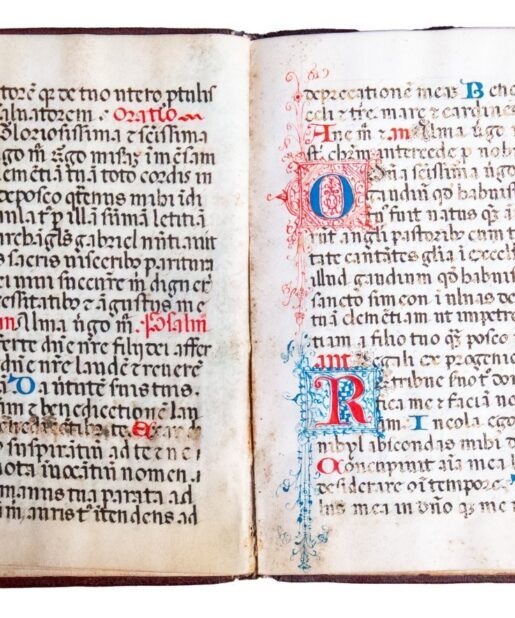
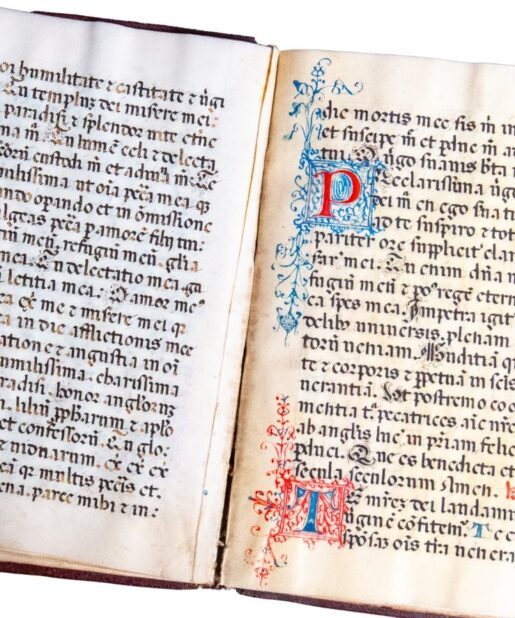
195 × 144 mm, 17 leaves, the first apparently blank, manuscript on parchment, apparently complete as presently constituted, written in a compact Gothic bookhand in dark brown ink, in a single column of 21 lines within a ruled space of approximately 157 × 104 mm, ruled in leadpoint, rubrics and liturgical directions in red, paragraph marks and minor initials alternately in red and blue.
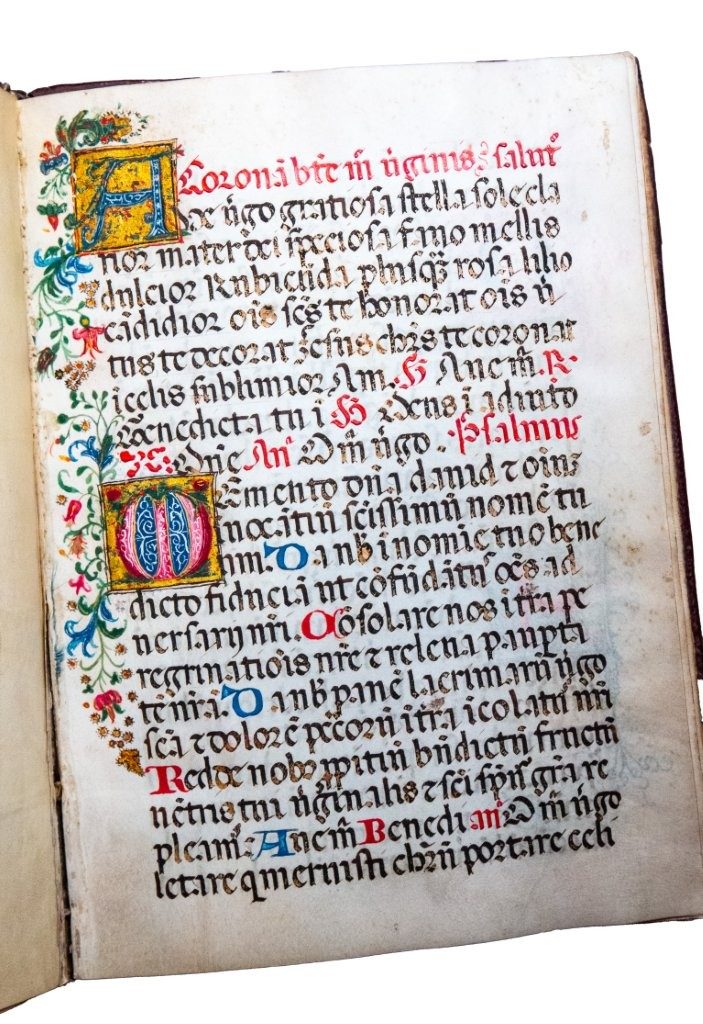
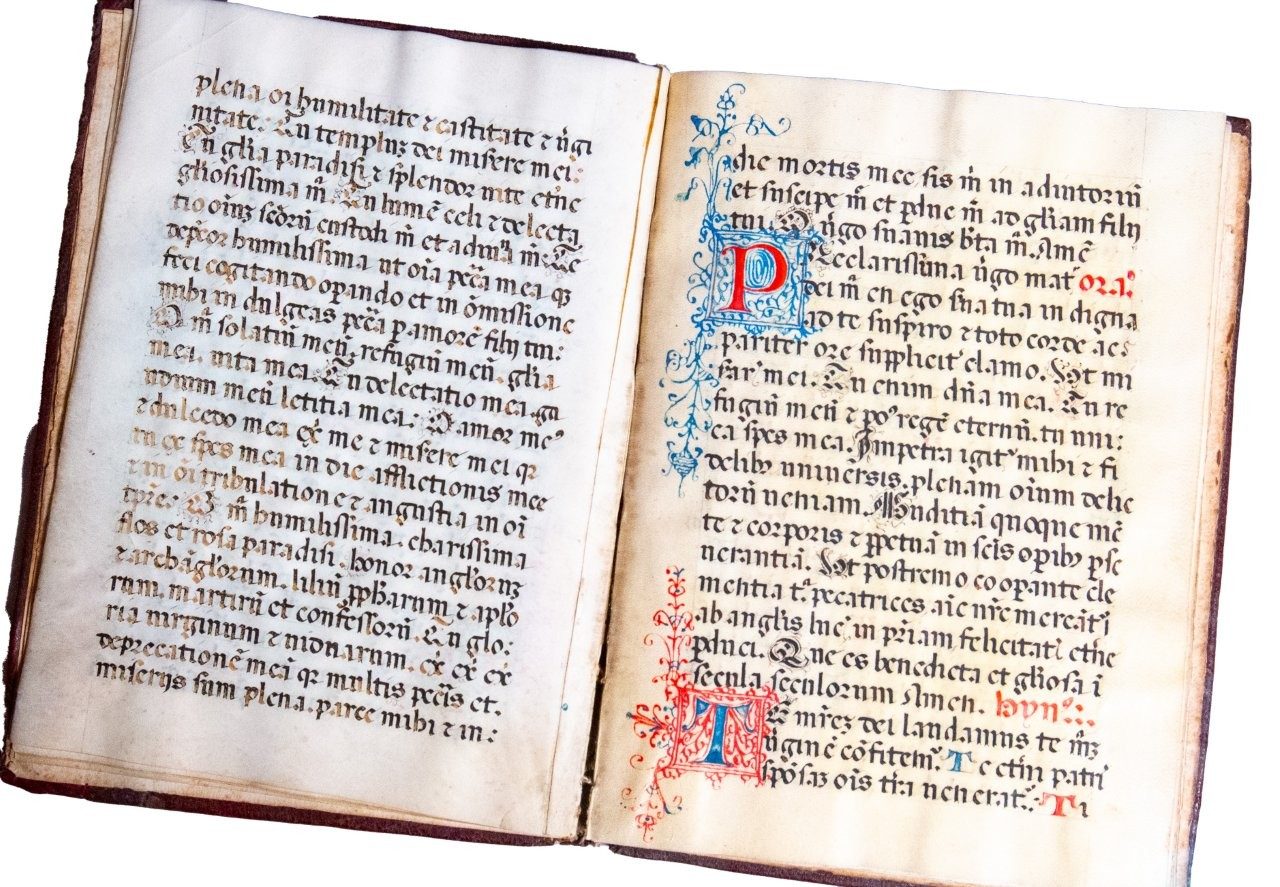
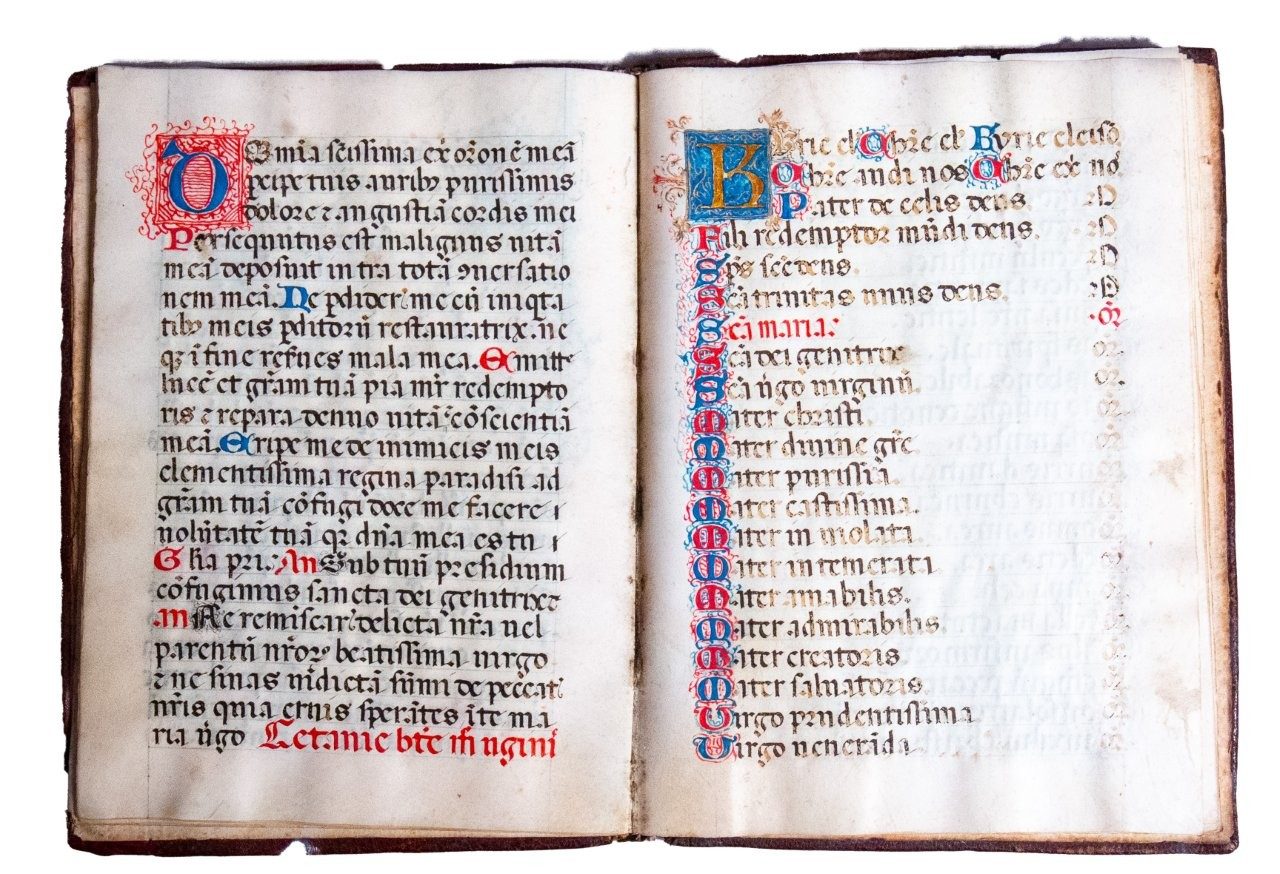
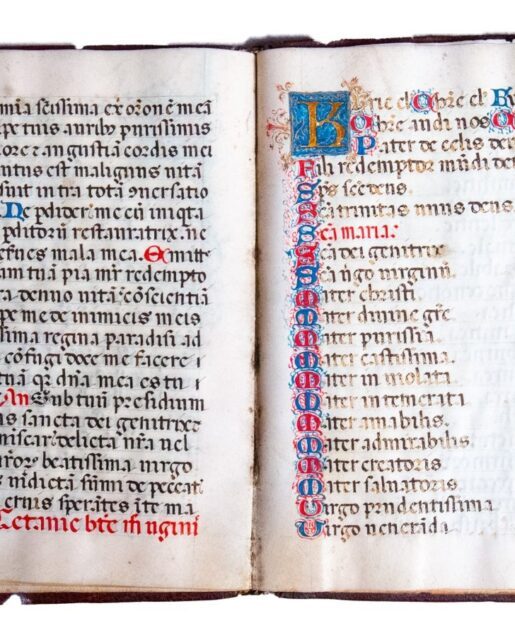
Decoration comprising two large illuminated initials on the principal opening, painted in blue, rose-pink and white on burnished or liquid-gold grounds, accompanied by delicate sprays of coloured foliage, flowers and gold bezants extending into the left-hand margin; several large red or blue initials with contrasting penwork flourishing, some extending the full height of the adjacent text; numerous smaller initials alternately in red and blue; and an especially decorative page introducing the Litany of the Blessed Virgin, with a large initial in blue and gold and a vertical sequence of invocations marked by alternating red and blue initials.
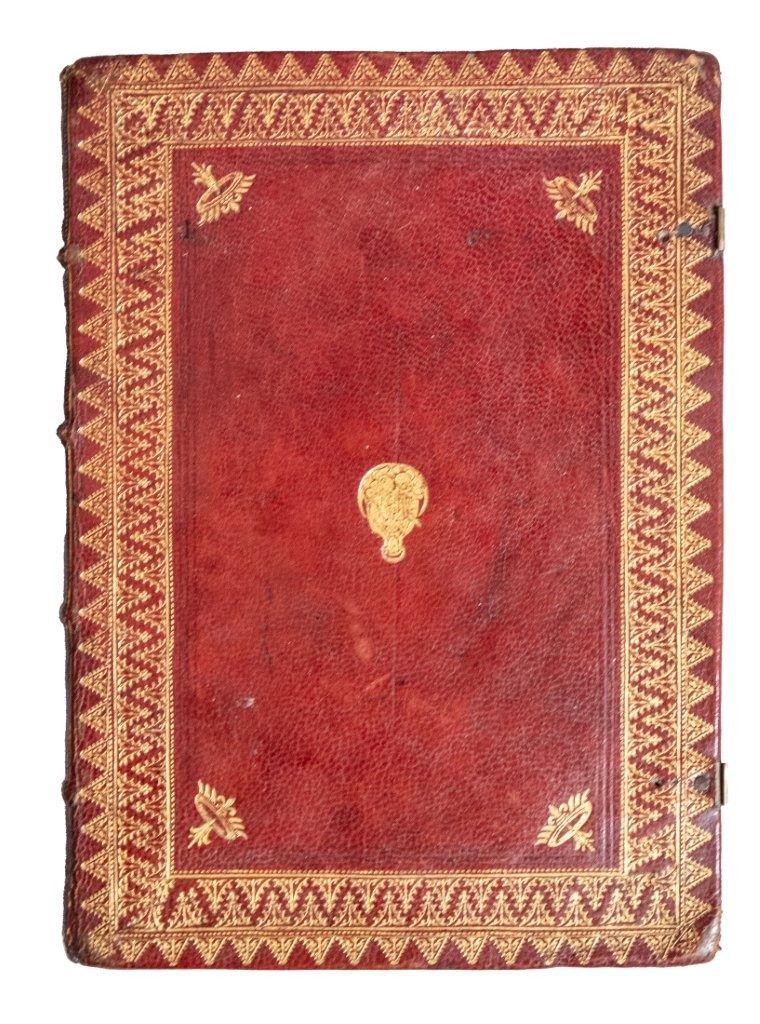
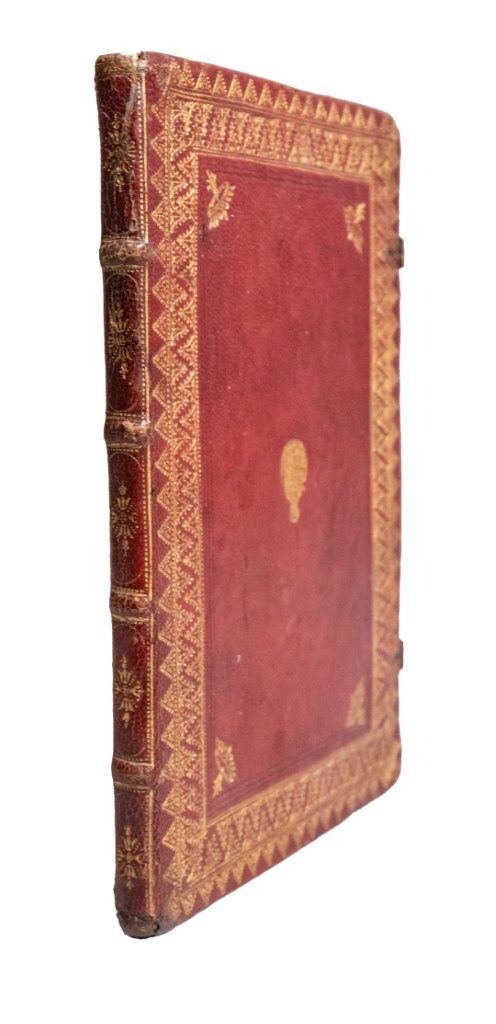
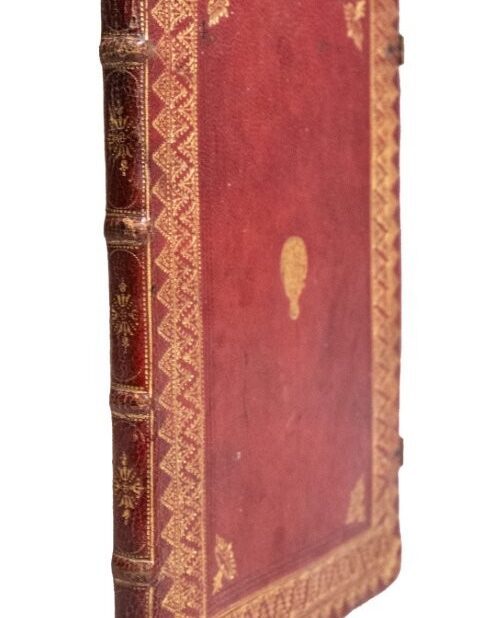
Bound, probably in the seventeenth or eighteenth century, in red morocco over pasteboards, the covers elaborately tooled in gold with concentric ornamental borders, an urn- or vase-shaped tool at the centre and small floral tools at the corners; spine with four raised bands, the compartments decorated with gilt floral tools; traces of two fore-edge clasps or catches; edges gilt; some rubbing and wear to the extremities and joints, occasional marks and natural variation to the parchment, but generally in excellent condition, the pigments and gold retaining considerable freshness.
Contents and interpretation
A compact collection of Latin prayers intended for the private devotional use of a Benedictine monk. The text is not simply a conventional Book of Hours. Rather, it appears to have been assembled as an individual monastic prayer book, combining Marian devotions, penitential and intercessory prayers, and prayers invoking the spiritual protection of the Virgin and of St Benedict.
The Benedictine character is established by the invocation of “sancti patris nostri Benedicti”—“our holy father Benedict”—visible in the manuscript. The language is also personal and explicitly masculine: the supplicant describes himself as mihi peccatori, “me, a sinner,” supporting the suggestion that the volume was written for the private use of a monk rather than for a female patron.
Among the identifiable contents are:
- prayers addressed to, or seeking the intercession of, the Virgin Mary;
- prayers for protection, forgiveness and deliverance from temptation;
- petitions invoking St Benedict;
- a prayer beginning with an invocation of the dulcissima virgo Maria, the “most sweet Virgin Mary”;
- a substantial Litany of the Blessed Virgin, introduced by the rubric Letanie beate Marie virginis;
- the customary opening invocations Kyrie eleison, Christe eleison and Pater de celis Deus;
- a series of Marian titles including Sancta Maria, Mater Christi, Mater divinae gratiae, Mater purissima, Mater castissima, Mater inviolata, Mater intemerata, Mater amabilis, Mater admirabilis, Mater creatoris, Mater salvatoris, Virgo prudentissima and Virgo veneranda.
This form of Marian litany is particularly interesting. Its series of titles is related to the devotional tradition that developed into the Litany of Loreto. The manuscript therefore witnesses the growth of increasingly elaborate Marian devotion in the Iberian world around the transition from the Middle Ages to the Renaissance. A comparable rubric, Letanie beate Marie Virginis, occurs in other late-medieval devotional manuscripts, including Bodleian Library, MS Canon. Liturg. 24.
Marian themes
The volume is an unusually intimate survival of late-medieval Benedictine spirituality. Its small format made it suitable for personal use, while its careful script and unexpectedly rich decoration distinguish it from an ordinary working monastic book. The decoration combines large initials painted in saturated blue, rose and gold with more restrained red-and-blue penwork initials. The most elaborate opening is surrounded by sprays of curling foliage, coloured flowers and gold ornament, creating the appearance of a much larger and more luxurious manuscript within the confines of a portable devotional volume.
The manuscript’s contents centre upon the Virgin as intercessor, protector and model of purity. The Litany repeatedly invokes Mary through a succession of honorific titles—Mother of Christ, Mother of Divine Grace, Mother Most Pure, Virgin Most Prudent and Virgin Most Venerable—each marked visually by alternating coloured initials. The resulting page is both text and devotional image: the accumulation of names creates a rhythmic act of prayer while the red, blue and gold initials guide the reader through its recitation.
The reference to “our holy father Benedict,” together with the male grammatical forms used by the supplicant, strongly suggests that the manuscript was commissioned for, or copied by, a Benedictine monk. It may have served as an individual supplement to the formal Divine Office, providing prayers for private recitation, penitence and Marian intercession outside the community’s prescribed liturgy.
Product Enquiry
Related products


C12th - C13th manuscripts
Elegant English Early Gothic Script from late C12th Passionale – Paulinus of Milan
£1,750.00


C12th - C13th manuscripts
£1,200.00

C14th -C16th manuscripts
£950.00


C14th -C16th manuscripts
Unknown codex by humanist Bernardius Florentius, 1476, Florence, Italy
C14th -C16th manuscripts
Leaf from a Bible, II Kings 17, C15th manuscript in Latin on parchment
£750.00

