



Leaf from a Psalter, preserving Psalm 41, Quemadmodum desiderat cervus, in Latin, decorated manuscript on vellum
[Germany, twelfth century]
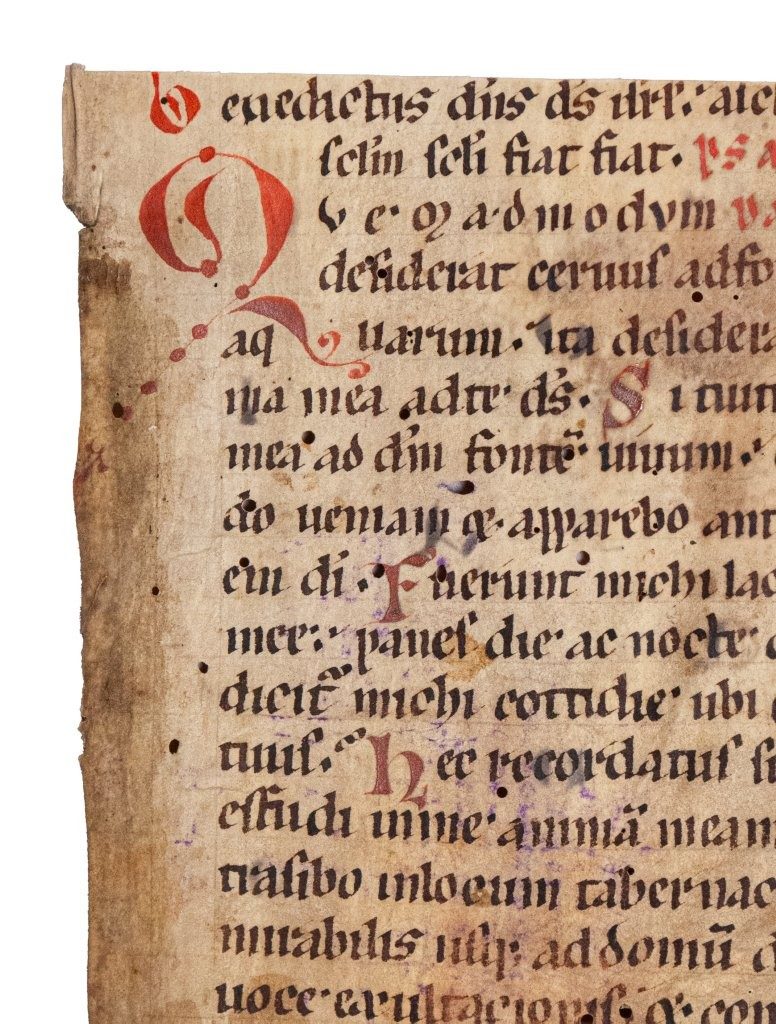
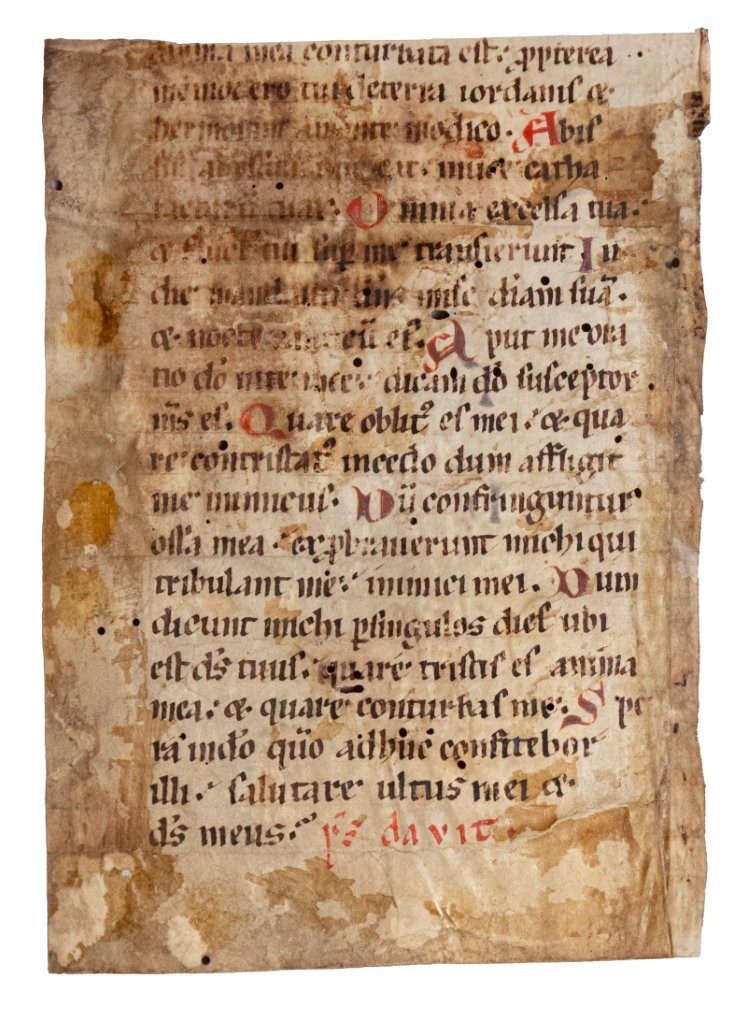
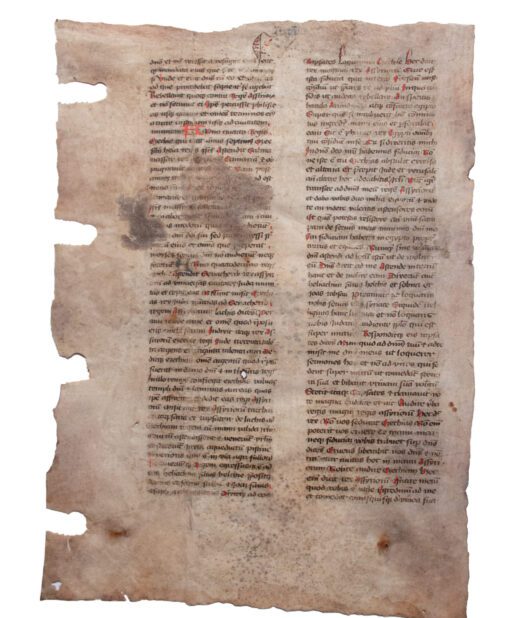
185 × 132 mm, single leaf, trimmed at the head with the loss of approximately one line, preserving 20 lines of text on each side, written in a strong Romanesque bookhand in dark brown ink, in a single column, with red rubrics and one-line initials in angular red penwork, several of the pigments now oxidised to purple; the psalm opening with a large red initial Q, its long curving descender ornamented with a sequence of small, rounded flourishes.
The leaf preserves almost the entirety of Psalm 41 according to the Vulgate numbering—Psalm 42 in modern English Bibles—opening:
Quemadmodum desiderat cervus ad fontes aquarum, ita desiderat anima mea ad te, Deus.
“As the hart longs for the springs of water, so longs my soul for you, O God.”
The text continues with the psalmist’s thirst for the living God, his tears “day and night,” his recollection of joining the multitude proceeding to the house of God, and the recurring exhortation:
Quare tristis es, anima mea, et quare conturbas me? Spera in Deo…
“Why are you cast down, O my soul, and why are you troubled within me? Hope in God…”
The verso carries the continuation of the psalm, including the imagery of “deep calling unto deep” and the declaration that God commands his mercy by day and gives his song by night, concluding with the repeated assurance of hope in God.
The principal initial is a particularly attractive example of restrained Romanesque decoration. Its broad red body is enlivened by the sweeping tail of the letter, which descends into the margin in a chain of rounded red and oxidised-purple forms. The smaller initials share a distinctive angular construction, including an unusual projecting stroke at the foot of the letter h, characteristic details which may eventually assist in placing the parent manuscript within a more specific German scriptorium.
Recovered from use in the binding of a later book, with the consequent trimming at the head, horizontal folds, staining, rubbing and surface abrasion, especially on the verso, several small holes and minor losses; nevertheless the recto remains clear and highly presentable, with the monumental script and large red initial retaining considerable visual strength.
Catalogue note
Psalm 41 is among the most poetic and immediately recognisable texts of the Psalter. Its opening image of the thirsty hart seeking running water became a powerful metaphor for the soul’s longing for God and inspired an extensive visual and musical tradition throughout the Middle Ages. Its language moves between spiritual desolation and consolation: the psalmist remembers the communal joy of worship, laments his present isolation and repeatedly commands his troubled soul to place its hope in God.
In a medieval monastic Psalter, the large, decorated initial would have enabled the reader to locate the opening of the psalm quickly while also marking it as a distinct unit for recitation. The sober palette, spacious layout and vigorous Romanesque script suggest a working liturgical volume of considerable scale and dignity. Despite its later reuse as binding material, the leaf retains the physical presence of the parent codex and preserves, in an unusually direct form, one of the defining expressions of spiritual yearning in the medieval Psalter.
Product Enquiry
Related products
C14th -C16th manuscripts
Finely produced illuminated leaf from a French Psalter c.1480
£550.00


C14th -C16th manuscripts
£1,500.00

C14th -C16th manuscripts
£350.00
C14th -C16th manuscripts
Single leaf from the so-called ‘Carondelet Breviary’ 1458 from the scribe Jean d’Aussert
£600.00


C12th - C13th manuscripts
£3,800.00


C14th -C16th manuscripts
Unknown codex by humanist Bernardius Florentius, 1476, Florence, Italy
C14th -C16th manuscripts
Leaf from a Bible, II Kings 17, C15th manuscript in Latin on parchment
£750.00