







Atilius Fortunatianus, Ars de metris (portion)
Humanist manuscript on paper, Italy (or northern Europe), second half of the 16th century
15 leaves (30 pages) plus self-cover; 280 × 205 mm
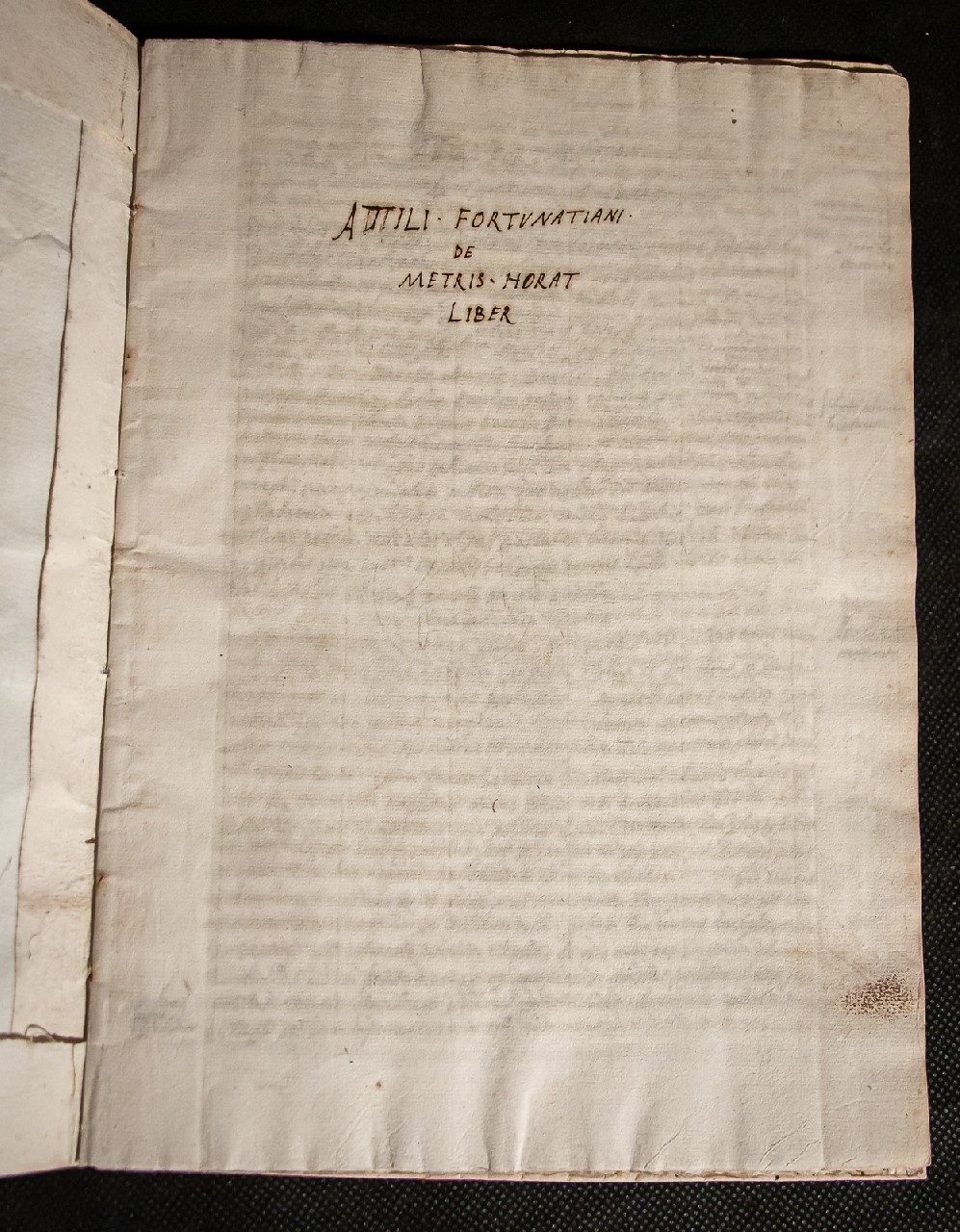
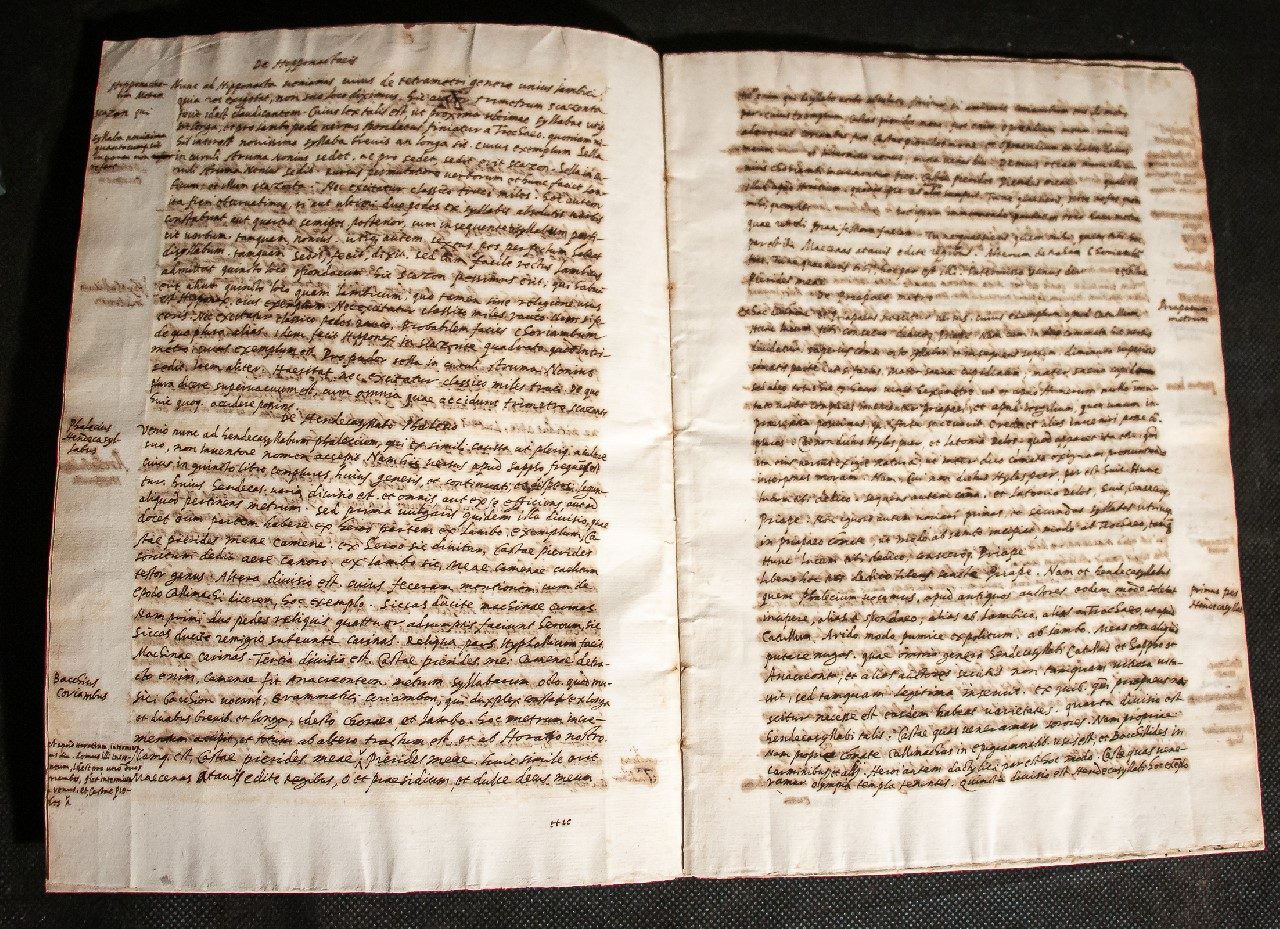
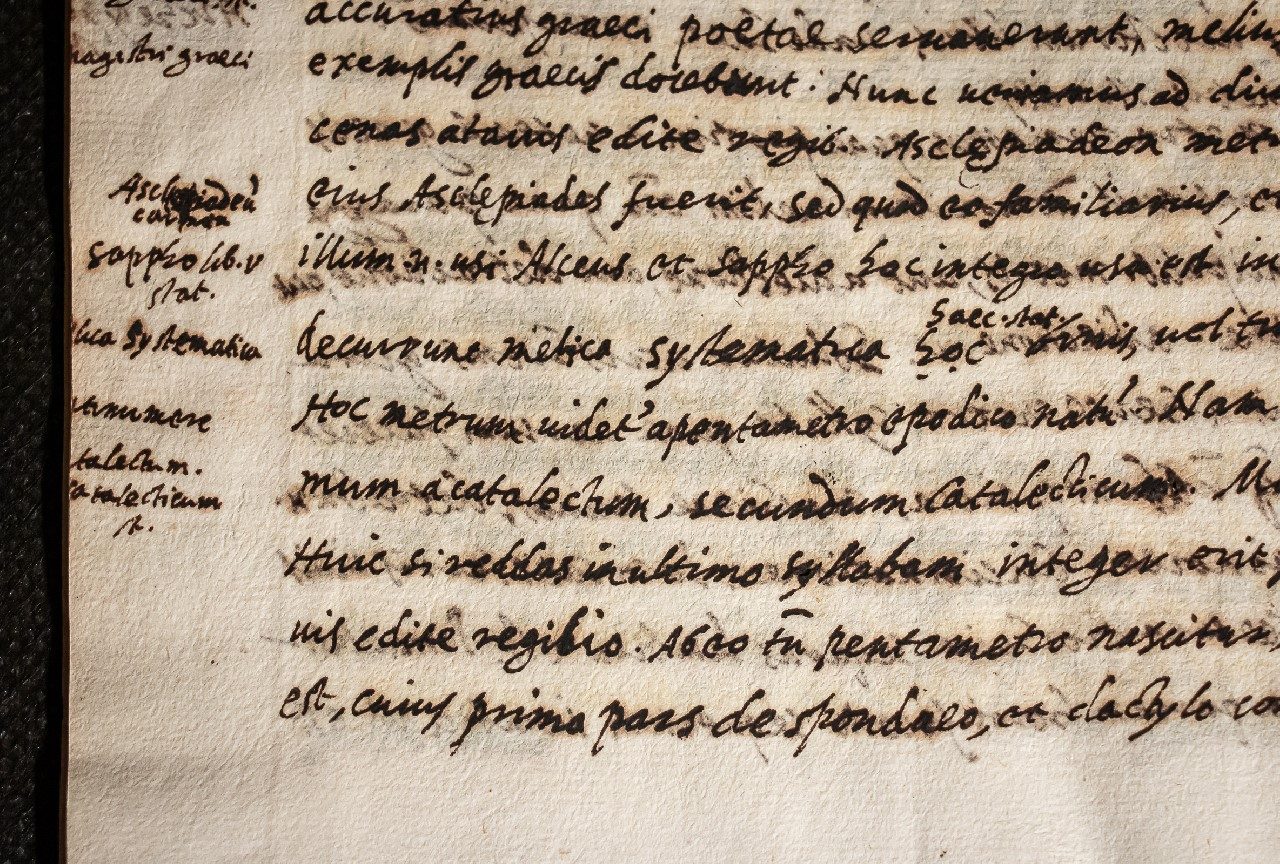
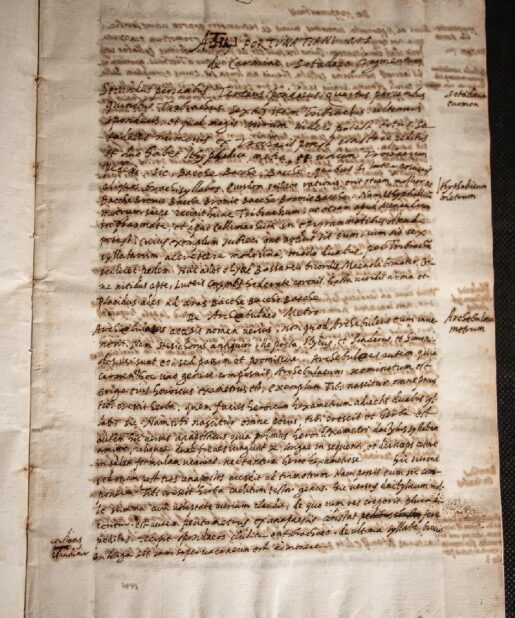
- A compact humanist teaching copy of the late-antique metre treatise attributed to Atilius Fortunatianus, copied for working use with running marginal headings (“Asclepiadeum,” “Sapphicum,” “Alcaicum,” iambicus trimeter, etc.) and brief scholia.
- Preserves, in continuous order, the lyric and comic metres through to the heroic examples, ending with the authorial explicit—an ideal specimen for courses and small exhibitions on ancient prosody, humanist pedagogy, and the Renaissance reception of Latin verse.
- Text aligns with the sequence of the standard printed tradition (as in Keil, Grammatici Latini VI), showing a humanist scribe copying from a Renaissance edition but adapting it for personal study.
Description
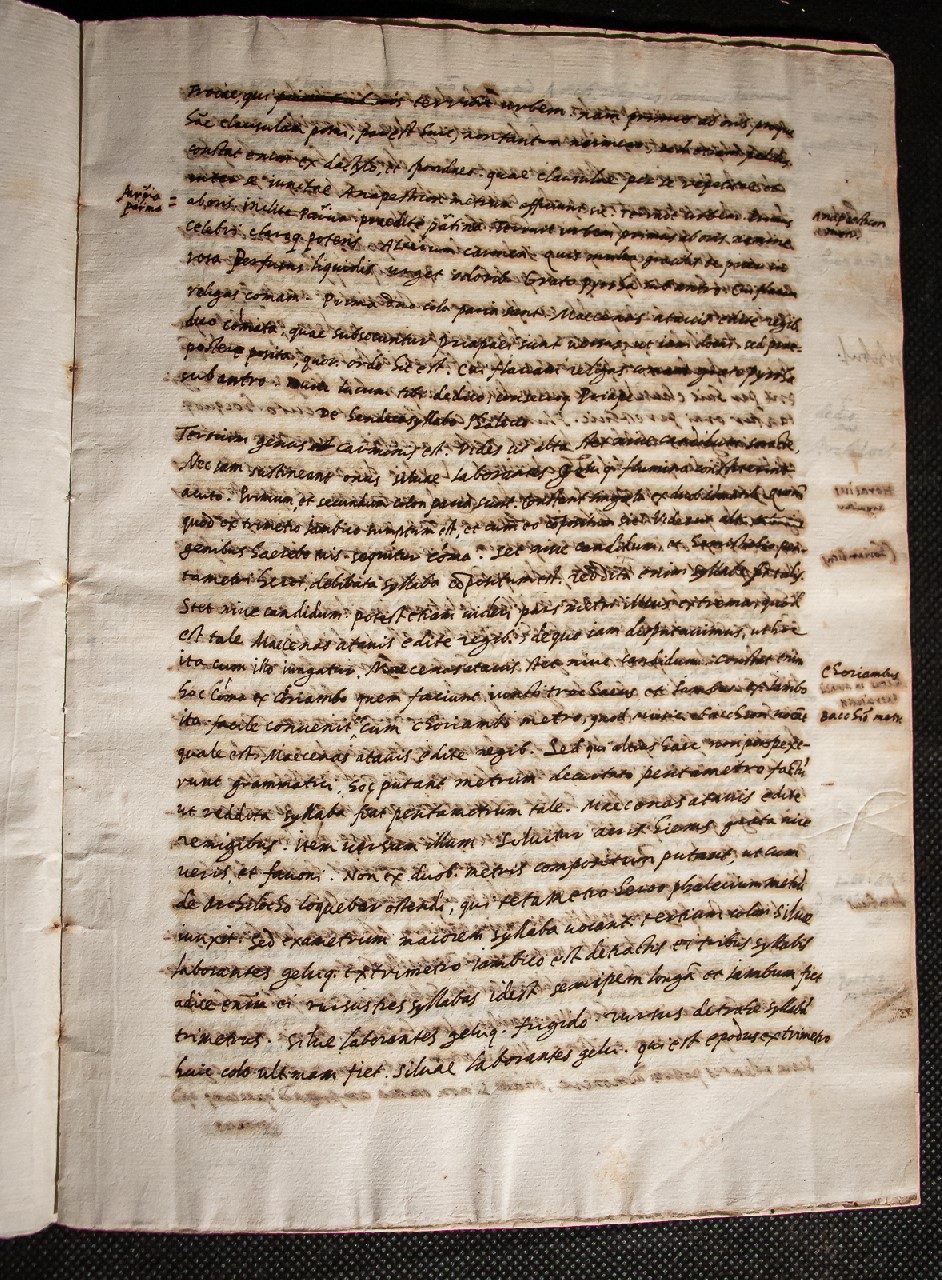
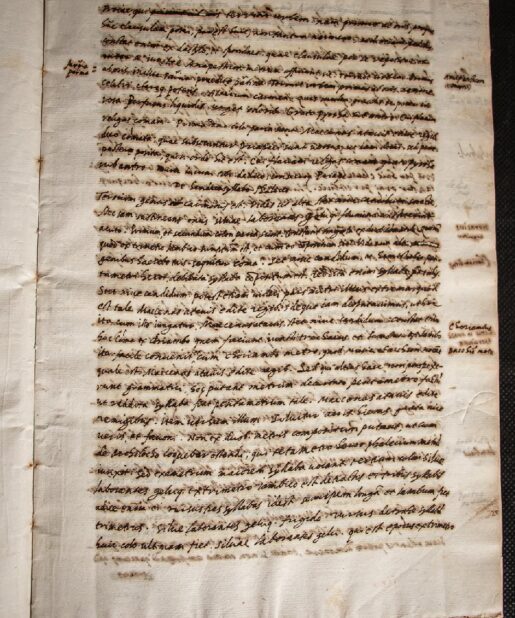
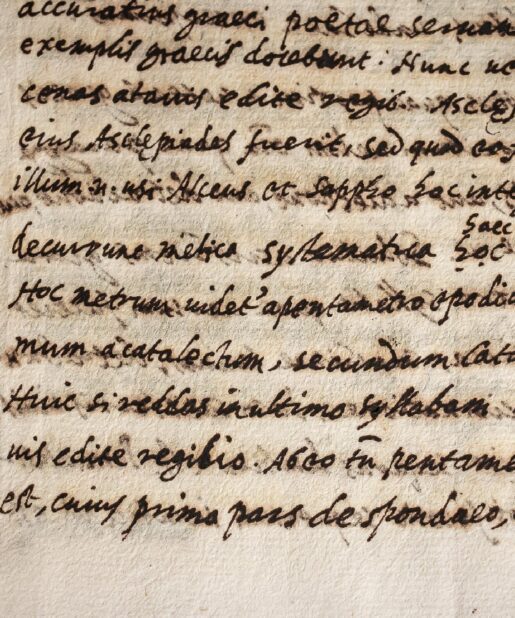
Paper manuscript, 15 leaves (single quire, self-cover), written on both sides in a slightly rapid humanist cursive (brown ink); occasional contemporary marginal notes and headings in the same hand; a few interlinear corrections; no decoration beyond simple paragraph breaks. Wide margins; deckle preserved on some edges. Clean and very legible, with the usual toning and a little offset/rubbing from heavy ink. Unbound as a stitched fascicle (self-cover), as originally used.
Contents (after Keil, Grammatici Latini VI)
The quire begins in medias res at the chapter De carmine sotadeo and runs continuously to the close of the work:
- Incipit (your first line): “Secundus pariambus, tertius spondeus…” (opening of De carmine sotadeo; ≈ Keil GL VI, p. 303).
- Followed by the lyric and dramatic metres in the usual order, with marginal cues for Asclepiadean, Sapphic, Alcaic, Glyconic/Pherecratean, iambic trimeter (senarius), trochaic tetrameter, anapaestic, choriambic, cretic, bacchiac, ionic, dochmiac, etc.
- Concludes with the heroic hexameter examples, including Lucan, Pharsalia 1.81: “Suis et ipsa Roma viribus ruit”.
- Explicit (final lines): “[…] Hexameter & Iambicus trimeter… Ars Atilii Fortunatiani explicit.”
Thus the manuscript preserves the latter portion of the Ars de metris, from De carmine sotadeo to the end; the earlier introductory books (feet, quantities, and earlier heroic/ elegiac sections) are not present.
Dating & origin
The humanist cursive, paper, and study format point to the second half of the 16th century (post-Renaissance). The linguistic and marginal habits suggest copying from a printed exemplar (Venetian or Basel imprints are most likely).
Significance
- Demonstrates how Renaissance readers learned and taught ancient metre: compact, annotated, and portable.
- Useful witness for textual/paratextual practices (headings, order of metres, choice of poetic examples), and for reception history—Fortunatianus’ manual was a staple for humanist schooling alongside Marius Victorinus, Terentianus Maurus, and Diomedes.
- A strong teaching piece for displays on prosody, classical pedagogy, and the transmission of Latin poetry.
Condition
Sound and complete for the preserved section; some show-through and uneven inking from a soft pen; a few marginal nicks; stitching sound. Very good for a working humanist fascicle.
References
- Keil, Grammatici Latini VI (Fortunatianus, Ars de metris).
- On humanist copying of ancient grammarians: R. Tarrant, “Ancient Scholarship and the Renaissance,” in The Oxford Handbook of Greek and Latin Scholarship.
Product Enquiry
Related products
![Leaf of Passionale in Latin [Italy, 12th century, first half] Lives of St Felicity and St Clement](https://stephenbutler.com/wp-content/uploads/2021/01/IMG_0696-515x618.jpg "Leaf of Passionale in Latin [Italy, 12th century, first half] Lives of St Felicity and St Clement")
C12th - C13th manuscripts
Leaf of Passionale in Latin [Italy, 12th century, first half] Lives of St Felicity and St Clement
£1,200.00

C14th -C16th manuscripts
£400.00
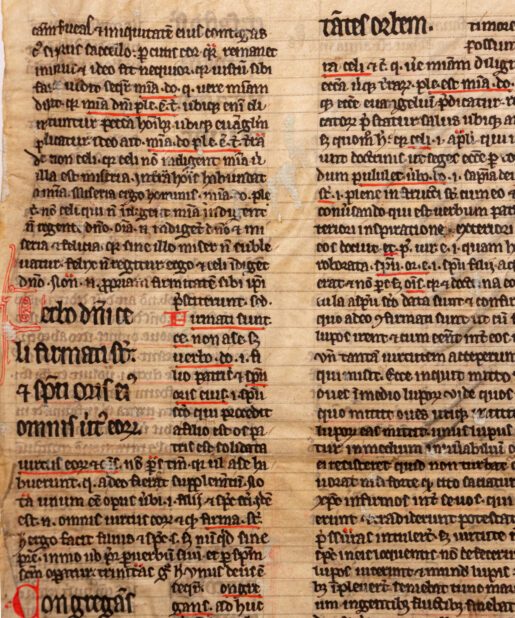
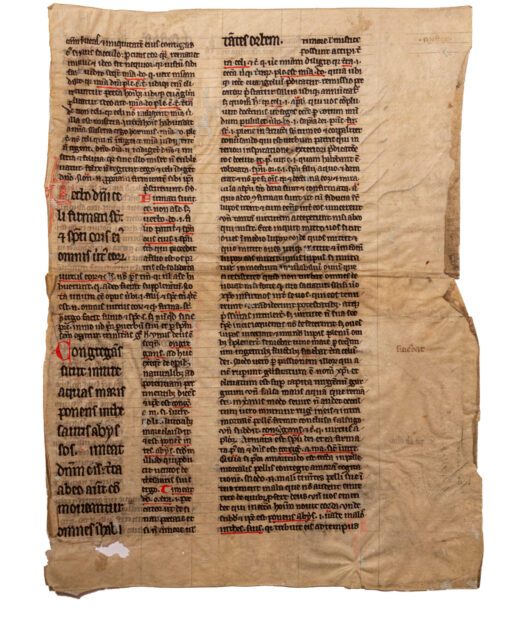
C12th - C13th manuscripts
Glossed Bible leaf reused as a binding in French archive. France (doubtless Paris), 13th century.
£1,500.00
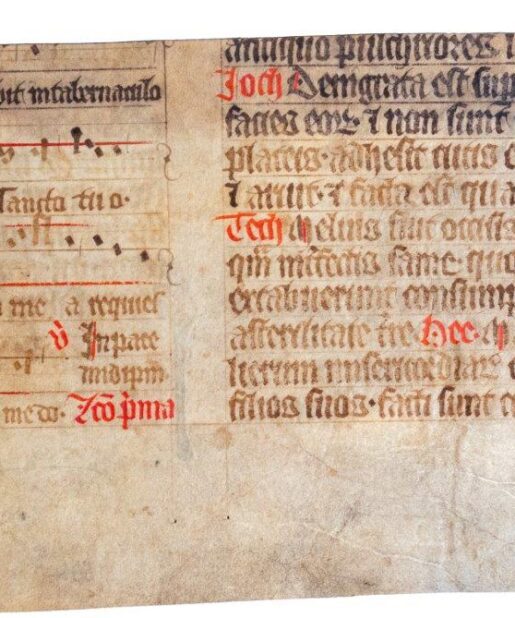
C14th -C16th manuscripts
A C14th cutting from a Noted Breviary with music on a 4-line stave arranged around a red clef line
£280.00
![A single leaf; Augustine’s Enarrationes in Psalmos, for Psalm 41:6-8 [manuscript]](https://stephenbutler.com/wp-content/uploads/2021/06/IMG_2115-scaled-515x618.jpg "A single leaf; Augustine’s Enarrationes in Psalmos, for Psalm 41:6-8 [manuscript]")
![A single leaf; Augustine’s Enarrationes in Psalmos, for Psalm 41:6-8 [manuscript]](https://stephenbutler.com/wp-content/uploads/2021/06/IMG_2112-scaled-515x618.jpg "A single leaf; Augustine’s Enarrationes in Psalmos, for Psalm 41:6-8 [manuscript]")
£3,750.00
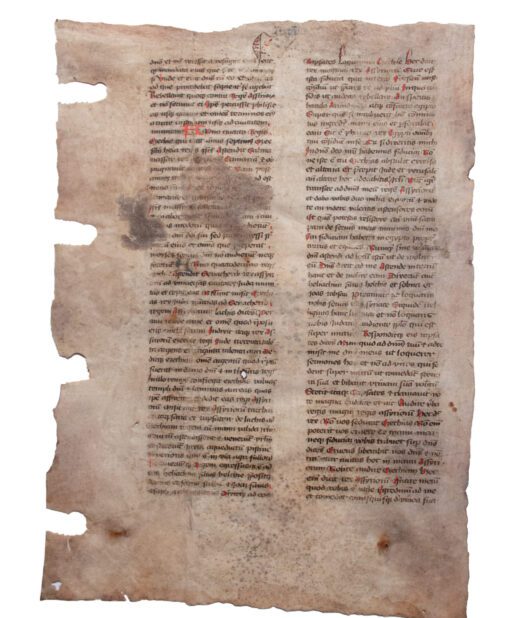
C14th -C16th manuscripts
Leaf from a Bible, II Kings 17, C15th manuscript in Latin on parchment
£750.00
C14th -C16th manuscripts
Single leaf from the so-called ‘Carondelet Breviary’ 1458 from the scribe Jean d’Aussert
£600.00


C14th -C16th manuscripts
Illuminated inital 1500 huge leaf on vellum, from Siena or Florence.
£750.00