

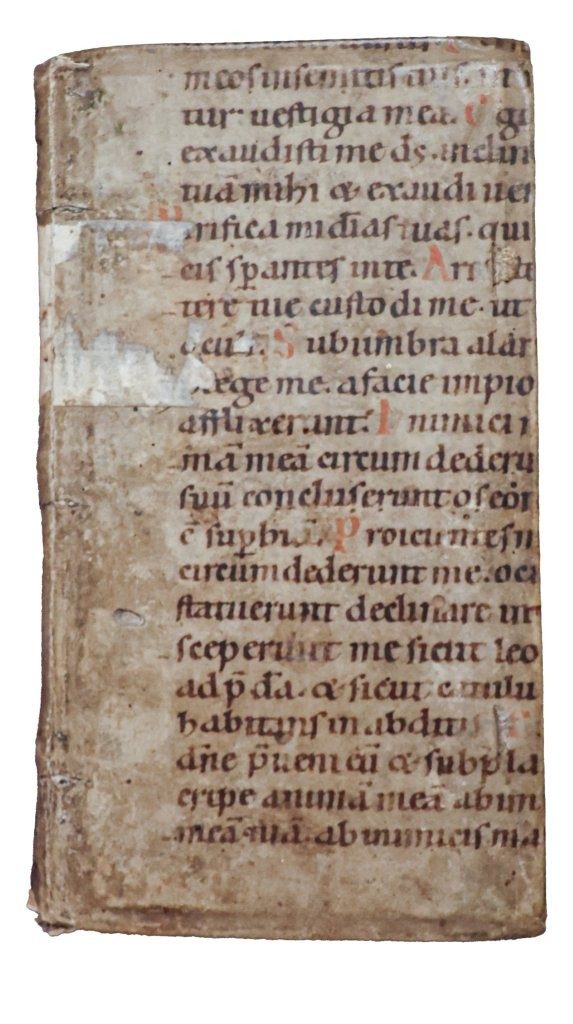
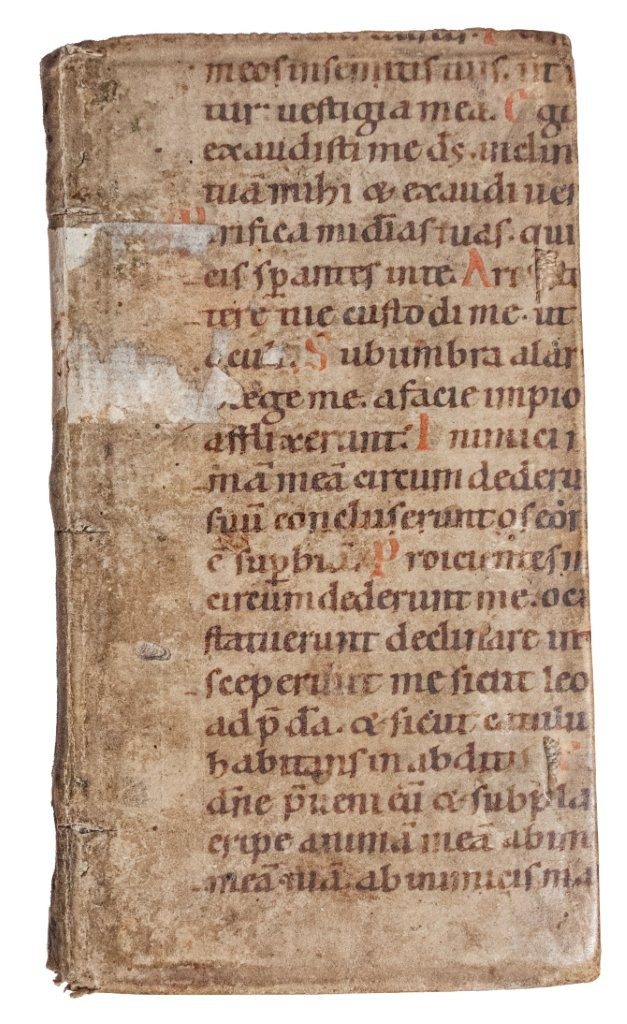
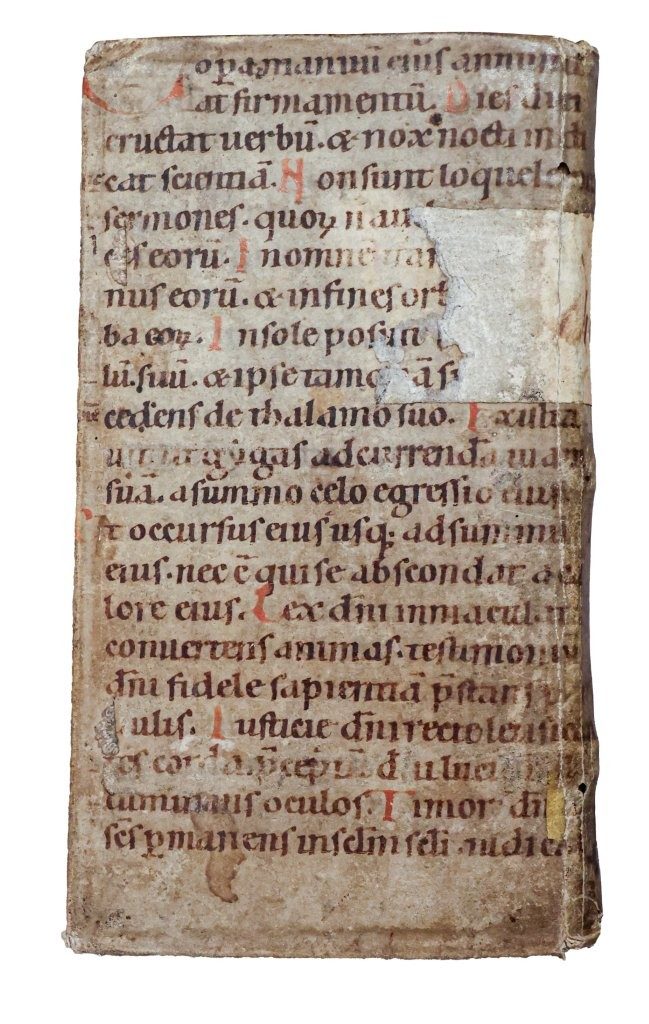
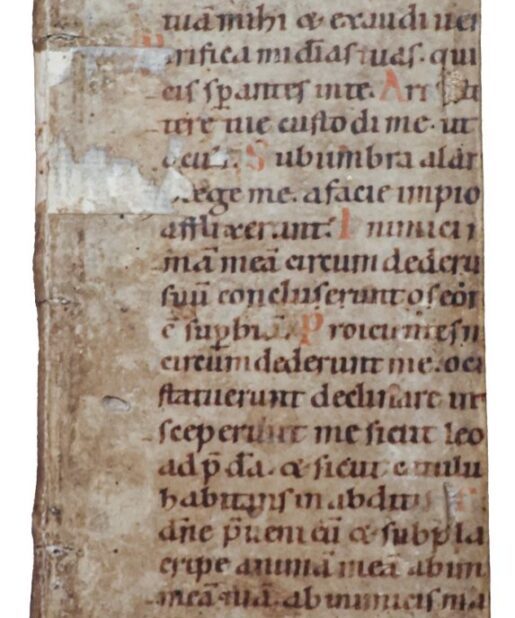
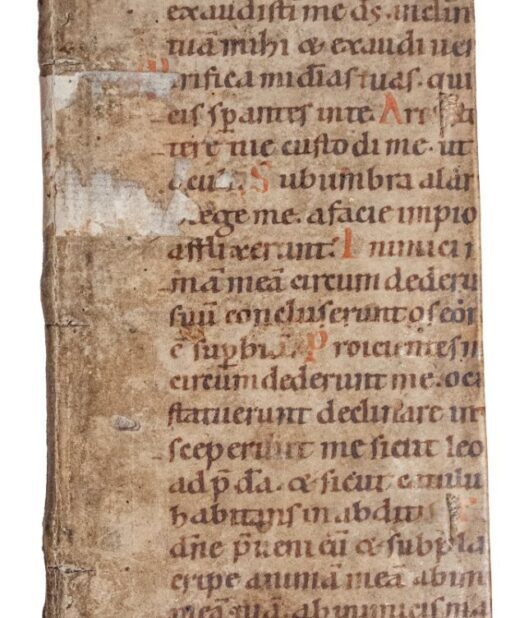
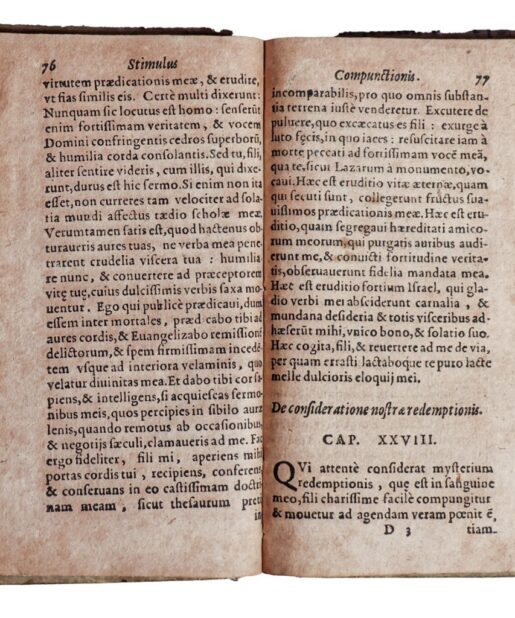
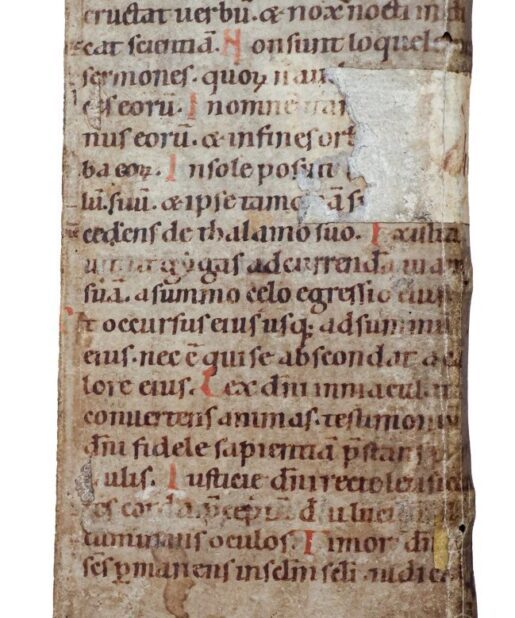

Leaf from a Romanesque Psalter In Latin, decorated manuscript on vellum [Germany (perhaps Bavaria, or Cologne), first half of the 12th century]
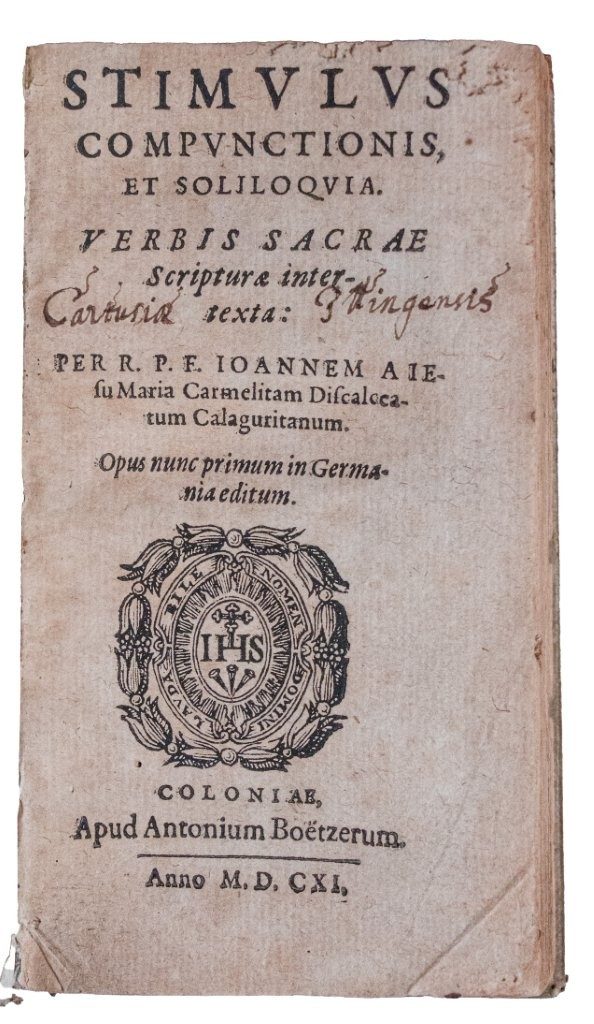
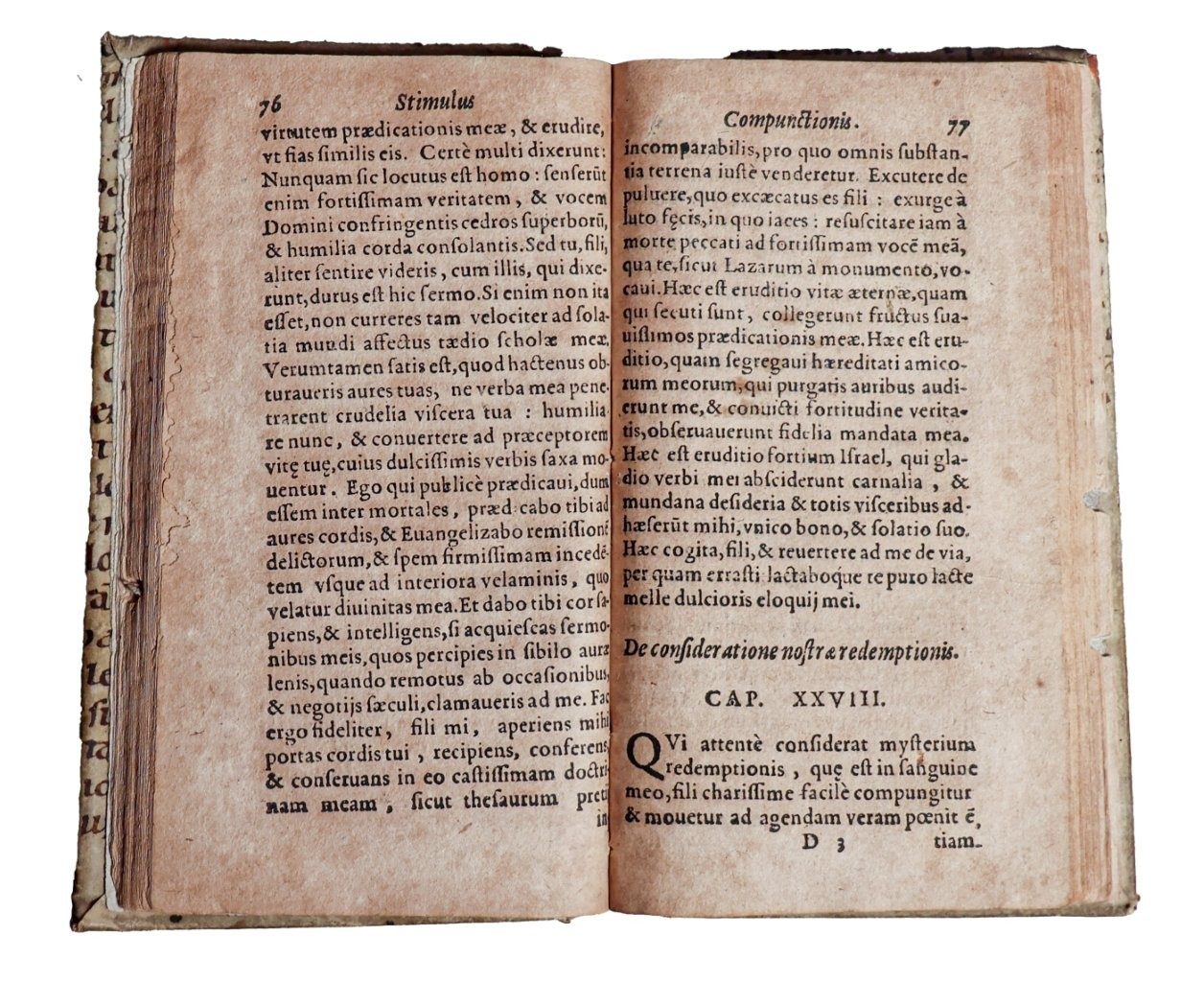
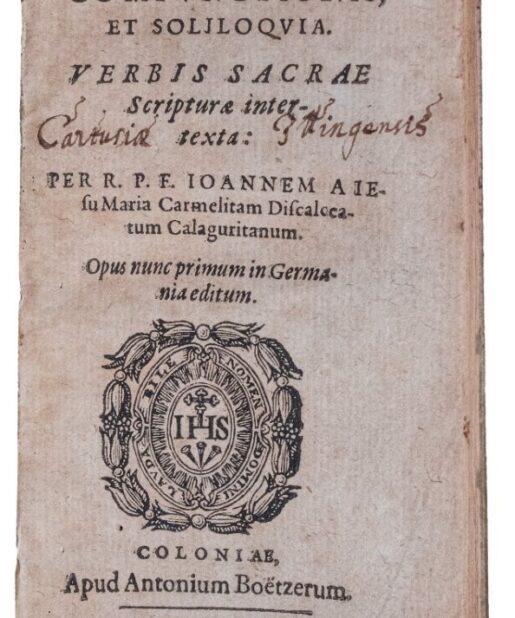
[with] Ioannes a Iesu Maria. Stimulus compunctionis et soliloquia verbis sacrae scripturae intertexta.
Cologne, apud Antonium Boëtzerum, 1611
180mm x 120mm
Description
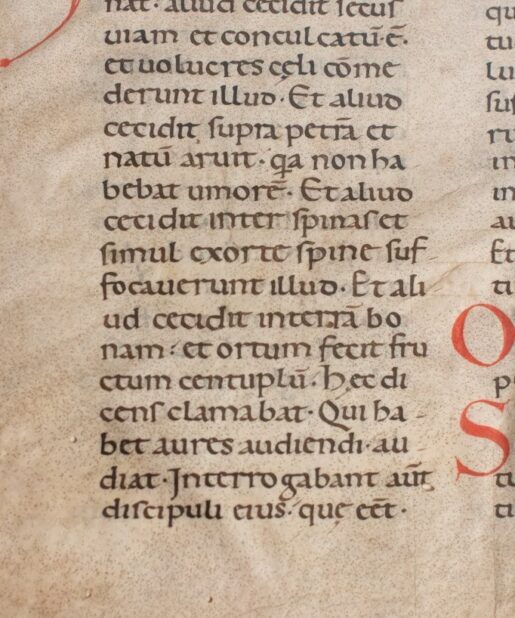
169+v (index). Single leaf as a binding from a finely executed Romanesque Psalter, written in a compact late Caroline/early protogothic bookhand, c. 14–16 lines preserved per page, in dark brown ink, with rubrication in red and occasional enlarged initials touched in red. The script is regular and upright, with clear word separation and restrained decoration.
Condition
The leaf shows clear signs of reuse: trimmed at all edges, with surface abrasion, adhesive staining, and areas of loss where it was pasted to the boards. Nonetheless, substantial portions of text remain legible, and the alternating red and brown ink retains strong visual contrast. Some marginal worming towards the end, not touching the text, browned otherwise good.
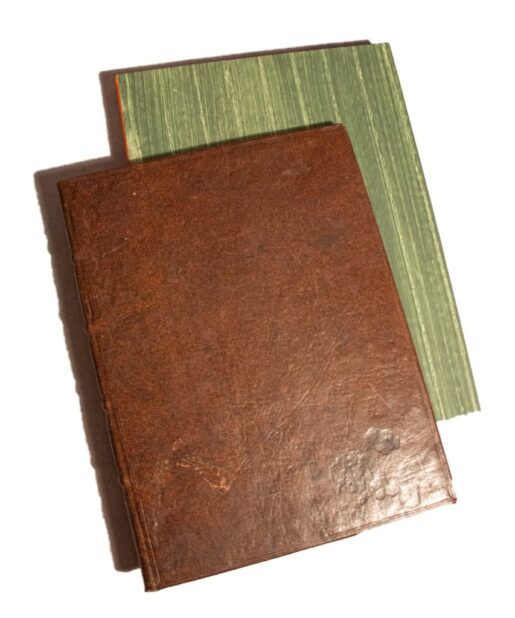
This medieval fragment survives as the binding material for a small 12mo printed devotional work. The volume remains in its original limp vellum binding.
Text
The text comprises portions of the Psalms (including passages identifiable from Psalmic liturgical sequences).
Provenance
1. The Charterhouse of Astheim, founded in 1409 by Carthusian monks from Cologne, maintained a modest but active library. The reuse of earlier manuscripts for binding purposes is entirely characteristic of Carthusian houses in the Early Modern period. The ex libris on the printed frontispiece: “Cartusiae Z[i]ttingensis” suggests an origin for the parent manuscript either in Bavaria where the charterhouse was founded in 1409, or Cologne where the founding monks came from. If the latter, then the parent manuscript may have been among the founding books of the charterhouse. The manuscript leaf was almost certainly reused for binding within the Charterhouse. Following the secularisation of 1803, the monastery was dissolved and its books dispersed; the present volume survives as a rare witness both to that library and to its earlier medieval holdings.
Product Enquiry
Related products
![Commentary on Aristotle, Categoriae, and the same authors translation of Perihermenias BOETHIUS [MS] C.13th](https://stephenbutler.com/wp-content/uploads/2013/08/IMG_8383-515x618.jpg "Commentary on Aristotle, Categoriae, and the same authors translation of Perihermenias BOETHIUS [MS] C.13th")
![Commentary on Aristotle, Categoriae, and the same authors translation of Perihermenias BOETHIUS [MS] C.13th](https://stephenbutler.com/wp-content/uploads/2013/08/IMG_8379-515x618.jpg "Commentary on Aristotle, Categoriae, and the same authors translation of Perihermenias BOETHIUS [MS] C.13th")
C12th - C13th manuscripts
£3,800.00


C12th - C13th manuscripts
£4,850.00
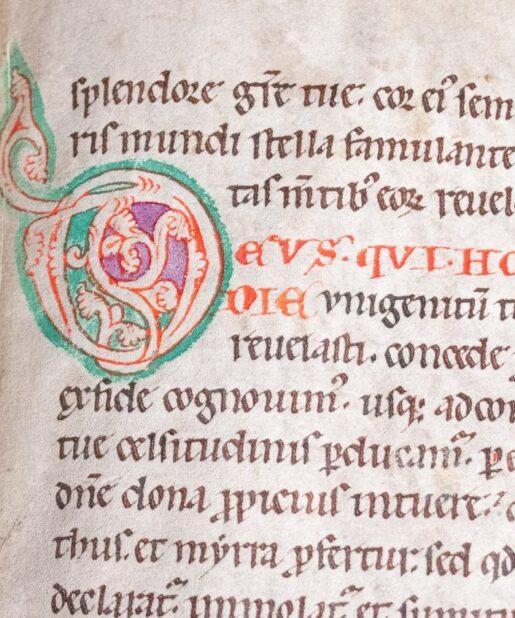

C12th - C13th manuscripts
A Monumental Romanesque Lectionary from Twelfth-Century Italy
£3,000.00

C14th -C16th manuscripts
£350.00
![Saints Peter and Paul, in an illuminated historiated initial ‘N’, cut from a Gradual in Latin on parchment [Italy (Florence); 15th century (c.1470s)]](https://stephenbutler.com/wp-content/uploads/2022/02/IMG_6782-515x618.jpg "Saints Peter and Paul, in an illuminated historiated initial ‘N’, cut from a Gradual in Latin on parchment [Italy (Florence); 15th century (c.1470s)]")
![Saints Peter and Paul, in an illuminated historiated initial ‘N’, cut from a Gradual in Latin on parchment [Italy (Florence); 15th century (c.1470s)]](https://stephenbutler.com/wp-content/uploads/2022/02/IMG_6781-515x618.jpg "Saints Peter and Paul, in an illuminated historiated initial ‘N’, cut from a Gradual in Latin on parchment [Italy (Florence); 15th century (c.1470s)]")


![Pontifical, service book for use by a bishop, in Latin [France, mid- to third quarter of the twelfth century]](https://stephenbutler.com/wp-content/uploads/2024/09/IMG_0290-515x618.jpg "Pontifical, service book for use by a bishop, in Latin [France, mid- to third quarter of the twelfth century]")
C12th - C13th manuscripts
£2,000.00