



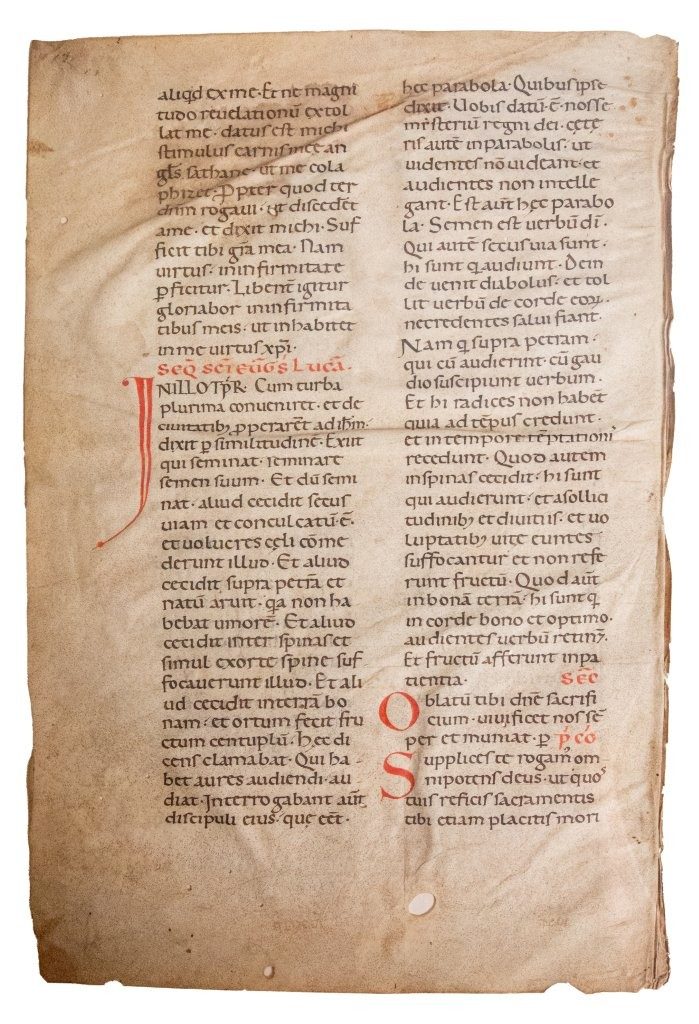

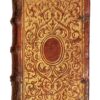
Leaf from a gargantuan Lectionary, in Latin, decorated manuscript on vellum, [Italy, first half of the twelfth century]
Description
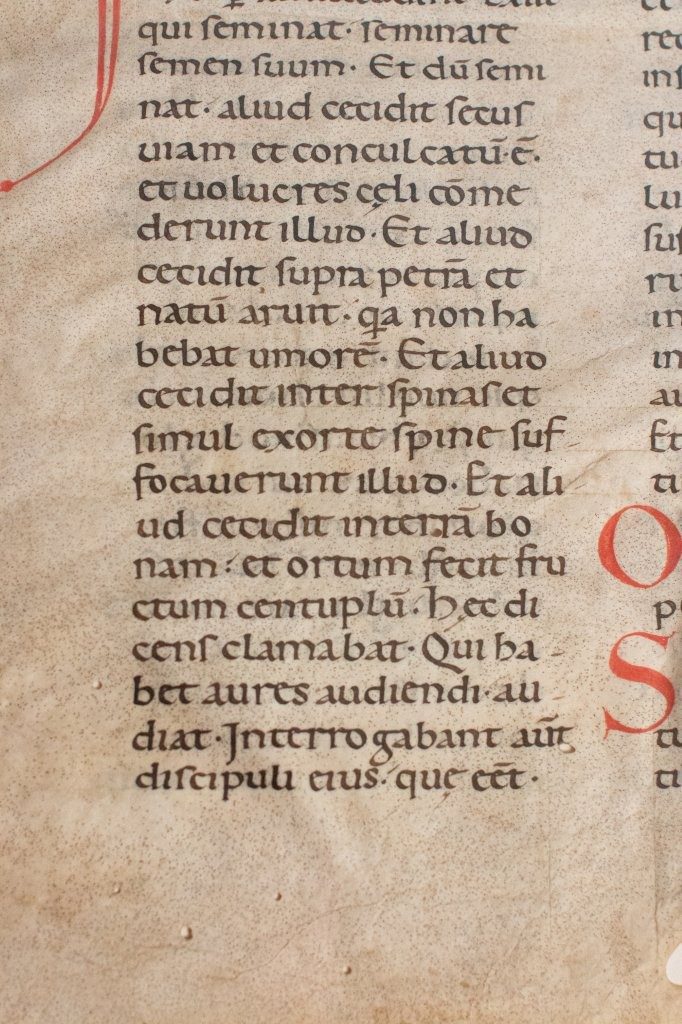
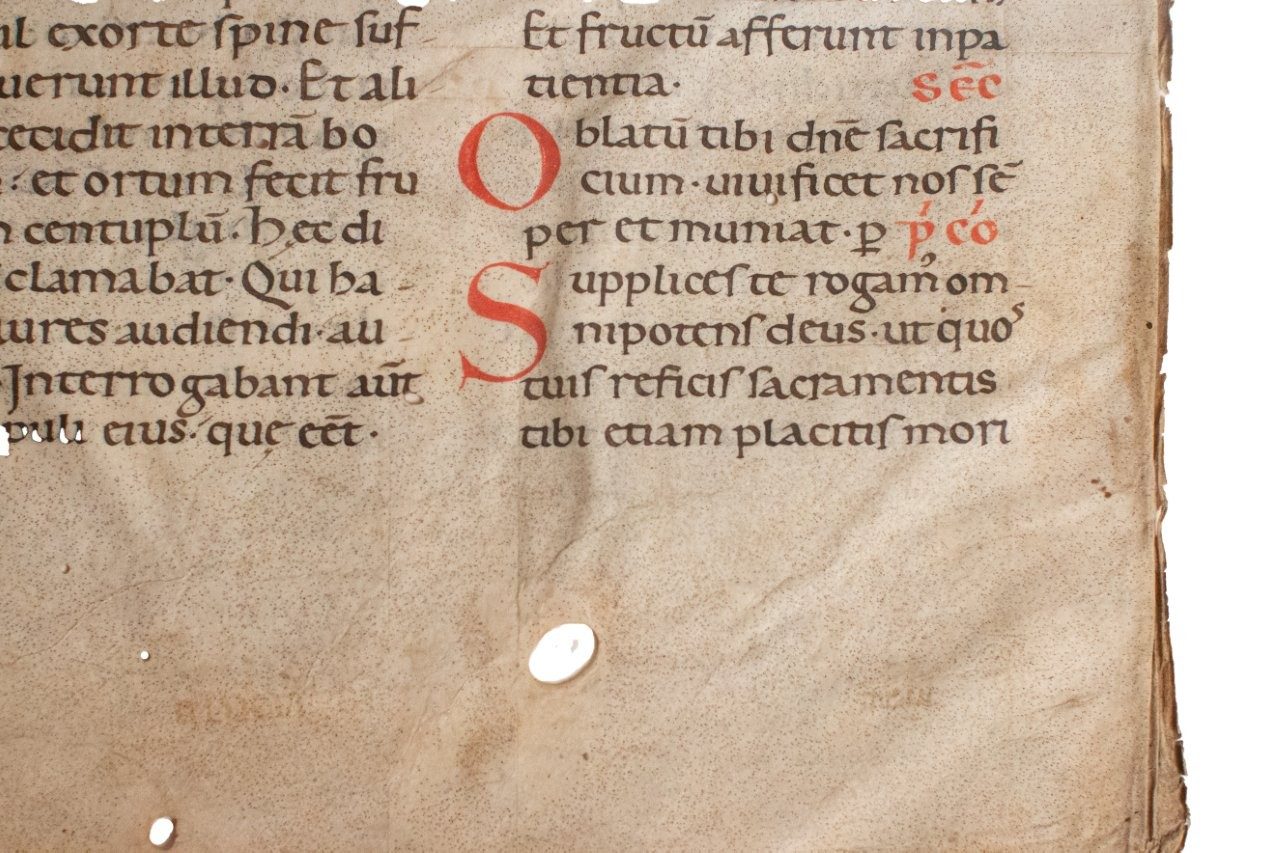
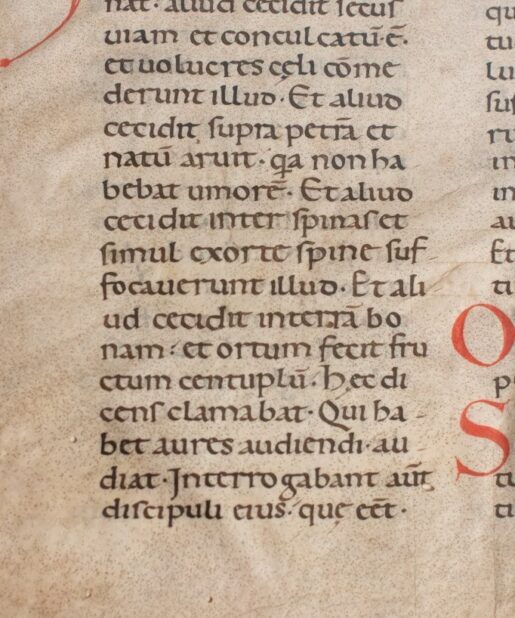
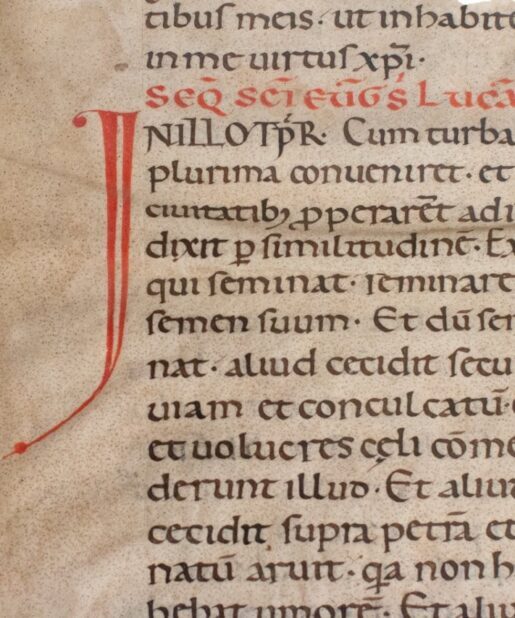
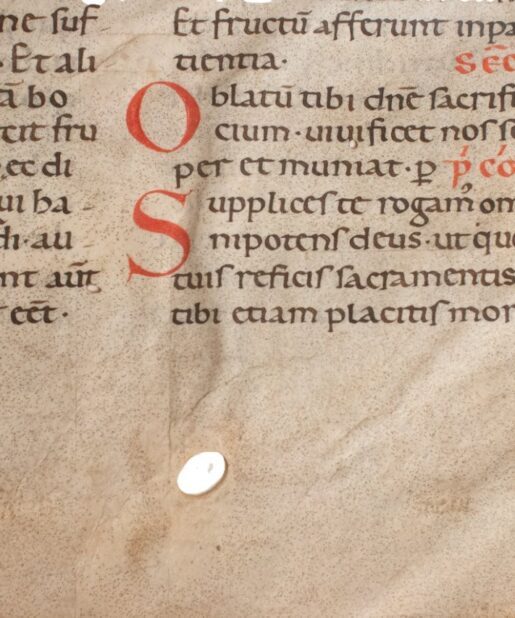
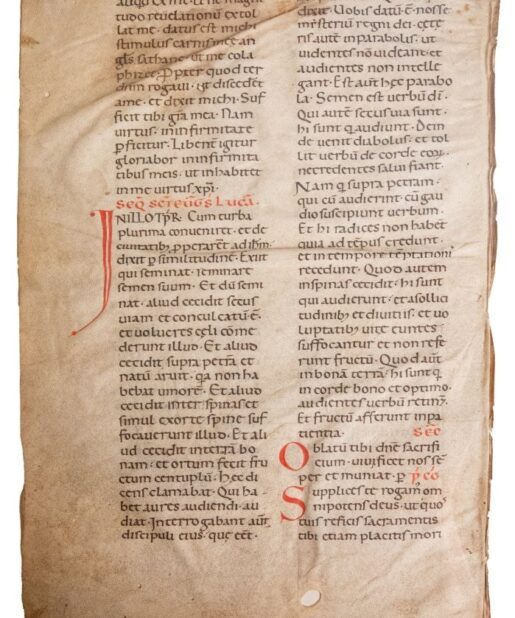
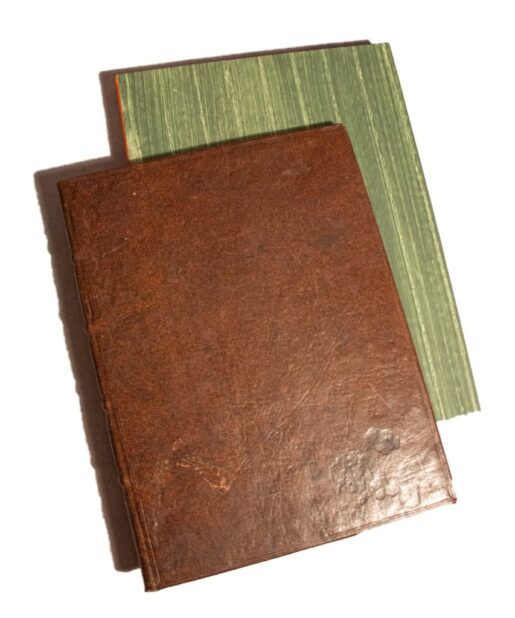
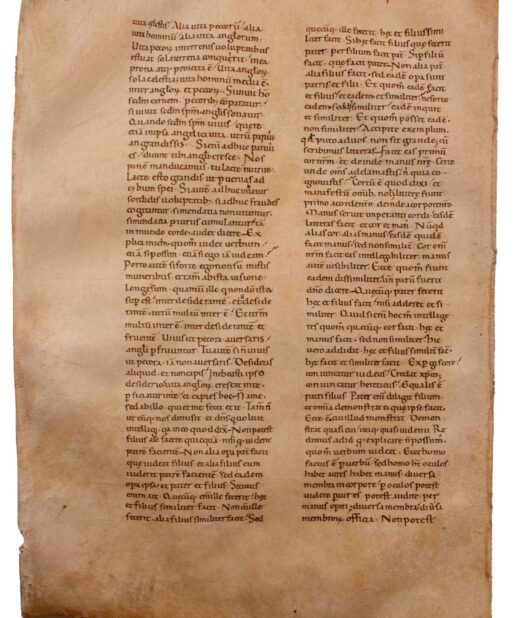
Leaf from a gargantuan Lectionary,in Latin, decorated manuscript on vellum, [Italy, first half of the twelfth century], single large leaf, with text in double column of 38 lines of a square Romanesque bookhand, written without biting curves, red rubrics, two small red initials, one larger initial in split bands of red decorated with a bauble mounted in the tip of its descender, small natural flaws (all in margins), a few apparently erased words in lower margin in medieval hand, some folds and stains from having been reused in a binding and then folded across its mid-point, else in good and presentable condition, 407 x 270mm.; framed in gilt, and only verso visible (not examined out of frame).
A striking survival of Romanesque book production, this imposing leaf comes from a monumental lectionary produced in Italy during the first half of the twelfth century. Its exceptional dimensions immediately reveal its original purpose: rather than being intended for private reading, it was written to be displayed upon a lectern and read aloud during the celebration of the Mass, allowing the sacred text to be clearly visible to the officiating clergy.
Executed in a bold and beautifully proportioned Romanesque bookhand, the manuscript embodies the clarity and discipline characteristic of Italian scriptoria in the decades before the widespread adoption of Gothic textualis. The generous spacing, broad letterforms and restrained decoration emphasise legibility above ornament, while carefully executed red rubrics and initials provide visual guidance through the liturgical text. Particularly attractive is the elongated red initial with its elegant split bands terminating in a distinctive bead-like finial, a decorative feature typical of Italian Romanesque illumination.
The text preserves readings from the Gospel of Luke, including Christ’s Parable of the Sower (Luke 8:4–15), one of the central Gospel passages explaining the reception of the Word of God, followed by the opening of another liturgical reading beginning Oblati sunt Domino sacrificii…. Such passages would have formed part of the annual cycle of Mass readings, proclaiming Scripture before the congregation on the appointed feast days.
Like many medieval manuscripts, the leaf enjoyed a long life beyond its original function. At some point it was recycled within the binding of a later volume, accounting for the folds, stains and evidence of wear that testify to centuries of practical use rather than neglect. Such reuse, now recognised as an invaluable source for the survival of medieval manuscripts, has paradoxically ensured the preservation of countless fragments that would otherwise have disappeared entirely.
⁂ Acquired from the medievalist and art dealer, Marc Antoine du Ry.
Product Enquiry
Related products
C12th - C13th manuscripts
£3,000.00
C12th - C13th manuscripts
Miniature Breviary leaf with unusual and handsome script, c.1280
£1,500.00
![A single leaf; Augustine’s Enarrationes in Psalmos, for Psalm 41:6-8 [manuscript]](https://stephenbutler.com/wp-content/uploads/2021/06/IMG_2115-scaled-515x618.jpg "A single leaf; Augustine’s Enarrationes in Psalmos, for Psalm 41:6-8 [manuscript]")
![A single leaf; Augustine’s Enarrationes in Psalmos, for Psalm 41:6-8 [manuscript]](https://stephenbutler.com/wp-content/uploads/2021/06/IMG_2112-scaled-515x618.jpg "A single leaf; Augustine’s Enarrationes in Psalmos, for Psalm 41:6-8 [manuscript]")
£3,750.00


C12th - C13th manuscripts
Elegant English Early Gothic Script from late C12th Passionale – Paulinus of Milan
£1,750.00
![Commentary on Aristotle, Categoriae, and the same authors translation of Perihermenias BOETHIUS [MS] C.13th](https://stephenbutler.com/wp-content/uploads/2013/08/IMG_8383-515x618.jpg "Commentary on Aristotle, Categoriae, and the same authors translation of Perihermenias BOETHIUS [MS] C.13th")
![Commentary on Aristotle, Categoriae, and the same authors translation of Perihermenias BOETHIUS [MS] C.13th](https://stephenbutler.com/wp-content/uploads/2013/08/IMG_8379-515x618.jpg "Commentary on Aristotle, Categoriae, and the same authors translation of Perihermenias BOETHIUS [MS] C.13th")
C12th - C13th manuscripts
£3,800.00
C12th - C13th manuscripts
£1,900.00

C12th - C13th manuscripts
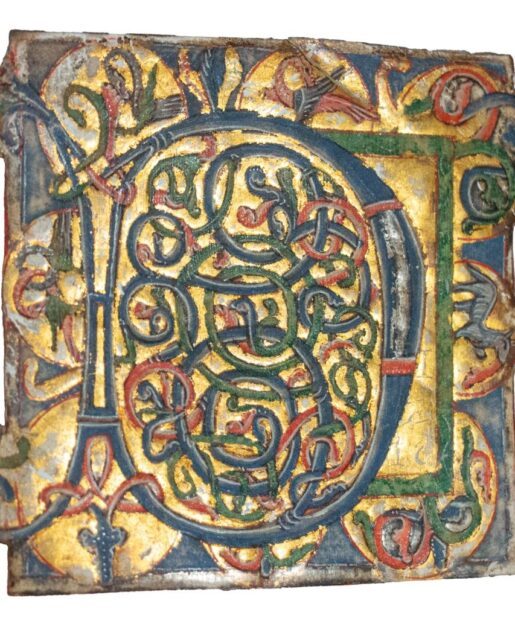
Intricate and large illuminated initial ‘D’ from a Breviary, C13th Germany
£5,000.00