



William de Cornhill, Bishop of Coventry – adviser to King John on the Magna Carta
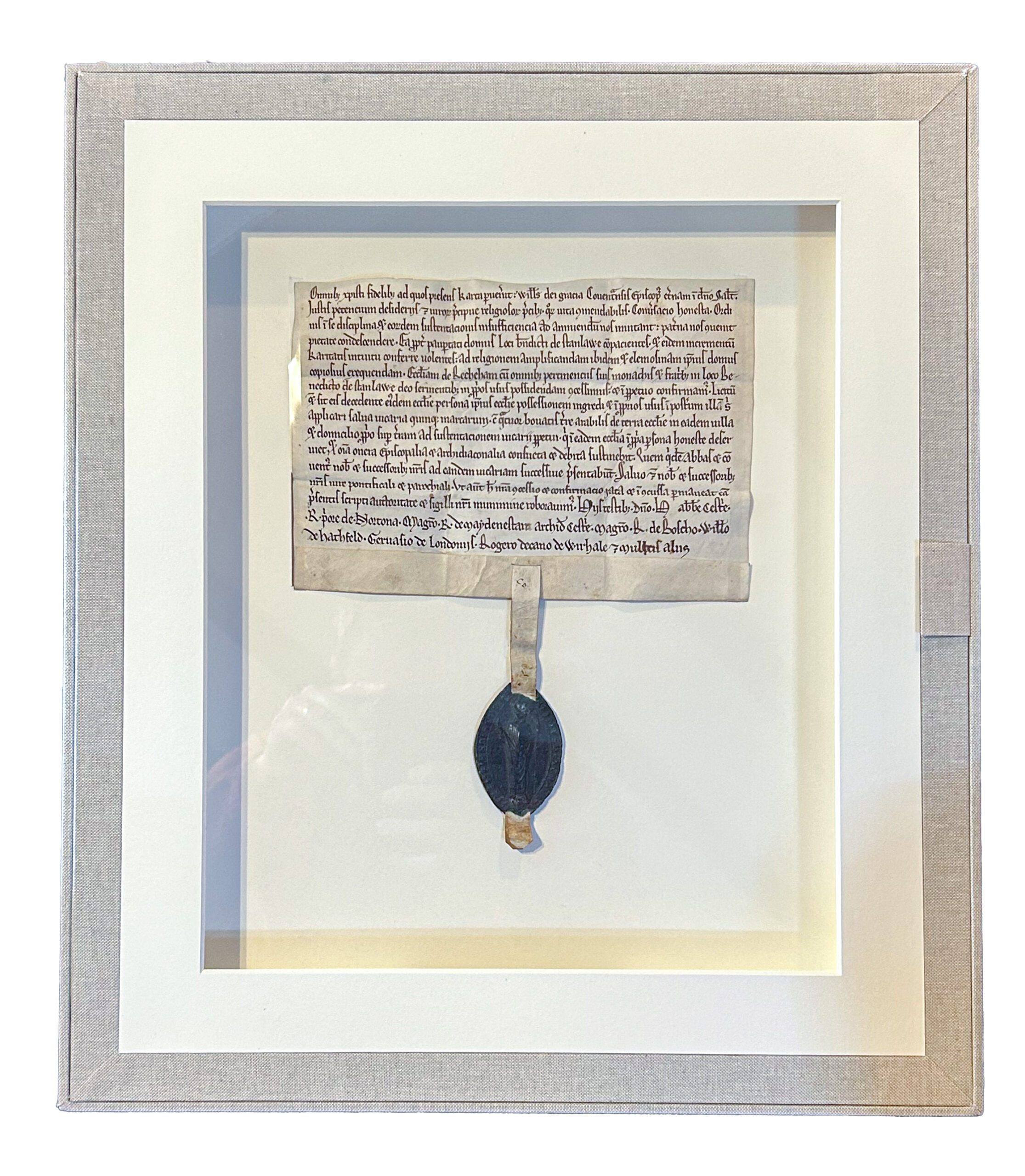
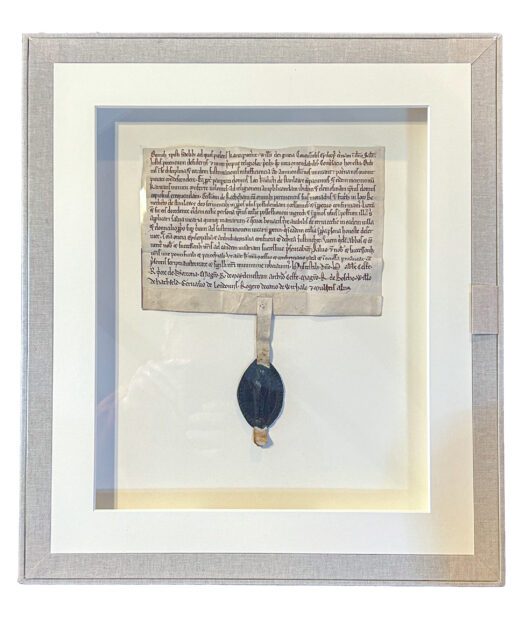
Latin charter granting the church of Rochdale to the Cistercian Abbey of Stanlaw, 1222 AD
Latin charter on vellum, granting the church of Rochdale to the Cistercian Abbey of Stanlaw. With attached pendant Episcopal seal of William Cornhill in dark green wax showing standing bishop and motto “S. Wil]ielmus: Dei Gracia [Cove]ntriensis: Episcopus,” and remnants of original cloth seal bag.
1 page, 6 x 9 inches; faint scattered foxing.
“William, Bishop of Coventry, out of desire for justice and for motives of religion and because of the poverty of the abbey of Stanlaw and because of his desire to increase the good work of the monks there, grants to the abbey the church of Rochdale with all its lands including sufficient arable land to maintain a suitable parson for the church to be appointed by the abbot of Stanlaw and his successors . . . .”
In 1172, John, Constable of Chester, founded the Cistercian Abbey of Stanlaw in Cheshire, which, in 1296, became incorporated into Whalley Abbey in Lancashire.
This document ends with a list of witnesses, including Ralph of Maidstone (d. 1245), who was an early Master of Oxford University and its Chancellor in 1231.
William of Cornhill (d. 1223) was bishop of Coventry between 1214 and 1223, holding a number of offices in the service of King John (1167-1216), whom William advised concerning the signing of the Magna Carta.
Cornhill, William of (d. 1223), bishop of Coventry, belonged to a London family who rose in the service of Henry II and his sons. Cornhill remained active on the side of John until the very end of the reign; he went on unsuccessful missions to persuade both the Londoners and the Welsh princes to support the king (Rymer, Foedera, 1.121, 127) and accompanied him to Runnymede, being named in Magna Carta as one of the magnates by whose advice it was issued. In September 1221 Cornhill was deprived of speech by a sudden stroke of paralysis during an ordination service. He died on 19 August 1223, and was buried in Lichfield Cathedral, where his coffin was discovered in 1662. The prior of Coventry’s contemporary epitaph was ‘Vir simplex et liberalis, fidelis regi et utilis regno’ (‘agenerous low-born man, faithful to the king and of service to the realm’; Dugdale, Monasticon, 6.1242).
Published
William Adam Hulton, ed., The Coucher Book or Chartulary of Whalley Abbey, vol. 1, 1847, no. IV. [pg 139];
Denton, Jeffrey H., English Episcopal Acta, 43: Coventry & Lichfield 1215-1256, OUP/British Academy 2014.
Product Enquiry
Related products

C12th - C13th manuscripts
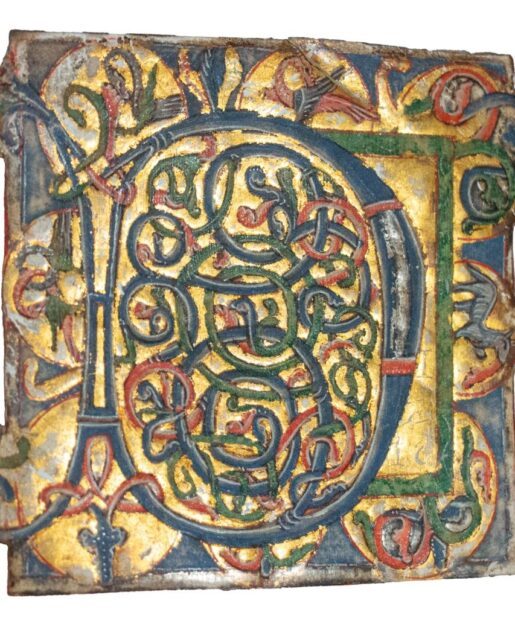
Intricate and large illuminated initial ‘D’ from a Breviary, C13th Germany
£5,000.00
C12th - C13th manuscripts
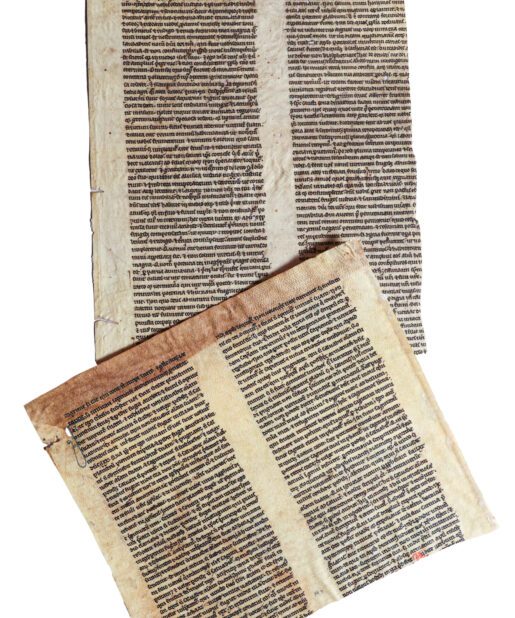
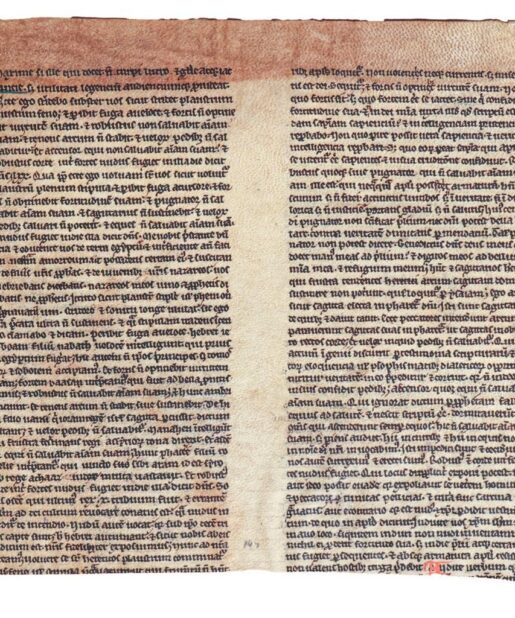
SAINT JEROME. Commentary on the Prophets Two manuscript fragments on vellum England, c. 1240
£750.00


C12th - C13th manuscripts
£5,000.00


C12th - C13th manuscripts
Beautiful painted white vine initial, Augustine’s Commentary on John’s Gospel, Italy C12th
£3,800.00

C12th - C13th manuscripts
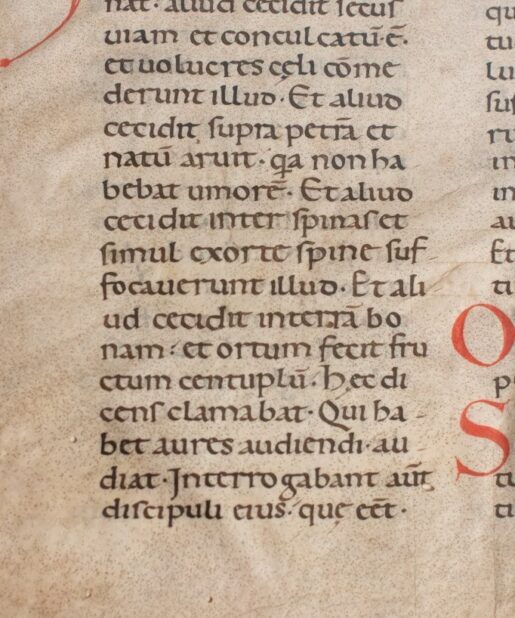
A Monumental Romanesque Lectionary from Twelfth-Century Italy
£3,000.00
![Commentary on Aristotle, Categoriae, and the same authors translation of Perihermenias BOETHIUS [MS] C.13th](https://stephenbutler.com/wp-content/uploads/2013/08/IMG_8383-515x618.jpg "Commentary on Aristotle, Categoriae, and the same authors translation of Perihermenias BOETHIUS [MS] C.13th")
![Commentary on Aristotle, Categoriae, and the same authors translation of Perihermenias BOETHIUS [MS] C.13th](https://stephenbutler.com/wp-content/uploads/2013/08/IMG_8379-515x618.jpg "Commentary on Aristotle, Categoriae, and the same authors translation of Perihermenias BOETHIUS [MS] C.13th")
C12th - C13th manuscripts
£3,800.00


![Fragmentary leaf of a Glossed Gospels, in Latin, manuscript on vellum [France(?), 12th century (3rd? quarter)]](https://stephenbutler.com/wp-content/uploads/2024/09/IMG_1175-515x618.jpg "Fragmentary leaf of a Glossed Gospels, in Latin, manuscript on vellum [France(?), 12th century (3rd? quarter)]")
C12th - C13th manuscripts
£1,600.00