

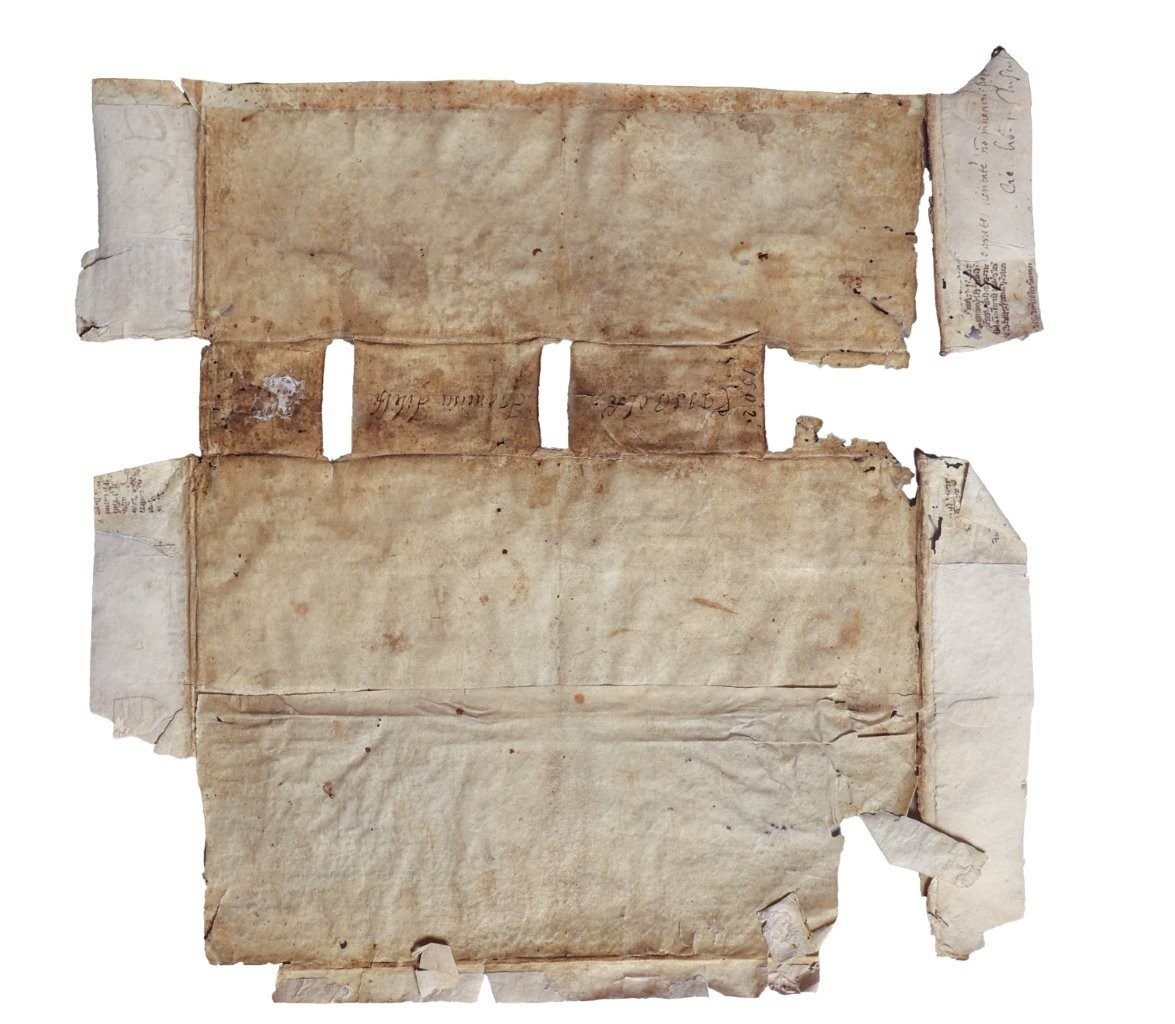
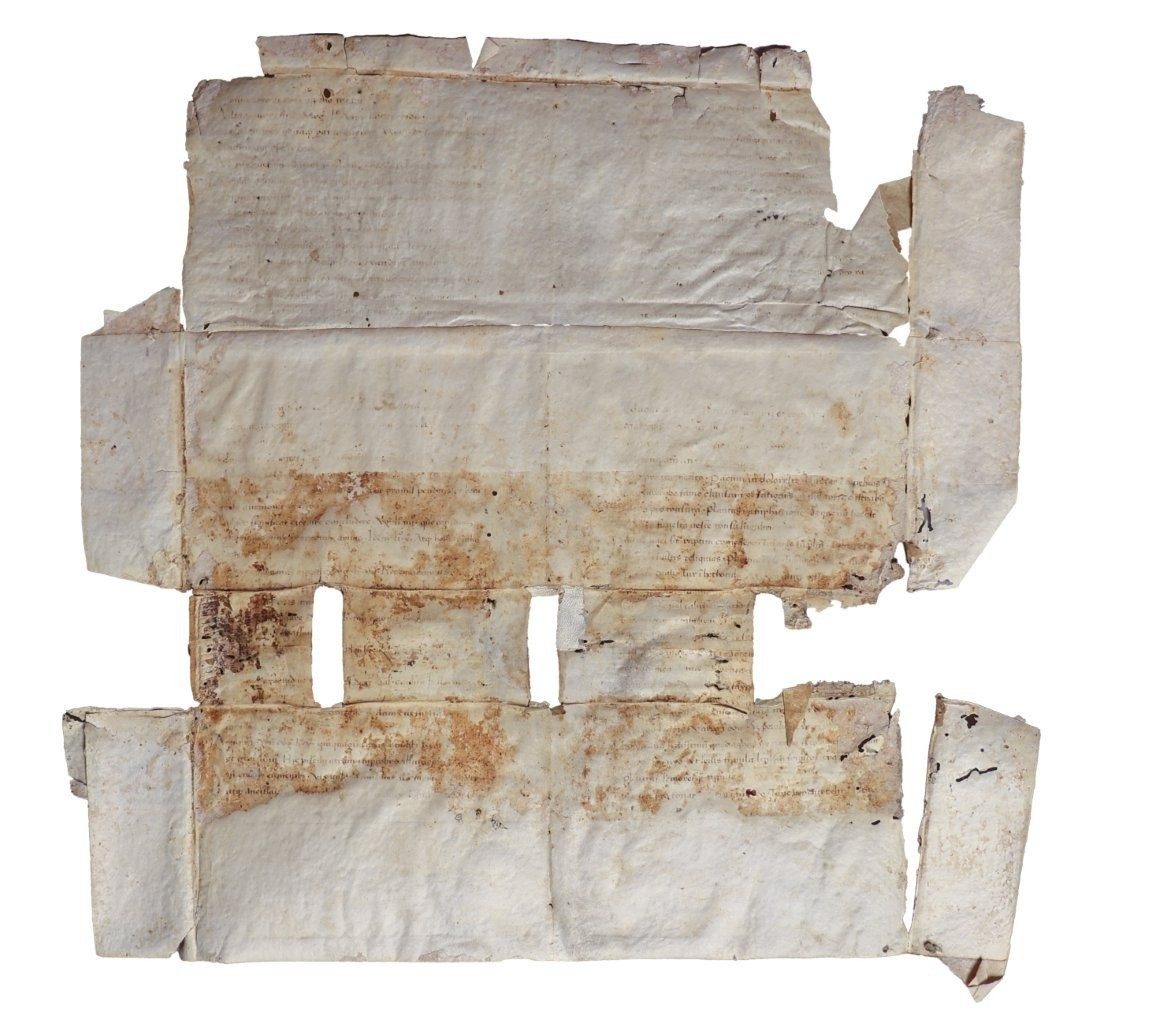
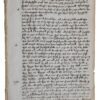
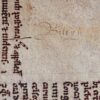
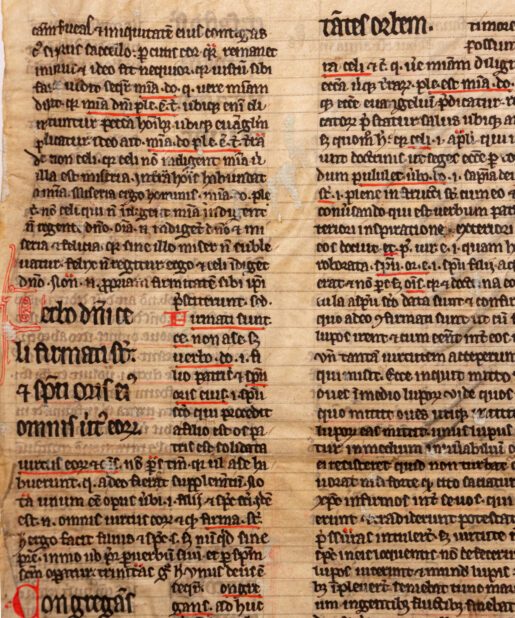
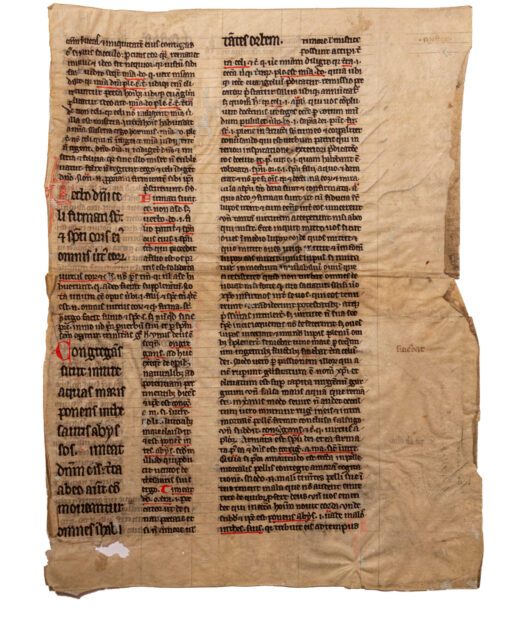
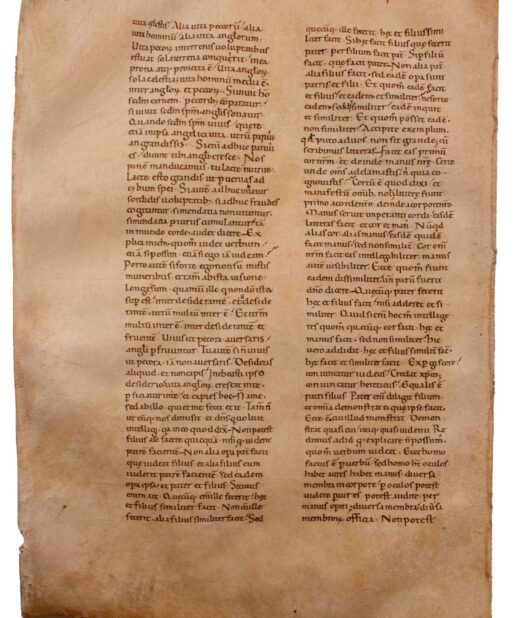
Fragment from a bifolium and a fragment from a leaf from a copy of Nonius Marcellus, De compendiosa doctrina (a dictionary-like encyclopedia quoting numerous otherwise lost Ancient authors), in Latin, humanist manuscript on parchment. [Italy, c. 1450]
Remains of three leaves, pasted together and reused on a later binding and so with scuffed surfaces, cuts to edges, and small rectangular sections cut away from middle to accommodate thongs on spine of later binding, remains of double column of 20 lines (with entries from the ‘A’ and ‘T’ sections of the text), approximately two thirds of surface damaged and difficult or impossible to read, the remainder with 14 legible lines from each leaf, reverse scrubbed clean and with sixteenth-century title added, small sections of a thirteenth- or fourteenth-century manuscript visible in offset on reverse, the bifolium 258 by 385mm. (the whole 375 by 385mm.)
Provenance: Bloomsbury Auctions, 10 July 2018, lot 14.
Text:
Nonius Marcellus was an important Roman author, who has been so spectacularly ill served by the passage of time that we know almost nothing about him, and his works are of superlative rarity in manuscript. He was a Roman grammarian who lived sometime between the third and fifth century (these dates established by the last authors he quotes being of the close of the second century, and Priscian noting that he was already dead), and the chance survival of the longer version of the title of his work identifies him as a peripatetic philosopher from Thubursicum in Numidia.
His only surviving work is this one: a vast twenty book encyclopedia of Latin literature, which sets out Latin words alongside examples of their use by known authors. It is of enormous importance for these quotations, as among the clutter of common works such as Cicero and Virgil, are witnesses to otherwise lost Latin Classical works, including the poetic tragedies of Accius (170-c. 86 BC.) and Pacuvius (220-c. 130 BC.), the satires of Lucilius (c. 180-103/2 BC., the earliest Roman satirist), and the history of Sisenna (c. 120-67 BC.). The present fragment quotes one of Accius’ works in the easily legible section of the bifolium, as well as another work by the same author and book xxx of Lucilius’ satires at the foot of the same leaf.
Product Enquiry
Related products


C12th - C13th manuscripts
£4,850.00


C12th - C13th manuscripts
Beautiful painted white vine initial, Augustine’s Commentary on John’s Gospel, Italy C12th
£3,800.00
C12th - C13th manuscripts
Glossed Bible leaf reused as a binding in French archive. France (doubtless Paris), 13th century.
£1,500.00
![A leaf from Hugh of St-Victor, De sacramentis, in Latin, decorated manuscript on parchment [France, second half of the 12th century]](https://stephenbutler.com/wp-content/uploads/2025/04/IMG_1562-515x618.jpg "A leaf from Hugh of St-Victor, De sacramentis, in Latin, decorated manuscript on parchment [France, second half of the 12th century]")
C12th - C13th manuscripts
£2,000.00
C12th - C13th manuscripts
£1,900.00


C12th - C13th manuscripts
£1,900.00

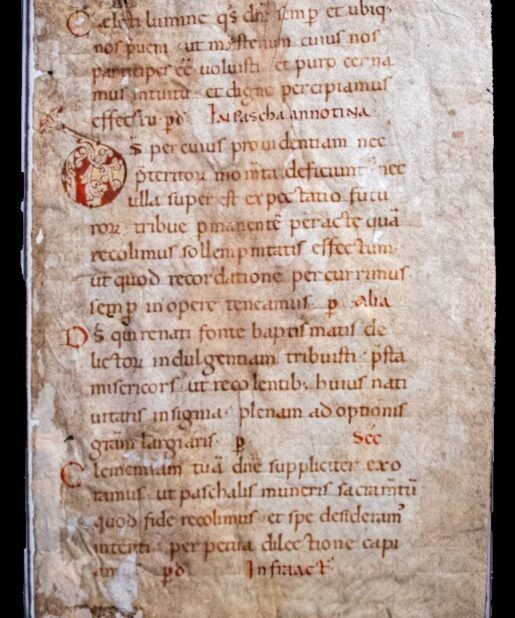
C12th - C13th manuscripts
C12th leaf with decorated initial, Germany with Paschal readings
£2,000.00