

This piece has been placed.
Many works of comparable significance pass through our hands each year.
If you’re seeking something similar, please send us an enquiry or browse recent acquisitions.
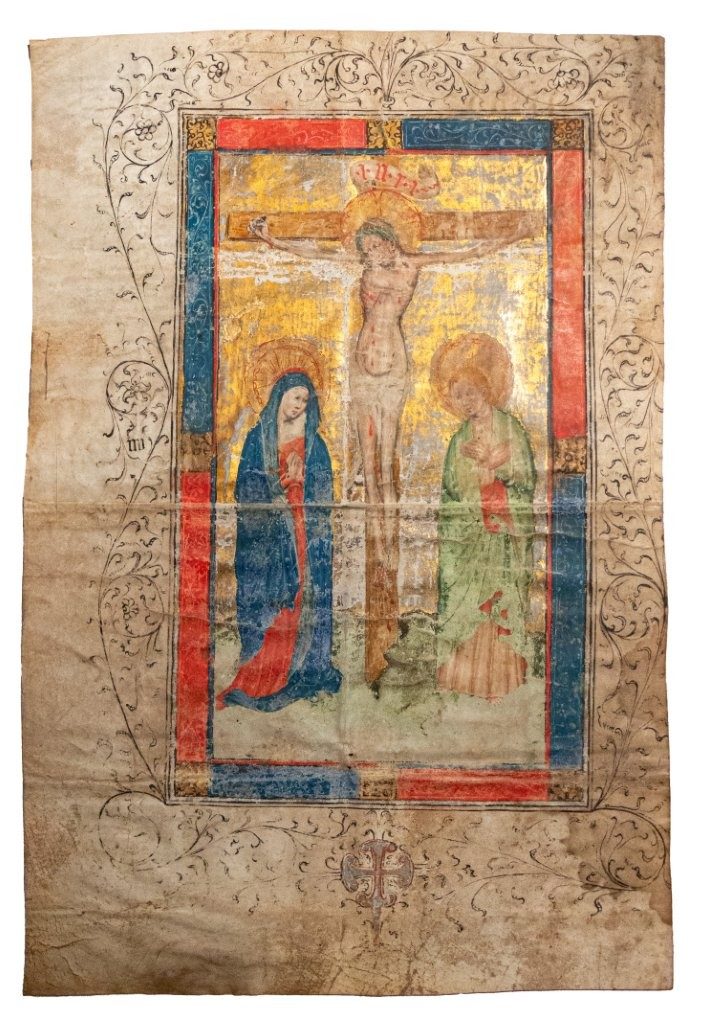
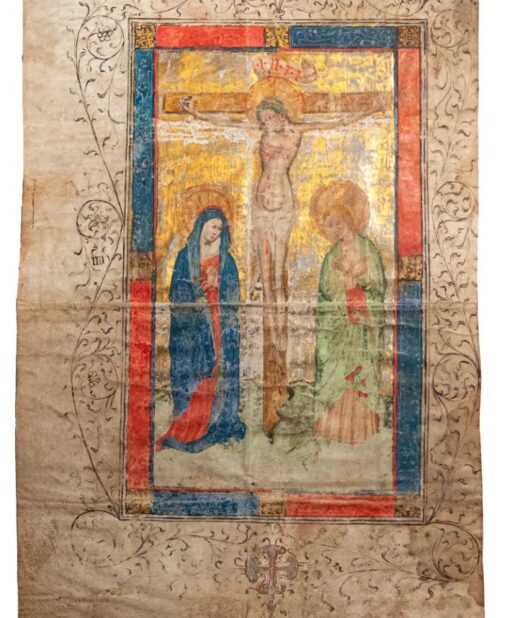
An unusually large illumination from a Missal c.1430, Austria of the Crucifixion
£9,500.00
Illuminated Leaf from a large Missal Austria (possibly Vienna/Salzburg or Klosterneuburg), c. 1430
Tempera, ink, and gold on vellum. Approx. 415 × 280 mm.
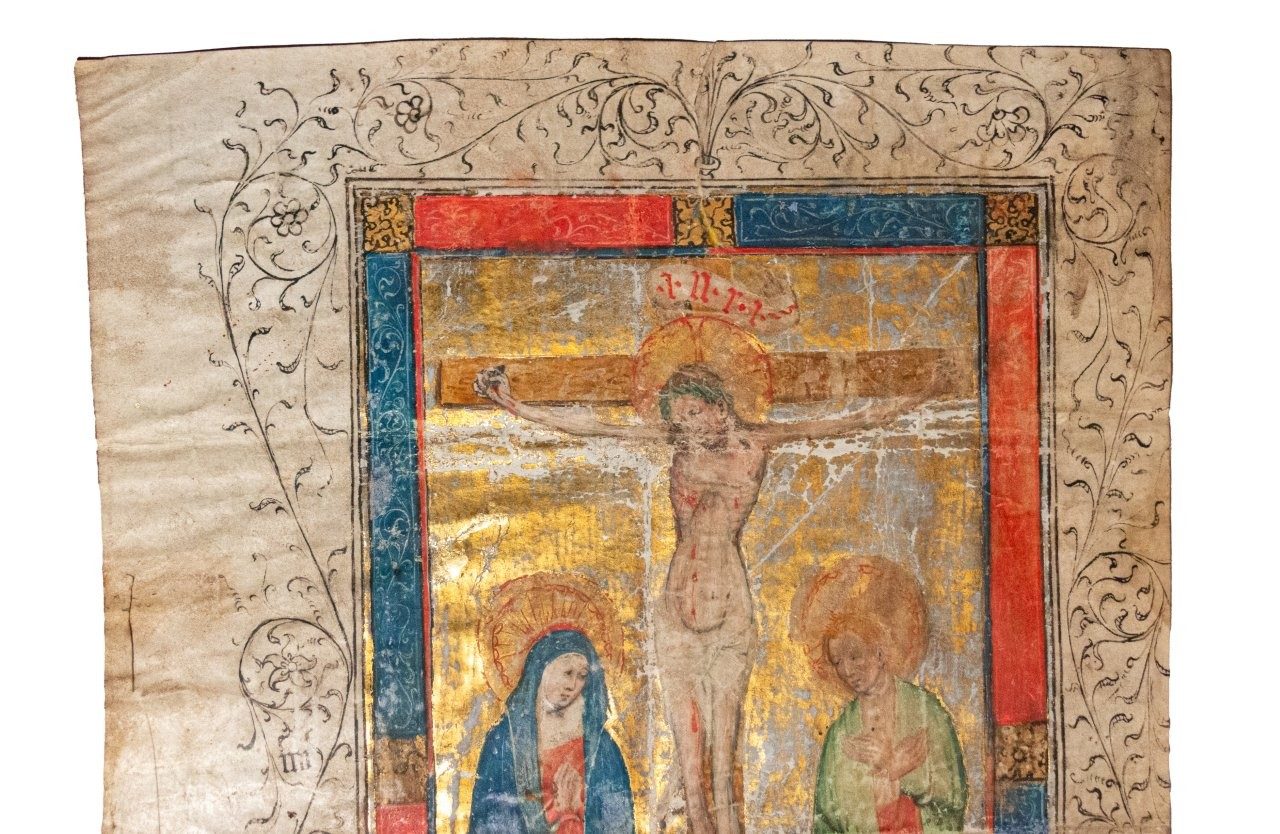
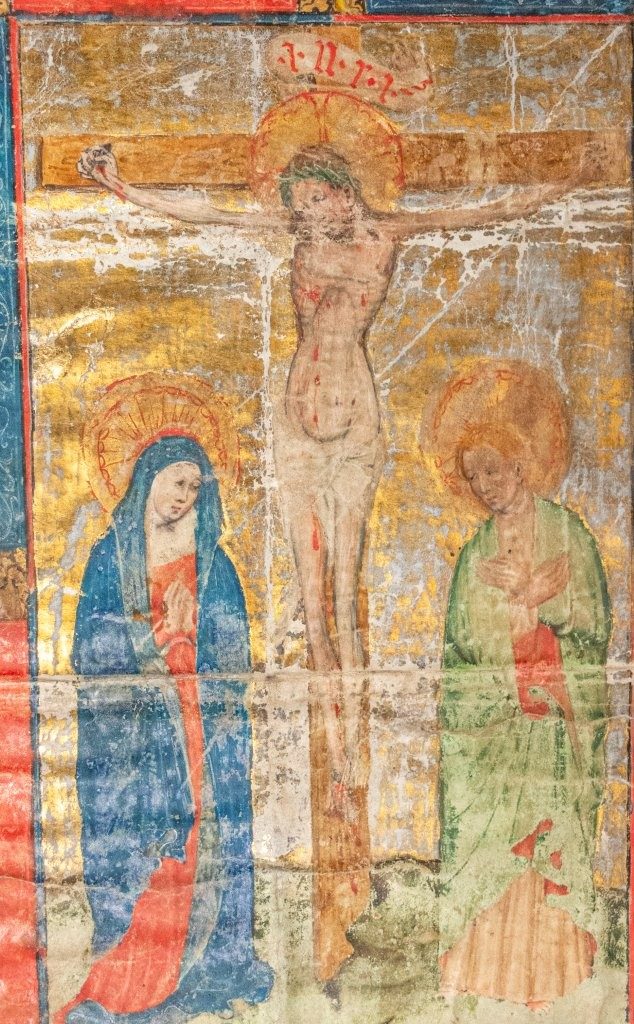
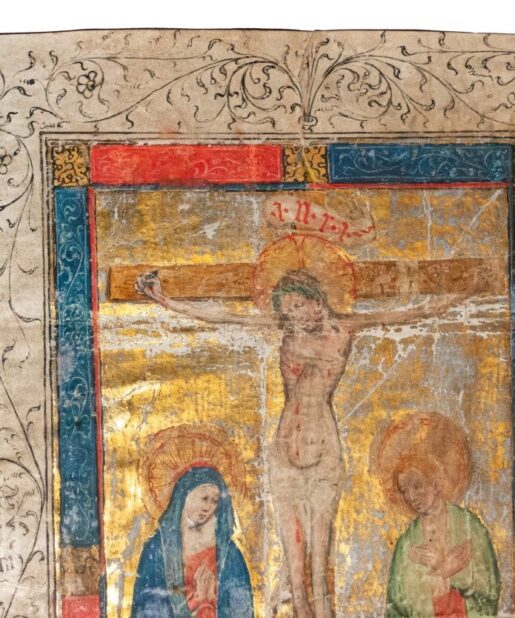
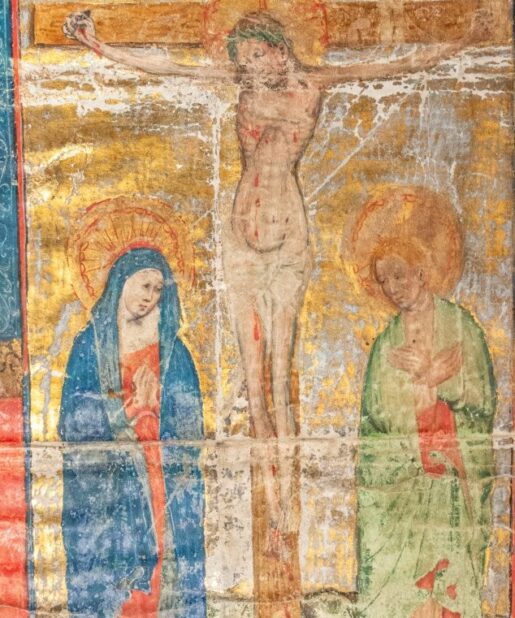
This distinguished illuminated leaf originates from a large-format Missal and presents a finely executed Crucifixion scene in tempera and burnished gold. Christ on the Cross is flanked by the Virgin Mary and Saint John, all set against a radiantly gilded background. The figures exhibit the slender proportions, expressive restraint, and stylised drapery characteristic of the International Gothic style. The harmonious palette—featuring lapis blues, soft reds, and pale greens—accentuates the luminous application of gold.
The overall composition, figural elegance, and decorative detail find strong stylistic affinities with the œuvre of Master Michael (Meister Michael), active in Vienna and Klosterneuburg between 1420 and 1450. Particularly noteworthy is the organic floral marginalia and the emotionally subdued presentation of the figures—both features closely aligned with manuscripts attributed to Michael’s circle, such as the Getty Missal (Ludwig V 6) and the Klosterneuburg Antiphonals (Cod. 65–68).
Embedded discreetly within the left margin is a monogram reading “MI”, likely referencing the artist or rubricator. While no securely documented monogram is known from Master Michael himself, the initials plausibly correspond to his name and may indicate authorship or workshop oversight.
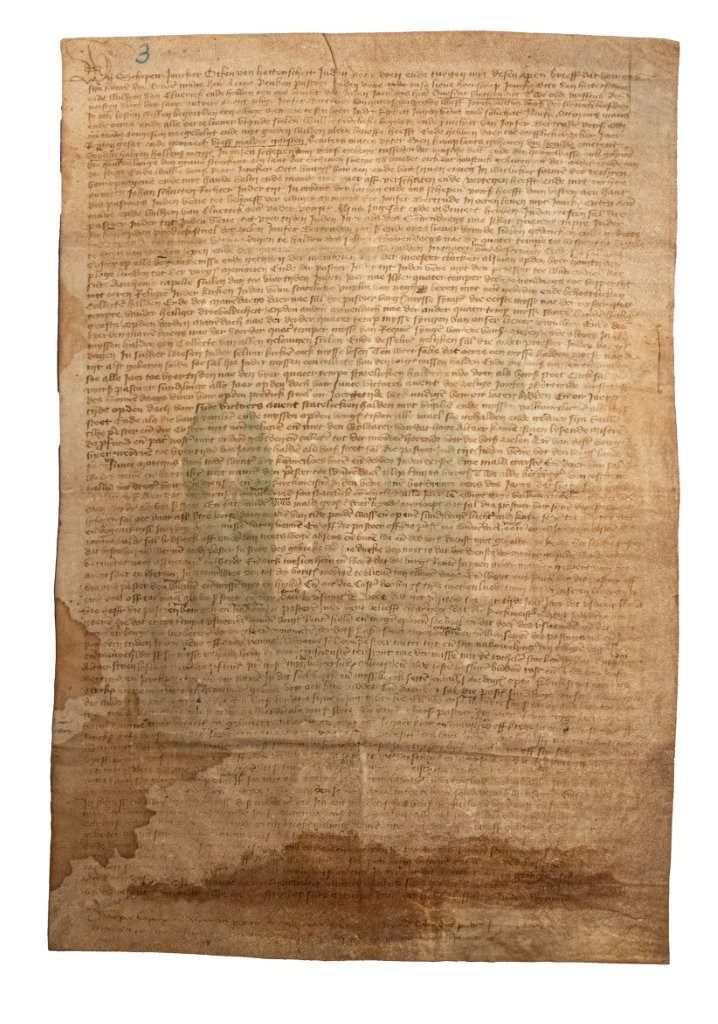
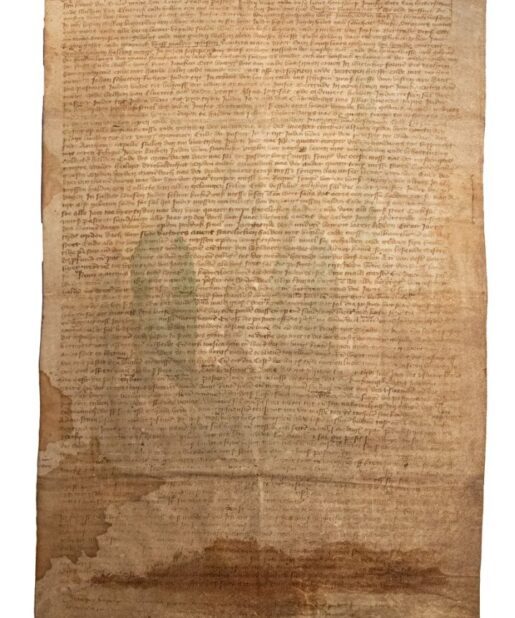
On the verso, the leaf was later reused as a notarial instrument written in Middle Dutch and dated 1489, indicating its repurposing in the Low Countries. Such reuse of valuable liturgical parchment in legal contexts is well documented in fifteenth-century archival practice.
Provenance:
– Reused as a Dutch notarial document, dated 1489 (verso).
– Private collection, Europe.
References:
– Getty Museum, Ludwig V 6 (Missal, c. 1420–30).
– Klosterneuburg, Cod. 65–68 (Antiphonals, ca. 1430).
– Rischpler, Der Illuminator Michael und sein Umkreis, Jahrbuch der Erzabtei Klosterneuburg.
VERSO-translation:
Diderich of Hettwischten, do hereby declare, publicly and truthfully by means of this open charter, that I have sold, transferred, and granted in perpetuity a kamp (a parcel of agricultural land), situated in the village of Hettwischten, to the honourable citizen of the City of Lübeck, Mr. Johann Schriever.
This kamp lies and extends from the land of the House of God to the village road, and from the village road to the land of the aforementioned Mr. Johann. I have conveyed it to him as hereditary property in every legal respect, together with all rights, appurtenances, and belongings, as lawfully pertain to me.
I renounce, for myself and for my heirs, all claims and entitlements to the said property — by my hand, my word, and through this binding legal document. I have bestowed and conveyed the aforementioned kamp to Johann Schriever and his heirs — forever, as lawful hereditary property.
Thus, he and his heirs may freely, lawfully, and eternally possess, use, and enjoy this piece of land, as they see fit, for their benefit and improvement, as their rightful and inherited estate, in accordance with the law.
Accordingly, I have relinquished and released the said kamp from my possession and that of my heirs, and transferred it into the hands and lawful ownership of Johann Schriever and his heirs, so that neither I nor my heirs shall ever hold any right or claim thereto — in perpetuity, in no manner, form, or guise.
Only Johann Schriever and his heirs shall rightfully possess the aforementioned kamp, as their eternal inheritance, lawful property, and for their free use — as prescribed by law and as is fitting.
In perpetual remembrance, I, Diderich of Hettwischten, have caused this public charter to be drawn up and have sealed it with my own seal.
Given in the year of our Lord 1489, on the day of the holy Pentecost.
Product Enquiry
Related products

C14th -C16th manuscripts
£1,500.00

C14th -C16th manuscripts
£950.00

C14th -C16th manuscripts
£350.00
C14th -C16th manuscripts
Leaf from a Bible, II Kings 17, C15th manuscript in Latin on parchment
£750.00


C14th -C16th manuscripts
Unknown codex by humanist Bernardius Florentius, 1476, Florence, Italy
C14th -C16th manuscripts
£7,500.00


Arabic and Ottoman
£1,900.00
![Two illuminated historiated initials on a C15th leaf – Prologue to Job [Bible]](https://stephenbutler.com/wp-content/uploads/2023/11/2E2A0165-515x618.jpg "Two illuminated historiated initials on a C15th leaf – Prologue to Job [Bible]")
![Two illuminated historiated initials on a C15th leaf – Prologue to Job [Bible]](https://stephenbutler.com/wp-content/uploads/2023/11/2E2A0146-3-515x618.jpg "Two illuminated historiated initials on a C15th leaf – Prologue to Job [Bible]")
C14th -C16th manuscripts
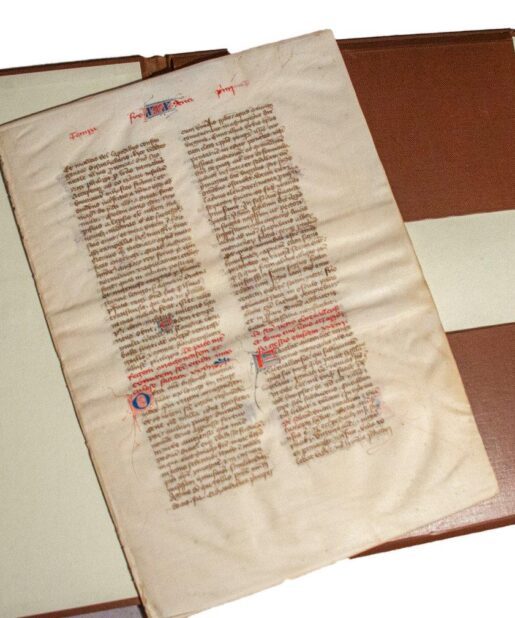
Two illuminated historiated initials on a C15th leaf – Prologue to Job [Bible]
£1,500.00