

![A Lost System of English Reformed Theology: Sir Henry Finch’s Rare and Anonymous Treatise on the Whole Body of Divinity. [1613]](https://stephenbutler.com/wp-content/uploads/2026/01/A59I7019.jpg "A Lost System of English Reformed Theology: Sir Henry Finch’s Rare and Anonymous Treatise on the Whole Body of Divinity. [1613]")
![A Lost System of English Reformed Theology: Sir Henry Finch’s Rare and Anonymous Treatise on the Whole Body of Divinity. [1613]](https://stephenbutler.com/wp-content/uploads/2026/01/A59I7020.jpg "A Lost System of English Reformed Theology: Sir Henry Finch’s Rare and Anonymous Treatise on the Whole Body of Divinity. [1613]")
![A Lost System of English Reformed Theology: Sir Henry Finch’s Rare and Anonymous Treatise on the Whole Body of Divinity. [1613]](https://stephenbutler.com/wp-content/uploads/2026/01/A59I7021.jpg "A Lost System of English Reformed Theology: Sir Henry Finch’s Rare and Anonymous Treatise on the Whole Body of Divinity. [1613]")
![A Lost System of English Reformed Theology: Sir Henry Finch’s Rare and Anonymous Treatise on the Whole Body of Divinity. [1613]](https://stephenbutler.com/wp-content/uploads/2026/01/A59I7022.jpg "A Lost System of English Reformed Theology: Sir Henry Finch’s Rare and Anonymous Treatise on the Whole Body of Divinity. [1613]")


![A Lost System of English Reformed Theology: Sir Henry Finch’s Rare and Anonymous Treatise on the Whole Body of Divinity. [1613]](https://stephenbutler.com/wp-content/uploads/2026/01/2E2A0252-100x100.jpg "A Lost System of English Reformed Theology: Sir Henry Finch’s Rare and Anonymous Treatise on the Whole Body of Divinity. [1613]")
![A Lost System of English Reformed Theology: Sir Henry Finch’s Rare and Anonymous Treatise on the Whole Body of Divinity. [1613]](https://stephenbutler.com/wp-content/uploads/2026/01/30886193121_2-100x100.jpg "A Lost System of English Reformed Theology: Sir Henry Finch’s Rare and Anonymous Treatise on the Whole Body of Divinity. [1613]")
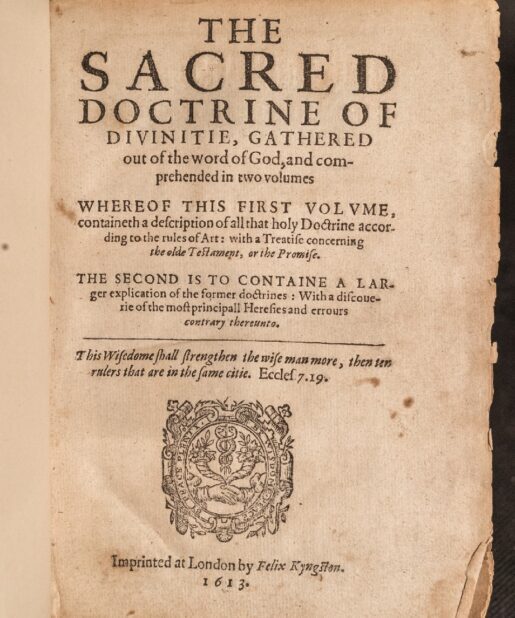
FINCH, Henry, Sir [ ? – 1625] The sacred doctrine of diuinitie, gathered out of the word of God Imprinted at London by Felix Kyngston, 1613.
Collation (as in this copy): [par.]⁴ A–E⁴ F² G–M⁴ N² (complete). Pagination irregular and disjunct, as issued: [4], 20, 24, 29–44, 40–69, 100–101, 72–112 pp.
Original title: The sacred doctrine of diuinitie, gathered out of the word of God… comprehended in two volumes…
Anonymous on the title-page; now attributed to Sir Henry Finch.
ESTC notes that most copies are anonymous; the British Library copy retains the dedication leaf to Thomas Egerton, Lord Ellesmere. Some copies show typographical variants in the headpiece; one Bodleian copy has a wrongly inserted Latin dedication leaf and an added errata leaf.
Only one institutional copy recorded in the United States (Boston Public Library) and a small handful in the United Kingdom.
Descrption
The sacred doctrine of diuinitie, gathered out of the word of God is a remarkable and little-known monument of early Stuart systematic theology, presenting an ambitious attempt to organise the entire body of Reformed doctrine “according to the rules of art.” Printed anonymously in 1613 by Felix Kyngston, the work offers a methodical exposition of Christian theology drawn directly from Scripture, combining scholastic structure with firmly Calvinist substance.
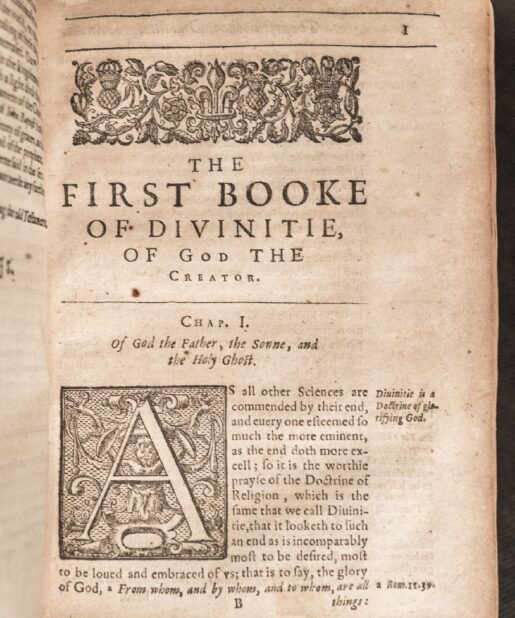
The volume is conceived as the first part of a two-volume project. This opening book sets out the principles of sacred doctrine and includes an extended treatise on the Old Testament covenant of promise, laying the doctrinal foundations for a projected second volume devoted to fuller exposition and the refutation of heresies and errors. Though the second part was issued separately, the present volume stands as a self-contained theological system of considerable intellectual ambition.
Long misattributed to Dudley Fenner, whose death is mentioned in the preface of the first edition, modern scholarship assigns the work to Sir Henry Finch, the distinguished jurist and learned lay theologian. Surviving copies are few, and institutional holdings are exceptionally sparse. Preserved here in a handsome early leather binding, this scarce quarto represents one of the earliest English attempts to construct a comprehensive Reformed “body of divinity” outside the universities and an important witness to the theological culture of Jacobean England.
Sir Henry Finch was one of the most learned and influential English jurists of the late Elizabethan and early Jacobean period, and a remarkable example of the union of law, theology, and humanist scholarship. Educated at Oxford and Gray’s Inn, he rose to become Reader at Gray’s Inn and later a Justice of the Common Pleas. His legal treatise Nomotexnia became a classic of English jurisprudence.
Alongside his legal career, Finch pursued serious theological study and composed The Sacred Doctrine of Divinitie as an ambitious system of Reformed theology. Though published anonymously, internal evidence and early attribution firmly connect the work to Finch, revealing a lay author deeply engaged with Calvinist orthodoxy and scholastic method.
Finch’s theology reflects the intellectual confidence of the Jacobean Reformation: Scripture as supreme authority, doctrine arranged by logical method, and heresy confronted by systematic exposition. His attempt to construct a full English “body of divinity” outside clerical authorship is highly unusual, and places him among the most learned lay theologians of his generation.
Product Enquiry
Related products


£125.00


£200.00
![[Thomas Forbes Kelsall] Catalogue of Valuable Books and Illuminated and other Manuscripts…The Library of Thos. Forbes Kelsall Esq. 1906](https://stephenbutler.com/wp-content/uploads/2024/09/IMG_1212-515x618.jpg "[Thomas Forbes Kelsall] Catalogue of Valuable Books and Illuminated and other Manuscripts…The Library of Thos. Forbes Kelsall Esq. 1906")
![[Thomas Forbes Kelsall] Catalogue of Valuable Books and Illuminated and other Manuscripts…The Library of Thos. Forbes Kelsall Esq. 1906](https://stephenbutler.com/wp-content/uploads/2024/09/IMG_1209-454x618.jpg "[Thomas Forbes Kelsall] Catalogue of Valuable Books and Illuminated and other Manuscripts…The Library of Thos. Forbes Kelsall Esq. 1906")


£1,750.00


£1,800.00
![Gu Hutou Hua Lienu Zhuan (Xin Kan Gu Lienu Zhuan) [An Ancient Edition of Biographies of Virtuous Women ] Liu Xiang; images attrib. to Gu Kaizhi](https://stephenbutler.com/wp-content/uploads/2024/08/IMG_0472-515x618.jpg "Gu Hutou Hua Lienu Zhuan (Xin Kan Gu Lienu Zhuan) [An Ancient Edition of Biographies of Virtuous Women ] Liu Xiang; images attrib. to Gu Kaizhi")
![Gu Hutou Hua Lienu Zhuan (Xin Kan Gu Lienu Zhuan) [An Ancient Edition of Biographies of Virtuous Women ] Liu Xiang; images attrib. to Gu Kaizhi](https://stephenbutler.com/wp-content/uploads/2024/08/IMG_0467-515x618.jpg "Gu Hutou Hua Lienu Zhuan (Xin Kan Gu Lienu Zhuan) [An Ancient Edition of Biographies of Virtuous Women ] Liu Xiang; images attrib. to Gu Kaizhi")


