



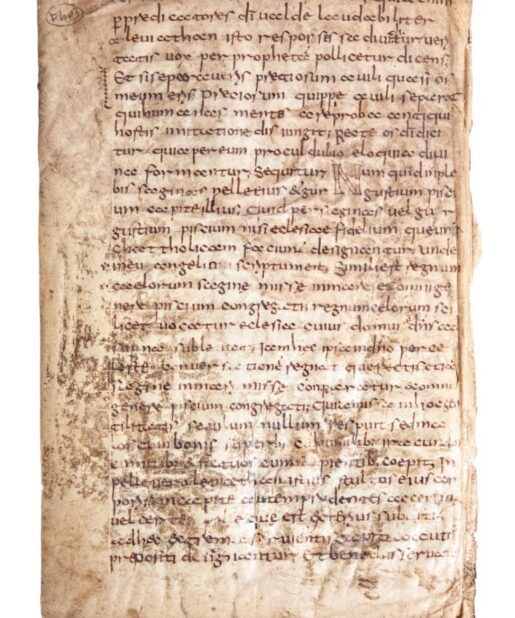
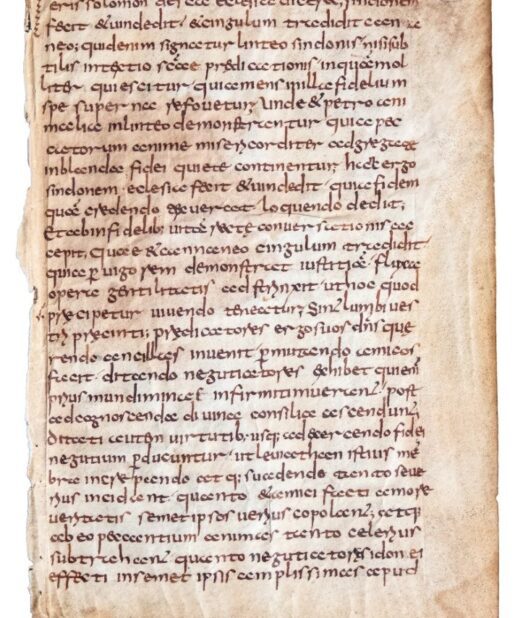
A grand and early leaf from a fundamental medieval text from the founding library of Reichenau monastery


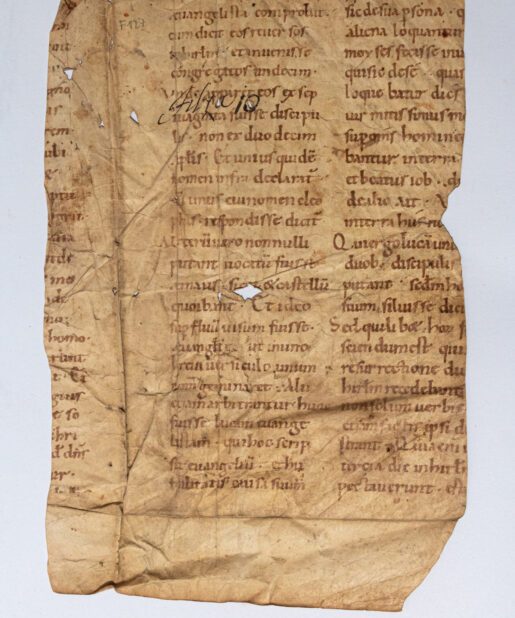
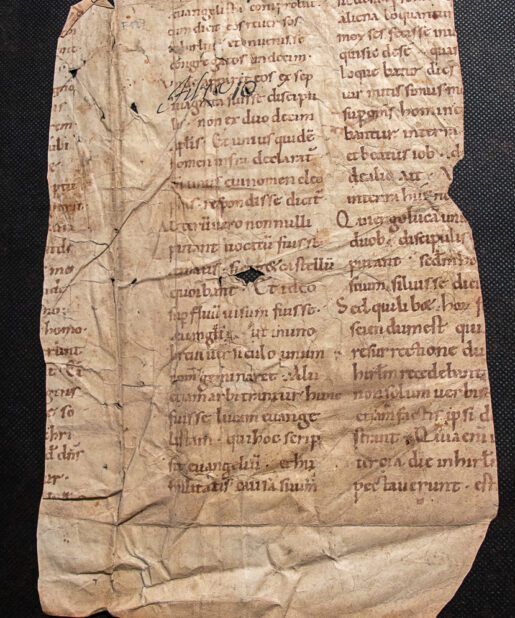
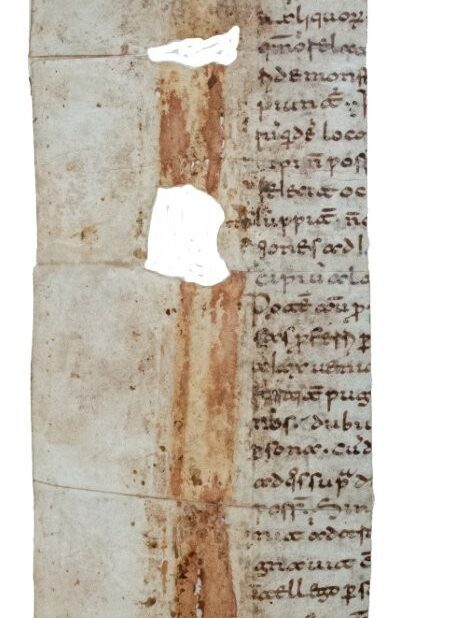
GREGORY THE GREAT. Leaf from an extremely early copy of Moralia in Job.
In Latin, manuscript on vellum Southern Germany, perhaps Reichenau, last decades of the 8th century, or c. 800
Dimensions
257 x 156mm
Description
Single large leaf, with single column of 30 lines (with parts of book VI:33)
in a large and bold pre- Carolingian Germanic minuscule, employing both open and closed ‘a’, a ‘t’ whose lefthand bar is written both in straight form and curving downwards to almost close with the main ascender of the letter, and a distinctive ‘ri’-ligature with the ‘i’ written as a final penstroke that passes downwards and back under the ‘r’.
Condition
Some tears and darkening to edges, small losses at head, slight cockling, but in good and fresh condition.
Text
The Moralia in Job (also Moralia, sive Expositio in Job) was one of the fundamental literary pillars of Early Medieval Western Christianity. It was composed as a commentary on the Biblical book of Job by Pope-Saint Gregory the Great (c. 540-604), between 578 and 595. It was to be found in virtually every monastic and cathedral library throughout the Middle Ages, and was so commonly read and essential to the minds of medieval Christians that it is perhaps the most common text of early manuscript fragments recovered from later bookbindings, after the Bible itself and liturgical service books.
Provenance
1. This is the sister-leaf of that once in the collection of the late Roger Martin of Grimsby (sold at Bloomsbury Auctions, London, 6 July 2021, lot 1; reappearing in Forum Auctions, 16 July 2026, lot 21). The two leaves are in closely-related, but distinct, hands. The hand here is less dominated by clusters of pre-Carolingian ligatures but has the same angularity and preponderance for ligatures in ‘r’ followed by a vowel. If, as seems likely, the parent codex was written in Reichenau, then it must have been part of that monastery’s earliest book collection, predating the expansion of the library under Abbot Reginbert in the decades up to his death in 846. Reichenau was closed initially in 1757, then permanently in 1803.
2. The leaves appear to have been reused at the close of the Middle Ages as the pastedowns in the binding of a large book in French ownership in the 17th or 18th century.
3. Mr de Coligny, a 20th century Parisian collector.
4. Removed from the later binding during modern restoration and sold in different directions.
Product Enquiry
Related products


C12th - C13th manuscripts
Elegant English Early Gothic Script from late C12th Passionale – Paulinus of Milan
£1,750.00

C14th -C16th manuscripts
£950.00
C12th - C13th manuscripts
£1,200.00
£3,800.00



£9,800.00
![Leaf of Passionale in Latin [Italy, 12th century, first half] Lives of St Felicity and St Clement](https://stephenbutler.com/wp-content/uploads/2021/01/IMG_0696-515x618.jpg "Leaf of Passionale in Latin [Italy, 12th century, first half] Lives of St Felicity and St Clement")
C12th - C13th manuscripts
Leaf of Passionale in Latin [Italy, 12th century, first half] Lives of St Felicity and St Clement
£1,200.00