



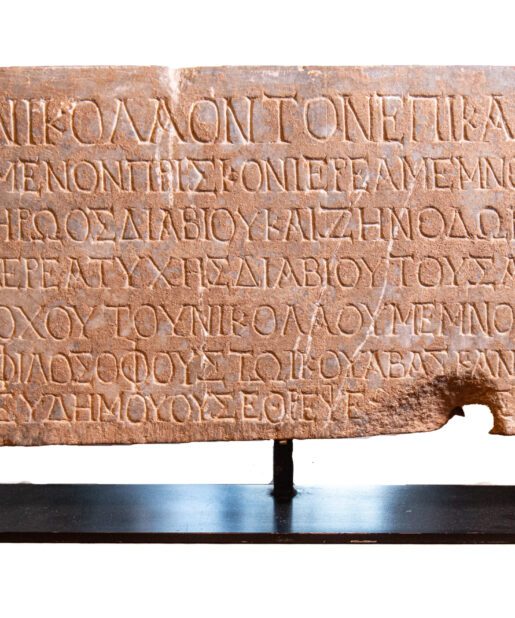
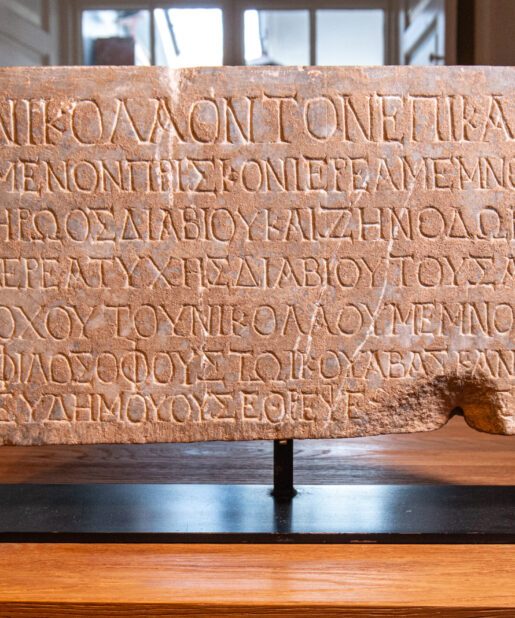
2nd century marble inscription to the cult of Memnon, one of the heroes of the Trojan war
Roman Marble Plaque with an inscription in ancient Greek 2nd century AD
Dimensions
450 x 240 x 40mm
Description
Large Roman period marble panel with seven lines of a Greek dedicatory inscription centred on the rectangular face, the first line cut in larger characters than the rest, with an ivy leaf (hedera) depicted at the end.
Condition
Complete. Minor ancient damage to the lower right front of the stone, obscuring one word, and four vertically scratched lines carved by early Christians in damnatio memoriae of pagan religion.
Translation
“Abaskantos son of Eudemos [set up] (statues of?) Nikolaos, also called Priskos, priest of the hero Memnon for life, and Zenodoros, priest of Tyche for life, whom he raised, both sons of Antiochos son of Nikolaos Memnonides the Stoic philosopher. And so forth.”
Text
An inscribed private dedication for civic benefactions, recording lifetime priesthoods for the dedicator’s two foster-sons, whose father had been a high-ranking civic dignitary in an unidentified city, possibly in Asia Minor or the Black Sea region. Two brothers (Nikolaos aka Priskos and Zenodoros) are honoured, perhaps with statues erected by their foster father Abaskantos. Abaskantos writes about himself in the past tense and in the third person, as this is a publicly visible notice in which he is documenting his dedication of the statues as an historical event. He would have been the one who commissioned the production of the inscription (in addition to the statues), and possibly composed or at least dictated, the text to the stonecutter. A rare epigraphic attestation of a public cult of the Homeric hero Memnon, a mythical Aethiopian king, son of Eos and Tithonus, who fought on the side of the Trojans during the war and was deified by Zeus after being slain by Achilles, the inscription corroborates the attestation of
tombs and/or cults of Memnon in the literary and historical record over a wide range of places in the ancient world. The public worship of the goddess Tyche as a protector of and personifying the city is well known.
Provenance
Sold Sotheby’s, Antiquities & Islamic Art, New York, June 13, 2002 (Sale no. N07812), lot 133 (p. 114), “A Roman Marble Plaque circa 2nd century AD”. On a museum- quality stand with iron support.
Product Enquiry
Related products
C14th -C16th manuscripts
Single leaf from the so-called ‘Carondelet Breviary’ 1458 from the scribe Jean d’Aussert
£600.00
C14th -C16th manuscripts
Leaf from a Bible, II Kings 17, C15th manuscript in Latin on parchment
£750.00
![Commentary on Aristotle, Categoriae, and the same authors translation of Perihermenias BOETHIUS [MS] C.13th](https://stephenbutler.com/wp-content/uploads/2013/08/IMG_8383-515x618.jpg "Commentary on Aristotle, Categoriae, and the same authors translation of Perihermenias BOETHIUS [MS] C.13th")
![Commentary on Aristotle, Categoriae, and the same authors translation of Perihermenias BOETHIUS [MS] C.13th](https://stephenbutler.com/wp-content/uploads/2013/08/IMG_8379-515x618.jpg "Commentary on Aristotle, Categoriae, and the same authors translation of Perihermenias BOETHIUS [MS] C.13th")
C12th - C13th manuscripts
£3,800.00


![Leaf of Passionale in Latin [Italy, 12th century, first half] Lives of St Felicity and St Clement](https://stephenbutler.com/wp-content/uploads/2021/01/IMG_0696-515x618.jpg "Leaf of Passionale in Latin [Italy, 12th century, first half] Lives of St Felicity and St Clement")
C12th - C13th manuscripts
Leaf of Passionale in Latin [Italy, 12th century, first half] Lives of St Felicity and St Clement
£1,200.00


C12th - C13th manuscripts
Elegant English Early Gothic Script from late C12th Passionale – Paulinus of Milan
£1,750.00


£3,500.00