


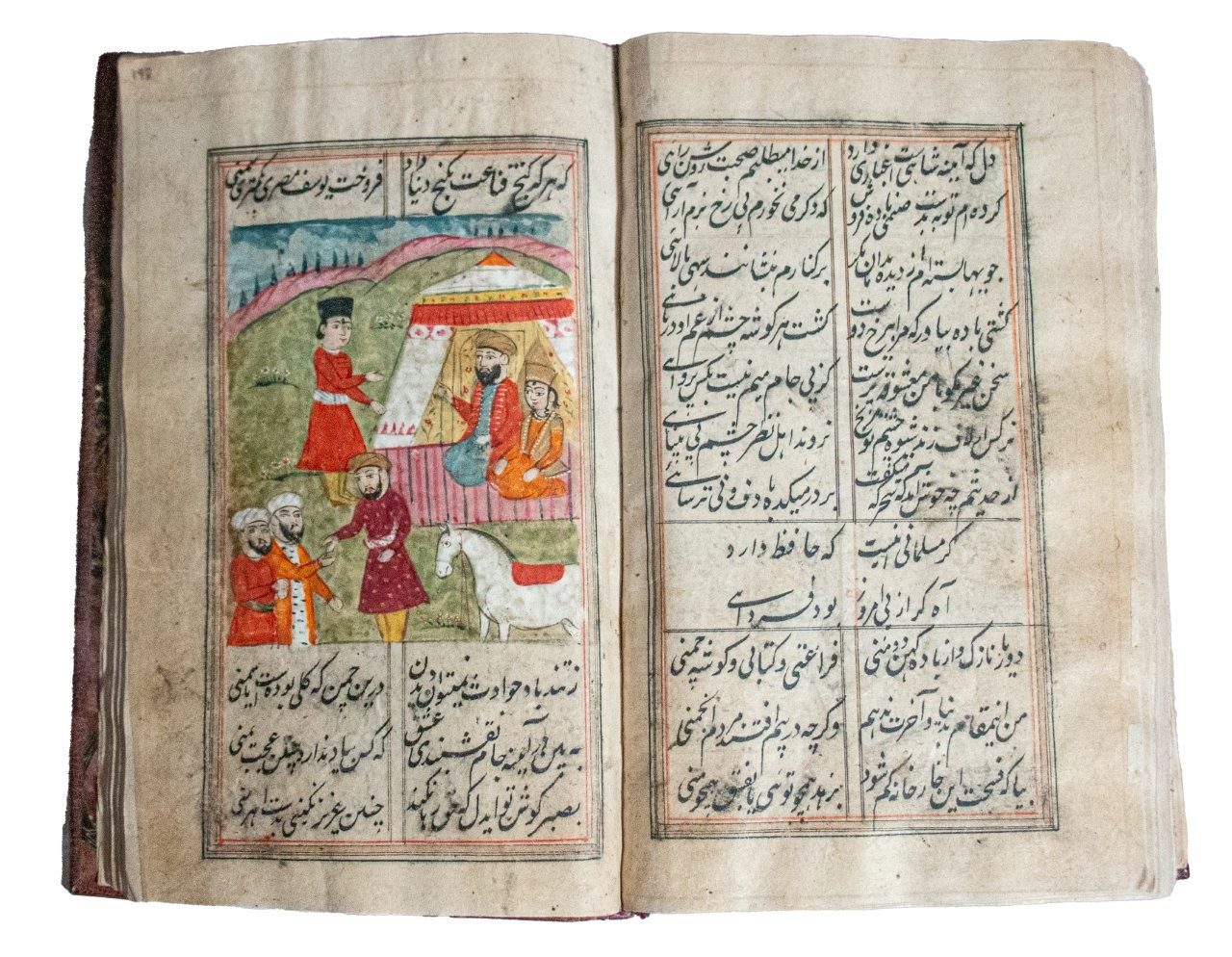

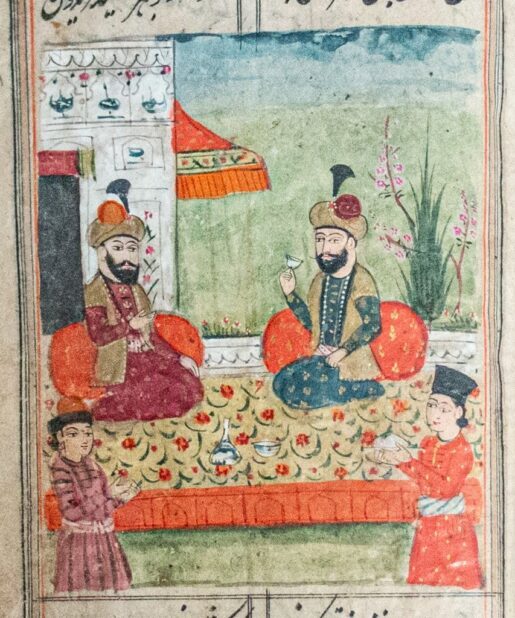
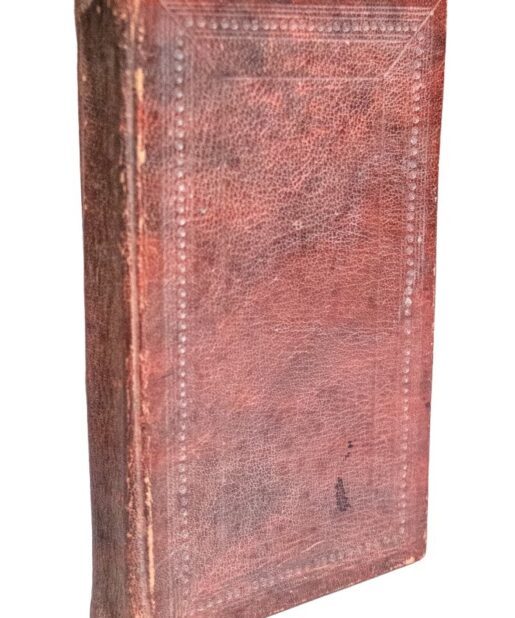
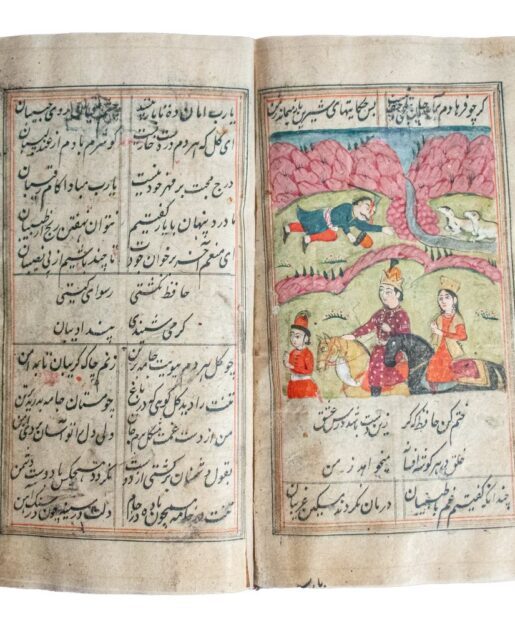
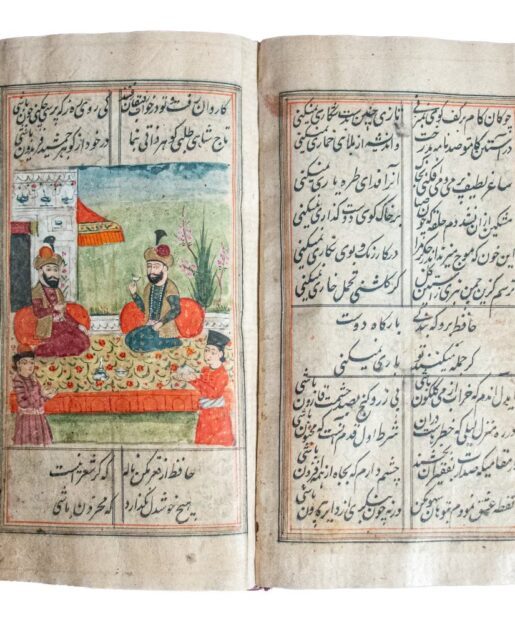

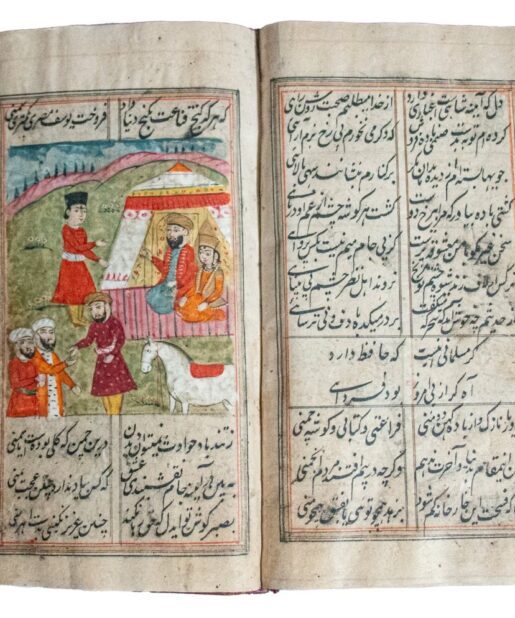
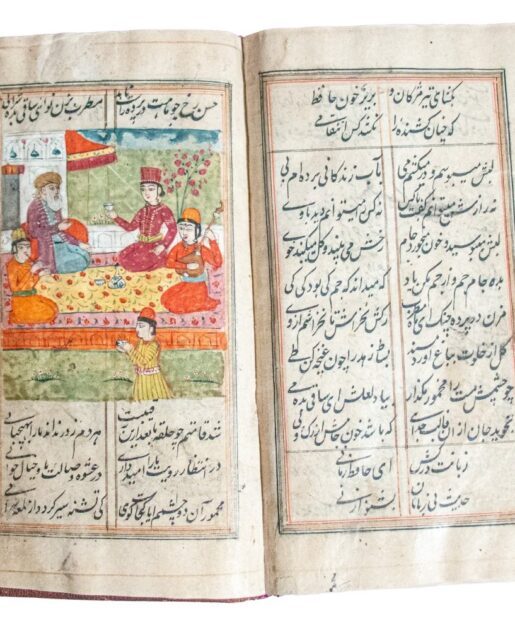
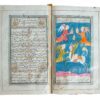
Hafez’s Diwan, Northern India, Kashmir late C18 or early C19
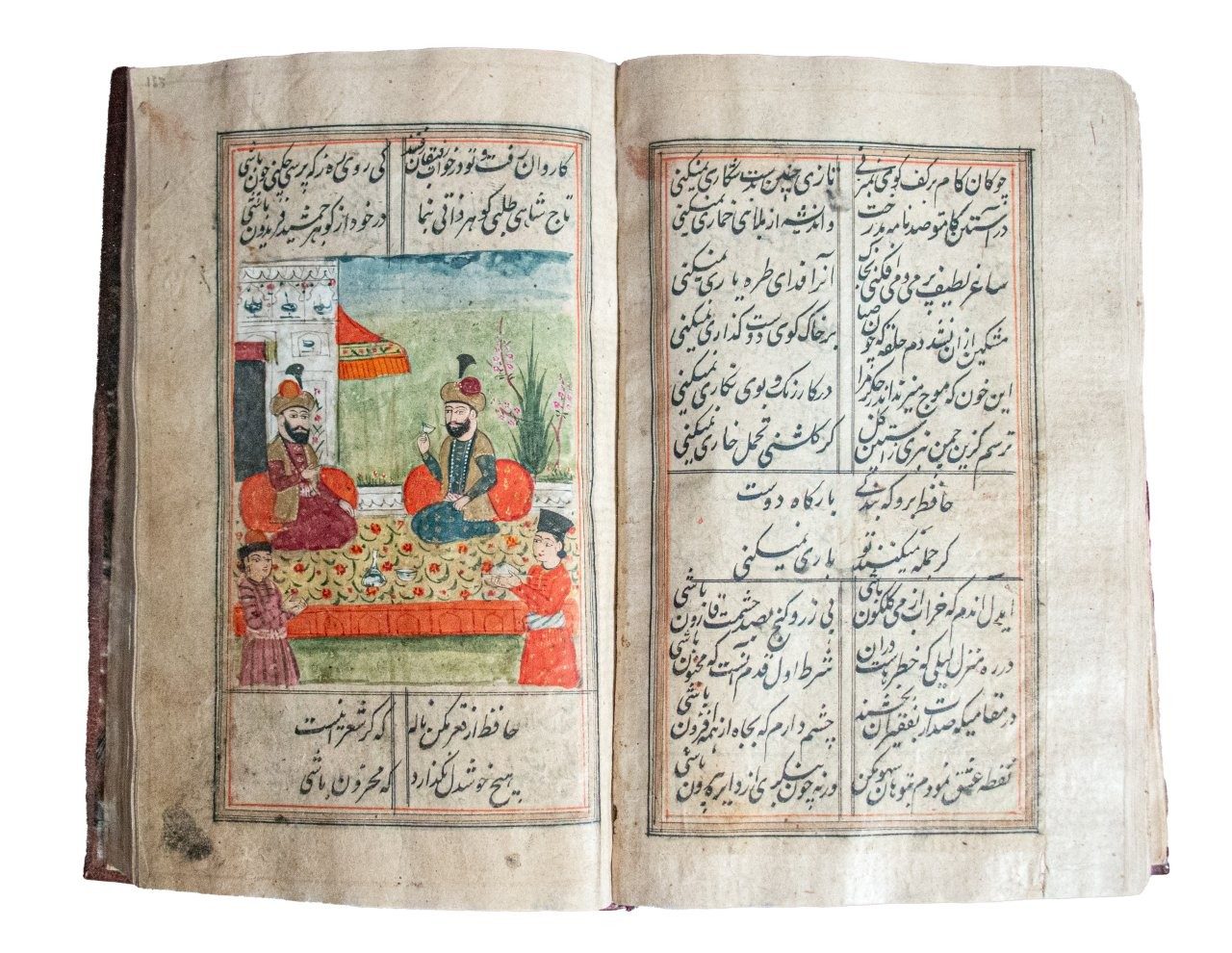
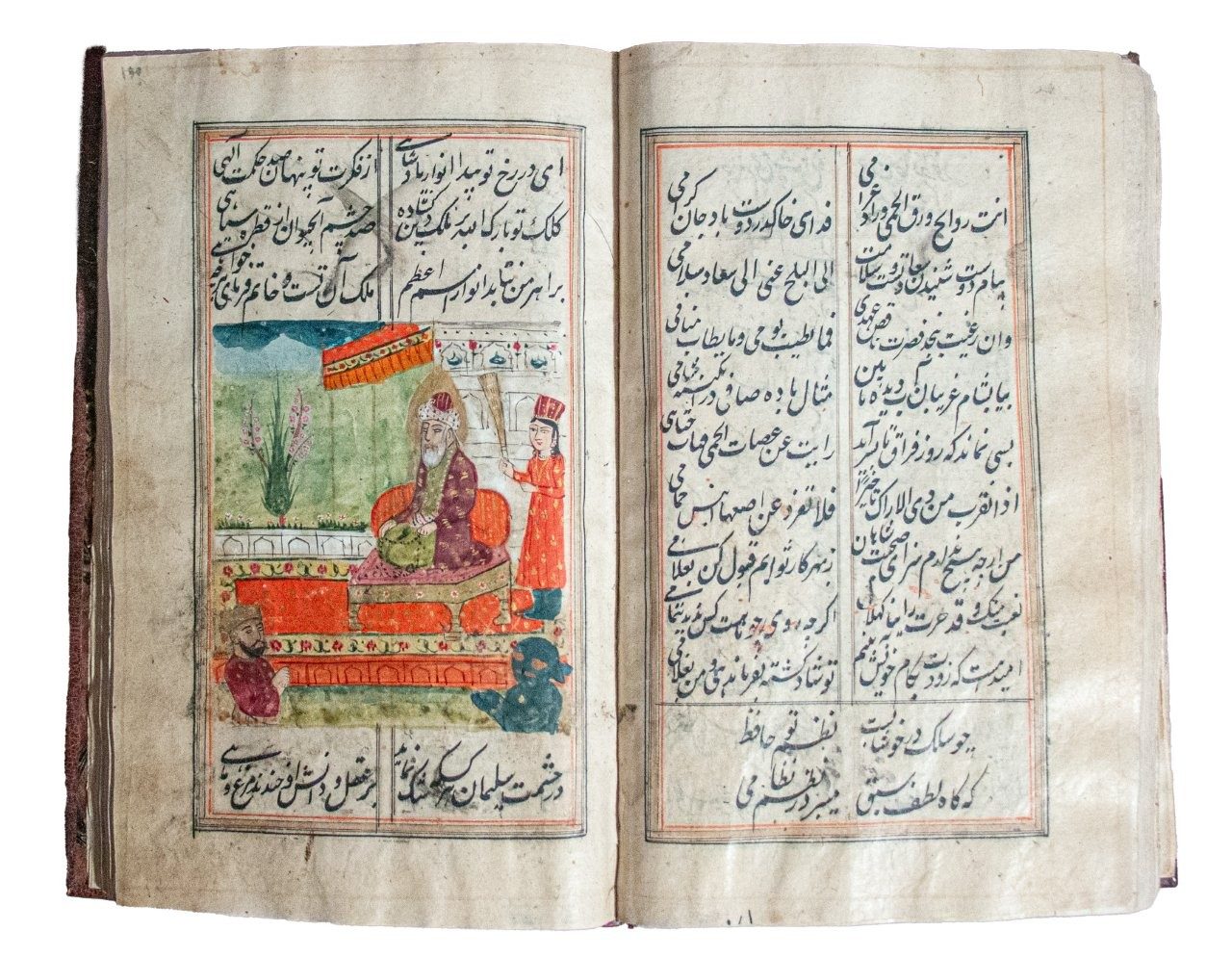
This illuminated Persian manuscript of Hafez’s Diwan encompasses 235 leaves, created in the late 18th or early 19th century (circa 1780–1820) in a region of Northern India, possibly Kashmir. The first leaf is blank. Its dimensions are approximately 182 x 115 mm, with text panels measuring about 145 x 80 mm. The Persian text is arranged in a 12-line double column, written in a Northern-Indian Nastaʿlīq script in black ink and framed by a triple-band ǧadval.
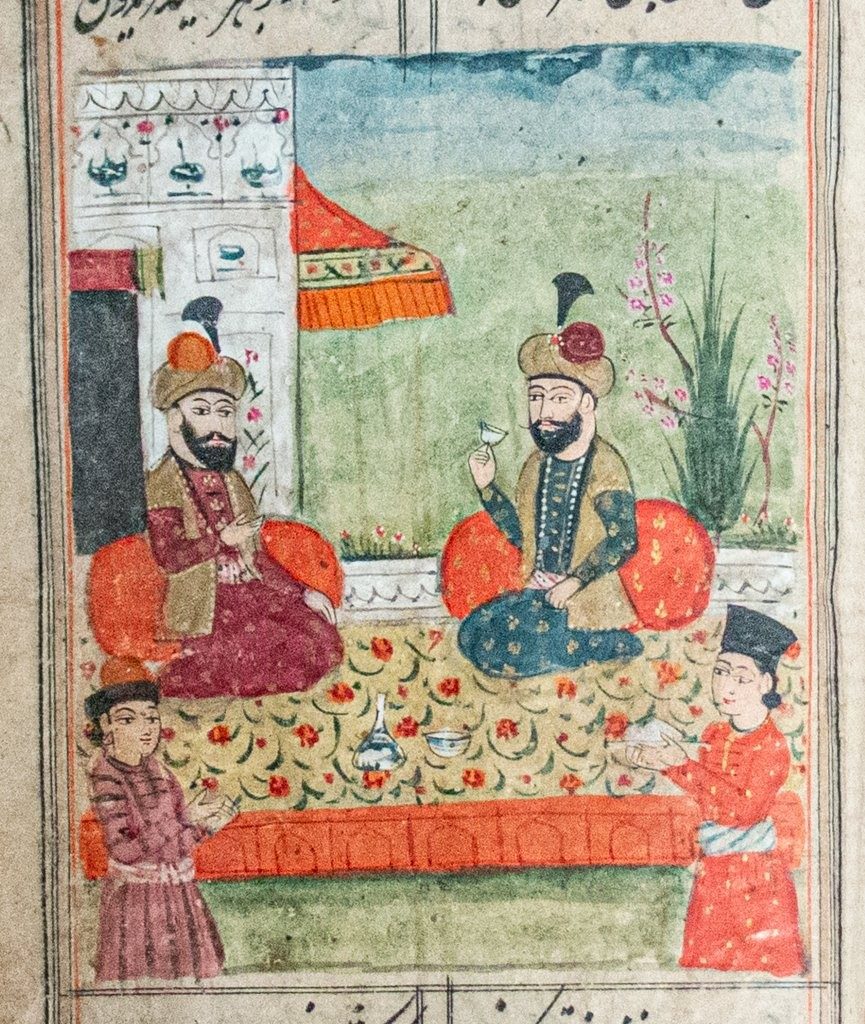
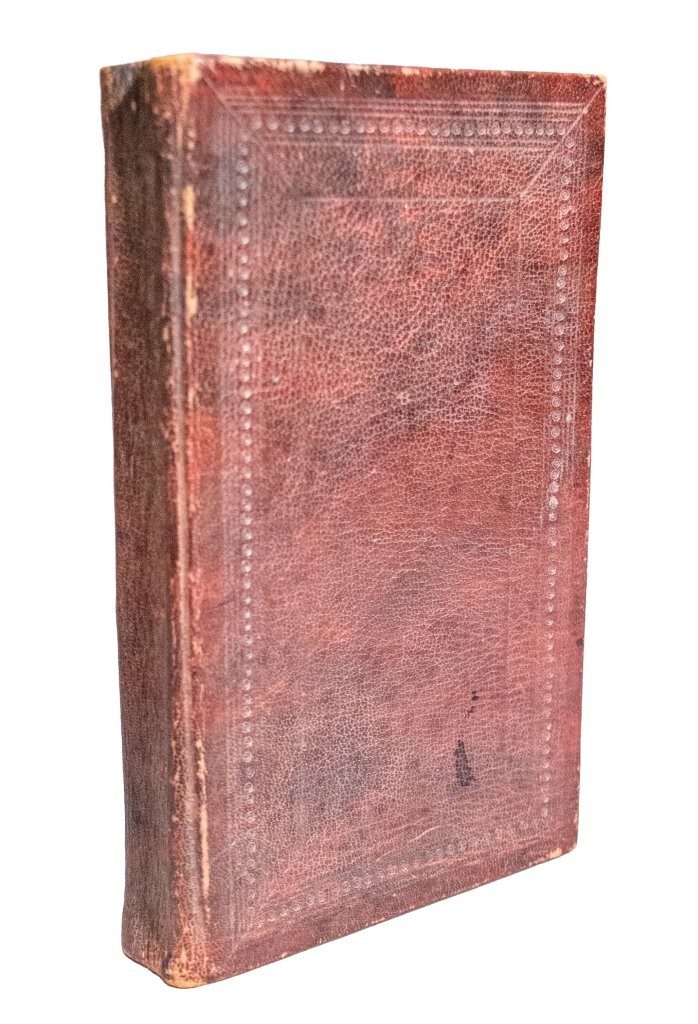
The manuscript’s decoration includes a gold-color title page (ᶜunwān) and 24 miniatures integrated into the text. The binding is made of blindstamped leather. While generally in good condition, the first ten and last two leaves are from a different calligrapher, indicating possible later additions or restorations.
Hafez (1315–1390), often referred to as the “Nightingale of Shiraz,” remains the most widely read and quoted Persian poet of the classical era. As scholar Baha’-al-Din Khorramshahi notes, Hafez’s strong attachment to Shiraz is a recurring theme in his poetry, where he often references the city and its beloved sites like Golgašt-e Moṣalla and Āb-e Rokn-ābād. His early life remains partially obscure; what is known comes from references in his Diwan and Golandām’s preface, which mention his studies in Quranic sciences and Arabic. He lived during a turbulent period marked by political upheaval following Mongol invasions, including the sack of Baghdad in 1258, which ushered in an era of instability yet also of cultural and literary achievement.
Hafez’s poetry reflects these turbulent times, with panegyrics and poems that mirror political changes and local dynastic rise and decline, such as the Inju, Muzaffarid, and Jalayerid dynasties. His verses often serve as subtle commentaries on his environment, blending political awareness with spiritual themes.
De Bruijn, a scholar of Persian literature, emphasizes that Hafez’s ghazals are highly complex, both thematically and stylistically. The genre of ġazal predates Hafez but became more intricate over centuries. His poetry explores a range of themes: romantic love, spiritual reflection, and social critique. On one level, his work celebrates earthly beauty, love, and the pleasures of wine; on another, it criticizes hypocrisy within religious and Sufi establishments.
Many Ghazals intertwine these themes—passionate love and divine spirituality, critique and praise, worldly desires and transcendental reflection—creating a layered poetic narrative. The poet often challenges clerics, judges, and ascetics, exposing their duplicity and hypocrisy. The contrast between spiritual ideals and worldly hypocrisy is a recurring motif, often addressed within a single poem, making some verses appear disjointed at first glance but rich in meaning upon closer examination.
Product Enquiry
Related products
C12th - C13th manuscripts
£1,200.00
![The Death of Ptolemy, a miniature on a cutting from Laurent de Premierfait, [France, probably Troyes, c.1470]](https://stephenbutler.com/wp-content/uploads/2021/01/IMG_0782-515x618.jpg "The Death of Ptolemy, a miniature on a cutting from Laurent de Premierfait, [France, probably Troyes, c.1470]")

£750.00


£3,500.00


C12th - C13th manuscripts
Elegant English Early Gothic Script from late C12th Passionale – Paulinus of Milan
£1,750.00
![Commentary on Aristotle, Categoriae, and the same authors translation of Perihermenias BOETHIUS [MS] C.13th](https://stephenbutler.com/wp-content/uploads/2013/08/IMG_8383-515x618.jpg "Commentary on Aristotle, Categoriae, and the same authors translation of Perihermenias BOETHIUS [MS] C.13th")
![Commentary on Aristotle, Categoriae, and the same authors translation of Perihermenias BOETHIUS [MS] C.13th](https://stephenbutler.com/wp-content/uploads/2013/08/IMG_8379-515x618.jpg "Commentary on Aristotle, Categoriae, and the same authors translation of Perihermenias BOETHIUS [MS] C.13th")
C12th - C13th manuscripts
£3,800.00
![Leaf from Baldo degli Ubaldi (1327–1400), Sextum codicis librum commentaria [Italy, late 15th century]](https://stephenbutler.com/wp-content/uploads/2023/07/IMG_0101-515x618.jpg "Leaf from Baldo degli Ubaldi (1327–1400), Sextum codicis librum commentaria [Italy, late 15th century]")
C14th -C16th manuscripts
£800.00