

![‘God Hath a Sad Controversie with the Land’: A Rare Apocalyptic Pamphlet from the Opening Year of the English Civil War. [1642]](https://stephenbutler.com/wp-content/uploads/2026/01/IMG_9993.jpg "‘God Hath a Sad Controversie with the Land’: A Rare Apocalyptic Pamphlet from the Opening Year of the English Civil War. [1642]")
![‘God Hath a Sad Controversie with the Land’: A Rare Apocalyptic Pamphlet from the Opening Year of the English Civil War. [1642]](https://stephenbutler.com/wp-content/uploads/2026/01/IMG_9992.jpg "‘God Hath a Sad Controversie with the Land’: A Rare Apocalyptic Pamphlet from the Opening Year of the English Civil War. [1642]")
![‘God Hath a Sad Controversie with the Land’: A Rare Apocalyptic Pamphlet from the Opening Year of the English Civil War. [1642]](https://stephenbutler.com/wp-content/uploads/2026/01/IMG_9994.jpg "‘God Hath a Sad Controversie with the Land’: A Rare Apocalyptic Pamphlet from the Opening Year of the English Civil War. [1642]")


![‘God Hath a Sad Controversie with the Land’: A Rare Apocalyptic Pamphlet from the Opening Year of the English Civil War. [1642]](https://stephenbutler.com/wp-content/uploads/2026/01/IMG_9927-1-100x100.jpg "‘God Hath a Sad Controversie with the Land’: A Rare Apocalyptic Pamphlet from the Opening Year of the English Civil War. [1642]")
![‘God Hath a Sad Controversie with the Land’: A Rare Apocalyptic Pamphlet from the Opening Year of the English Civil War. [1642]](https://stephenbutler.com/wp-content/uploads/2026/01/30886198060_2-100x100.jpg "‘God Hath a Sad Controversie with the Land’: A Rare Apocalyptic Pamphlet from the Opening Year of the English Civil War. [1642]")
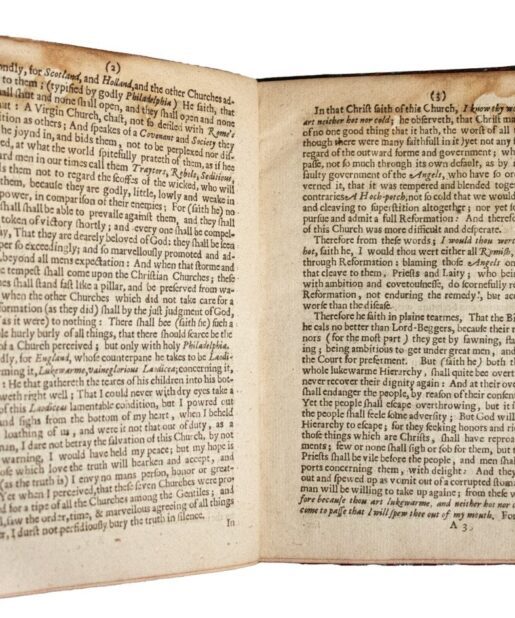
Brightman, Thomas Reverend Mr. Brightmans iudgement, or prophesies what shall befall Germany, Scotland, Holland, and the churches adhering to them. Likewise what shall befall England, and the hierarchy therein. Collected out of his exposition on the Revelations, printed above forty yeares since. Wonderfull to see how they are fulfilled, and in fulfilling, foreseeing and foretelling what our eyes have seen, and may see, both in the past, present and future state of our times. Declaring that the reformation began in Queene Elizabeth s dayes, is not sufficient for us under greater light. Finishing the work if we now withstand as heretofore, we are to expect, God hath a sad controversie with the land.
London : printed for R. Harford, in Queens-head Alley, in Pater noster-row, 1642
1st Edition. Quarto.[2],6pp collates as per ESTC. Rare, only 4 copies uK and 2 in US. Some waterstaining. Bookplate of Mechanic’s Library, Nottingham. Half-leather, marbled boards. Thomas Brightman wrote a definitive book on the book of Revelation ‘above forty yeares ago’. This precis is “for the good of those who want time or coine, to purchase so large a volume.” The prophecies which Brightman draws out of the Book of Revelation include a ‘bitterest scourge for Germany’ which the author likens to Sardis. Scotland and Holland get off lightly because they have embraced the Reformation and he compares them to the church of Philadelphia. As for England, he applies the verse from Ch.3 “I will spew thee out of my mouth” due to the lukewarm nature of England neither adopting the ‘Romish Church’ and only accepting a half-hearted Reformation.
_______________________________________________________________________________________________________________
Published in 1642, at the very outbreak of the English Civil War, Reverend Mr. Brightmans iudgement, or prophesies… is a striking example of revolutionary apocalyptic literature, extracting and repackaging the prophetic interpretations of the celebrated Elizabethan divine Thomas Brightman for a nation on the brink of collapse. Drawn from Brightman’s monumental commentary on the Book of Revelation, printed more than forty years earlier, this slim quarto pamphlet presents a distilled programme of political and ecclesiastical prophecy “for the good of those who want time or coine” to consult the original work.
The tract interprets contemporary Europe through the lens of the Seven Churches of Revelation. Germany is warned of a coming “bitterest scourge”; Scotland and Holland are praised as a new Philadelphia for embracing the Reformation; and England is sternly condemned as the lukewarm Laodicea — threatened with being “spewed out” for halting between Rome and full reformation. The pamphlet insists that Elizabethan reform was only a beginning, and that resistance to further purification will bring divine judgment: “God hath a sad controversie with the land.”
Issued in the first year of open conflict between King and Parliament, this rare pamphlet captures with extraordinary immediacy the prophetic imagination that fuelled Puritan radicalism. Surviving in only six recorded institutional copies in the UK and United States, it stands as a vivid survival of the apocalyptic mood that accompanied England’s descent into civil war.
Thomas Brightman was one of the most influential English apocalyptic theologians of the late Elizabethan period and a foundational figure in Protestant prophetic interpretation. Educated at Queen’s College, Cambridge, he became rector of Hawnes, Bedfordshire, where he devoted himself to biblical exegesis rather than ecclesiastical advancement. Brightman is best known for his vast and controversial commentary on the Book of Revelation, Apocalypsis Apocalypseos (1609, posthumously), which became a standard work of Reformed eschatology throughout England and the Netherlands.
Brightman interpreted Revelation as a continuous prophetic history of the Church, identifying the papacy with Antichrist and mapping contemporary nations onto the Seven Churches of Asia. His readings profoundly shaped Puritan political theology: his favourable judgments on reformed Scotland and Holland, and his severe condemnation of England as spiritually “lukewarm,” were repeatedly cited by later reformers.
Though Brightman died in 1607, his influence reached its peak during the crisis of the 1640s, when his prophecies were revived in cheap pamphlet form, as here, to interpret the outbreak of civil war as the unfolding of divine judgment and reformation. This pamphlet preserves the living afterlife of Elizabethan prophecy in the most explosive decade of English religious history.
Product Enquiry
Related products


£9,800.00


£400.00
![Gu Hutou Hua Lienu Zhuan (Xin Kan Gu Lienu Zhuan) [An Ancient Edition of Biographies of Virtuous Women ] Liu Xiang; images attrib. to Gu Kaizhi](https://stephenbutler.com/wp-content/uploads/2024/08/IMG_0472-515x618.jpg "Gu Hutou Hua Lienu Zhuan (Xin Kan Gu Lienu Zhuan) [An Ancient Edition of Biographies of Virtuous Women ] Liu Xiang; images attrib. to Gu Kaizhi")
![Gu Hutou Hua Lienu Zhuan (Xin Kan Gu Lienu Zhuan) [An Ancient Edition of Biographies of Virtuous Women ] Liu Xiang; images attrib. to Gu Kaizhi](https://stephenbutler.com/wp-content/uploads/2024/08/IMG_0467-515x618.jpg "Gu Hutou Hua Lienu Zhuan (Xin Kan Gu Lienu Zhuan) [An Ancient Edition of Biographies of Virtuous Women ] Liu Xiang; images attrib. to Gu Kaizhi")