

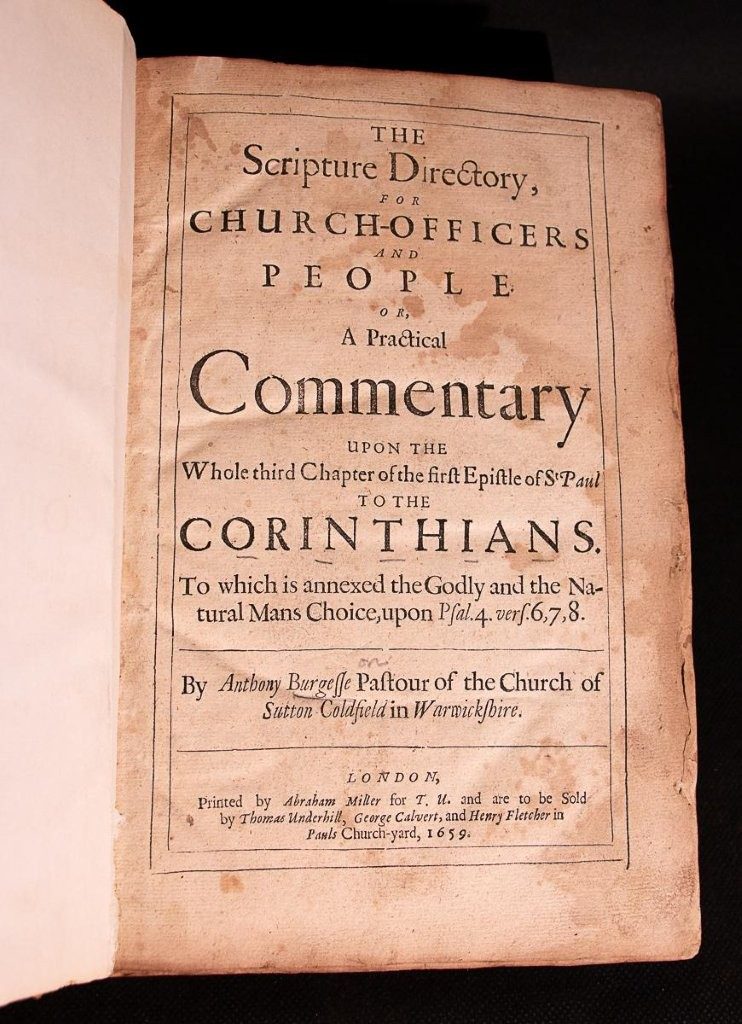
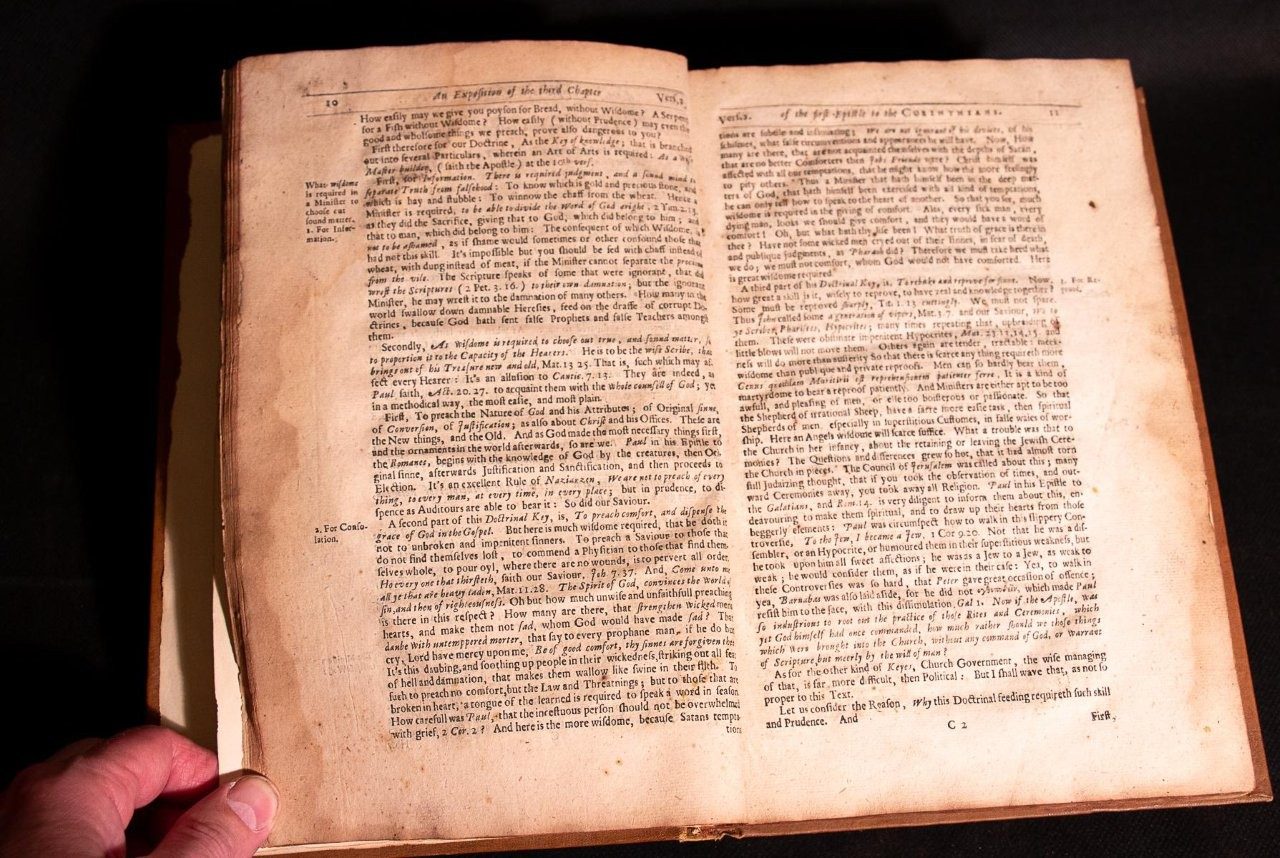


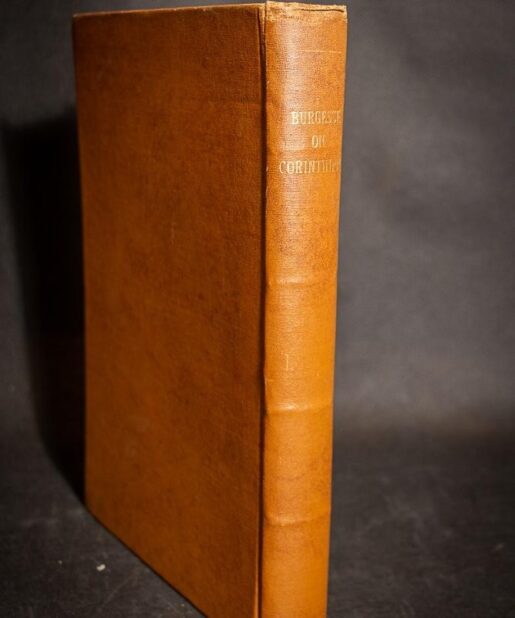
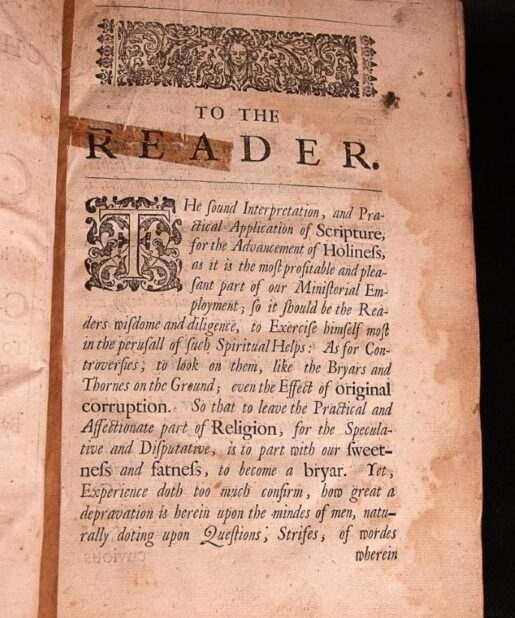

BURGESS, Anthony The Scripture Directory, for Church-Officers and People. Or, A Practical Commentary upon the Whole Third Chapter of the First Epistle of St Paul to the Corinthians. To Which Is Annexed The Godly and the Natural Man’s Choice, upon Psal. 4. vers. 6, 7, 8. By Anthony Burgesse, Pastor of the Church of Sutton Coldfield in Warwickshire.
London: Printed by Abraham Miller for Thomas Underhill, and sold by Thomas Underhill, George Calvert, and Henry Fletcher in Paul’s Church-yard, 1659.
Folio (28 × 19 cm).
A substantial and influential Puritan exposition of 1 Corinthians chapter 3, addressing the theology and practical governance of the Christian church, written by a leading member of the Westminster Assembly. Burgesse’s Scripture Directory functions both as a biblical commentary and as a manual of ecclesiology, offering detailed guidance on ministers, congregations, church discipline, unity, schism, and spiritual maturity.
The work was published during the late Interregnum, at a moment of acute debate over church order, clerical authority, sectarianism, and the future settlement of English Protestantism. Burgesse expounds Paul’s teaching on carnality, spiritual growth, and ministerial stewardship to argue for a disciplined, learned, and morally serious Reformed church.
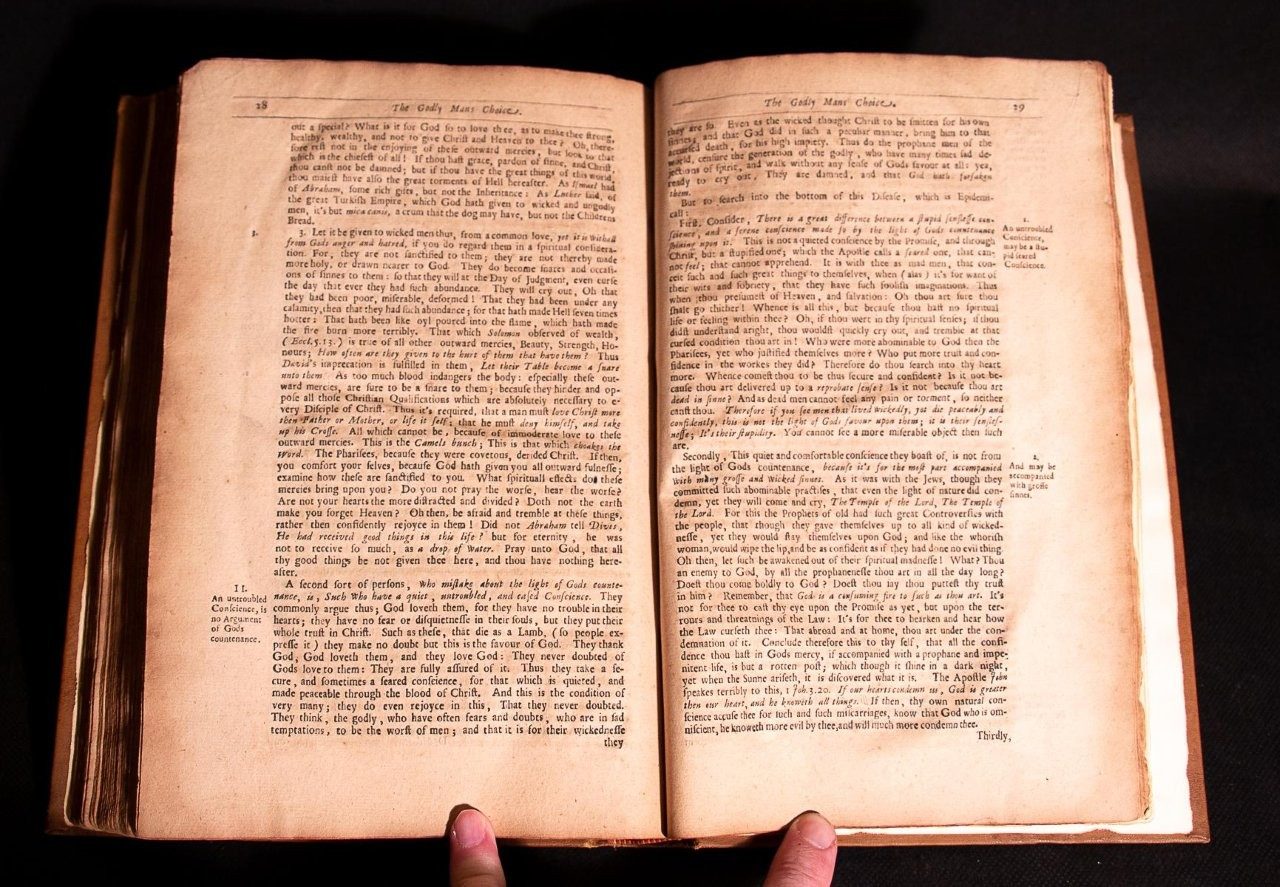
The appended treatise, The Godly and the Natural Man’s Choice (on Psalm 4:6–8), provides a compact devotional contrast between worldly and spiritual desires, rounding out the volume with a work of practical divinity.
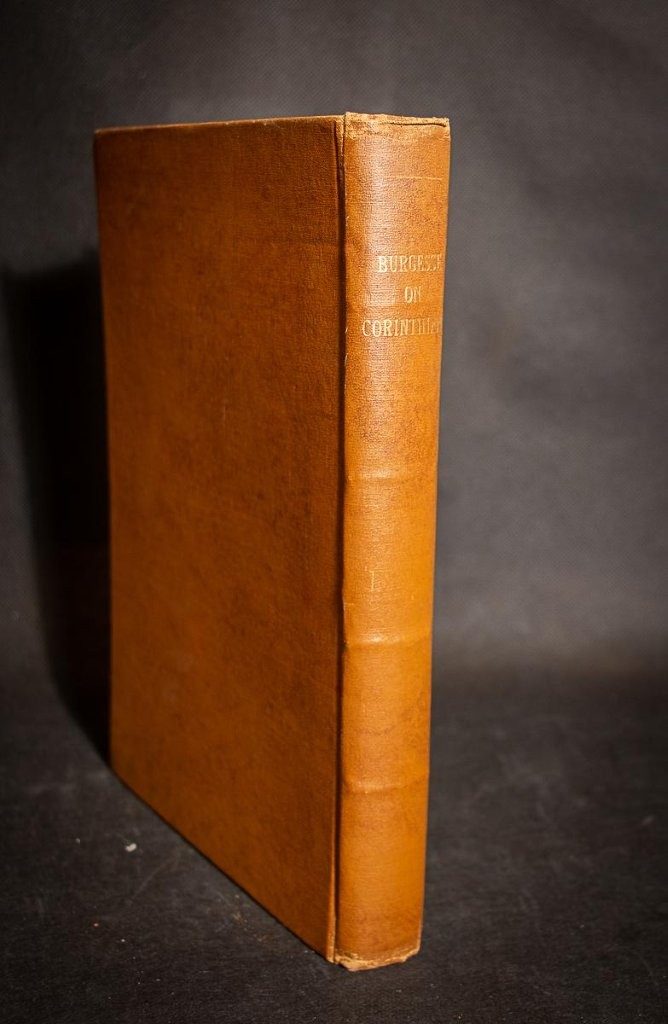
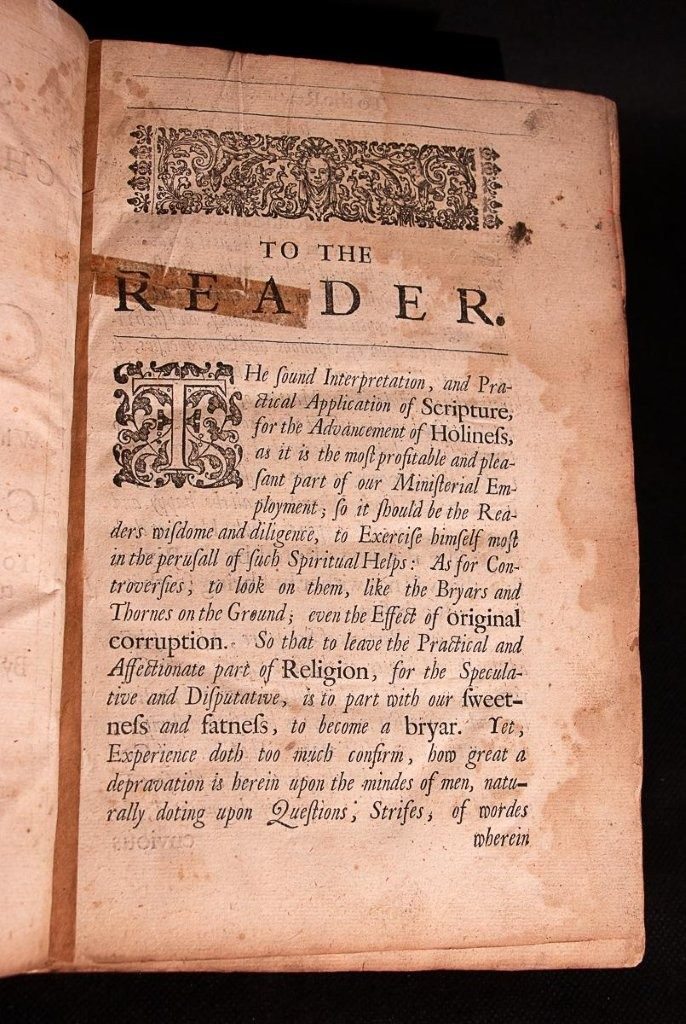
Folio. [22], 301, [7], 57, [15] pp. Staining to outer margins throughout; text generally in good condition with minor browning and marks. Bound in later library buckram with new endpapers. A complete and textually sound copy of a scarce and important Puritan ecclesiological folio.
Anthony Burgesse (c.1600-1664) was a prominent English Puritan minister, theologian, and church controversialist, best known as a member of the Westminster Assembly of Divines (1643–1653), which produced the Westminster Confession of Faith and Catechisms.
Educated at Emmanuel College, Cambridge, Burgesse became pastor of Sutton Coldfield, Warwickshire, and emerged as a leading Presbyterian voice during the Civil War and Interregnum. He was a prolific author, publishing widely on justification, sanctification, assurance, church order, and pastoral theology.
Burgesse was a vigorous defender of learned ministry and disciplined ecclesiastical structures, and he wrote extensively against sectarianism, antinomianism, and religious enthusiasm. After the Restoration, he was ejected from his living in 1662 under the Act of Uniformity and died two years later.
His works were widely read among English Presbyterians and later Nonconformists, and he remains one of the most significant Puritan systematizers of Reformed theology in mid-seventeenth-century England.


![Gu Hutou Hua Lienu Zhuan (Xin Kan Gu Lienu Zhuan) [An Ancient Edition of Biographies of Virtuous Women ] Liu Xiang; images attrib. to Gu Kaizhi](https://stephenbutler.com/wp-content/uploads/2024/08/IMG_0472-515x618.jpg "Gu Hutou Hua Lienu Zhuan (Xin Kan Gu Lienu Zhuan) [An Ancient Edition of Biographies of Virtuous Women ] Liu Xiang; images attrib. to Gu Kaizhi")
![Gu Hutou Hua Lienu Zhuan (Xin Kan Gu Lienu Zhuan) [An Ancient Edition of Biographies of Virtuous Women ] Liu Xiang; images attrib. to Gu Kaizhi](https://stephenbutler.com/wp-content/uploads/2024/08/IMG_0467-515x618.jpg "Gu Hutou Hua Lienu Zhuan (Xin Kan Gu Lienu Zhuan) [An Ancient Edition of Biographies of Virtuous Women ] Liu Xiang; images attrib. to Gu Kaizhi")

